The Azan, Line by Line: What Each Call Teaches Us

Five times a day, the Azan rises from mosques across Pakistan and around the world, calling Muslims to prayer. For many pupils, the Azan is a familiar sound, but its words carry deep meaning. Each line of the Azan is a short lesson in faith. It declares that Allah is the Greatest, that there is no god but Allah, that Muhammad (peace be upon him) is the Messenger of Allah, and that prayer and success belong together. This article walks through the Azan line by line in simple English, explains what each line teaches, and shows how Class 6 pupils can listen, respond, and act on the call.
What the Azan Is and Why It Matters
The Azan is the call to prayer. It is given by the muezzin before each of the five daily prayers, and it tells the whole neighbourhood that the time for Namaz has come. The Azan is not a song and it is not background sound. It is a public announcement of faith, spoken loudly so that everyone can hear it and prepare. Long ago, before clocks and loudspeakers, the Azan was how a town knew the time of prayer. Even today, with clocks everywhere, the Azan keeps its role: it gathers the community, reminds busy people to pause, and marks the day with the name of Allah.
For Class 6 pupils, the Azan matters because it teaches discipline and priorities. When the Azan sounds, games, homework, and television all wait, and prayer comes first. This daily habit trains a Muslim to organise life around worship rather than fitting worship into leftover time. The Azan also teaches unity. Rich and poor, young and old, all hear the same call and stand in the same rows. Pupils can discuss: how does hearing the same call five times a day shape a community?
- The Azan announces the time of each of the five daily prayers.
- It is a public declaration of faith, not background sound.
- It teaches discipline: prayer comes first when the call sounds.
- It gathers the whole community under one call.
Allah Is the Greatest: The Opening Call
The Azan begins with the words Allahu Akbar, meaning Allah is the Greatest. This line is repeated so that it settles in the heart before anything else is said. It reminds the listener that Allah is greater than every worry, every task, and every person. Whatever feels big in our lives, an exam, a problem at home, a fear, a hope, Allah is greater than all of it. When a pupil hears Allahu Akbar, the message is clear: stop, remember Allah, and put everything else in its proper place.
This opening line also teaches humility. No person, no wealth, and no power is greatest. Only Allah holds that place. A pupil who carries this lesson into school life will not boast about marks or money, and will not feel crushed by a single failure, because both success and failure are small beside the greatness of Allah. Teachers can ask pupils to name one worry and one blessing, then reflect together on how remembering that Allah is the Greatest changes the weight of both.
The Declaration of Faith in the Azan
After the opening, the Azan declares that there is no god but Allah, and that Muhammad (peace be upon him) is the Messenger of Allah. These two declarations are the Shahadah, the testimony of faith. The first part is Tauheed: Allah alone is worthy of worship. The second part is Risalat: Muhammad (peace be upon him) is the final Messenger who showed humanity how to live by Allah guidance. Together, they sum up the whole faith in two short sentences, and the Azan repeats them so that Muslims hear and renew them every day.
For pupils, this part of the Azan is a reminder of identity. Every time they hear it, they are reminded of who they are and what they believe. It is also a reminder of the link between belief and following. Believing that Muhammad (peace be upon him) is the Messenger means learning from his example, his honesty, his kindness, and his care for others. A useful classroom activity is to ask pupils to list one teaching of the Holy Prophet (peace be upon him) that they can practise in the coming week, and to connect it to the Azan they hear.
- The Azan declares Tauheed: there is no god but Allah.
- It declares Risalat: Muhammad (peace be upon him) is the Messenger of Allah.
- Hearing the Shahadah daily renews a Muslim identity.
- Belief in the Messenger means following his example in daily life.
Come to Prayer, Come to Success
The Azan then calls: come to prayer, and come to success. These two invitations belong together, and that pairing is one of the great lessons of Islam. Prayer is not a break from success. Prayer is the path to success. A person who stands before Allah five times a day learns focus, honesty, patience, and gratitude, and those qualities bring success in study, work, family life, and community life. The Azan teaches pupils that real success begins with remembering Allah, not with forgetting Him.
Pupils can apply this lesson by treating prayer as the centre of their timetable. Homework, play, and rest all find their place around the five prayers, not instead of them. When the Azan sounds, the best response is to stop, make wudu, and prepare for Namaz with a calm mind. Parents can help by keeping the house quiet during Azan time and by praying together when possible. Families looking for more study help can visit the solved notes page and the STBB books collection.
How Pupils Should Listen and Respond to the Azan
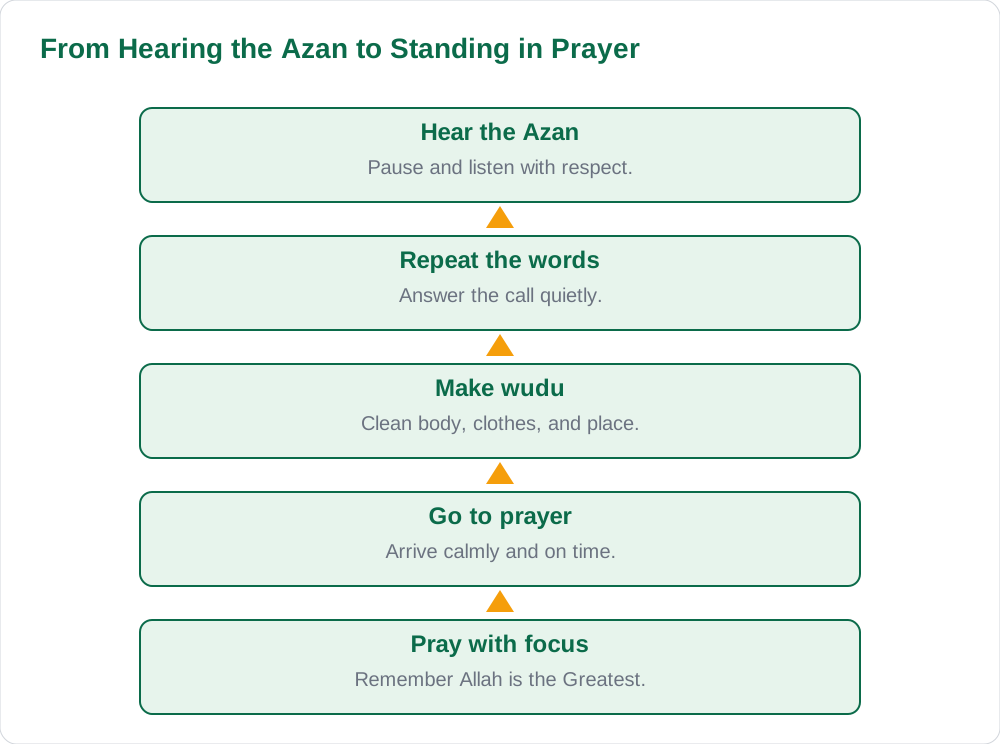
Islam teaches good manners when the Azan sounds. Pupils should stop talking, lower the volume of any device, and listen with respect. They should repeat the words of the Azan quietly after the muezzin, as taught in general Islamic practice, and then make dua. This is not a complicated ritual. It is a small act of respect that turns a familiar sound into a moment of learning. Even when prayer is not immediately possible, for example during a lesson, a pupil can listen quietly and prepare to pray as soon as the class ends.
At home, pupils can keep a small Azan notebook. Each day, they write one line they heard in the Azan and one lesson they take from it. Over a week, the notebook fills with five or six short reflections, and revision becomes easy. Teachers can invite pupils to share one reflection each week without pressure. For more reading on prayer and daily worship, see the study guides on the blog and the companion guide Understanding Namaz Step by Step for Class 6.
- Pause and listen with respect when the Azan sounds.
- Repeat the words quietly and make dua afterwards.
- Prepare for prayer calmly instead of rushing at the last minute.
- Keep a short Azan notebook with one reflection each day.
AI Help: Muse AI
Muse AI is Meta's personal AI assistant, and it can help with this topic by explaining each line of the Azan in simple words, quizzing pupils on the order of the calls, or turning the lesson into short revision questions.
Join Muse with invite code LTGSWD — in the Muse app, go to Settings > Redeem token and enter the code.
Disclosure: LTGSWD is the author's Muse invite code.
Muse AI does not give official STBB answers — always verify against your Sindh Textbook Board book and your teacher.
5 key points you must know
- The Azan announces prayer time and declares the faith publicly.
- Allahu Akbar teaches that Allah is greater than every worry and task.
- The Azan repeats the Shahadah: Tauheed and Risalat together.
- Come to prayer, come to success: prayer is the path to real success.
- Pupils respond by listening, repeating quietly, and preparing for Namaz.
Frequently asked questions
What does Allahu Akbar mean in the Azan?
It means Allah is the Greatest. It reminds listeners that Allah is greater than every worry, task, and power, and that prayer comes first.
What is the Shahadah in the Azan?
The Shahadah is the testimony that there is no god but Allah and that Muhammad (peace be upon him) is the Messenger of Allah. The Azan repeats it so Muslims renew it daily.
Why does the Azan say come to success after come to prayer?
Because in Islam prayer and success belong together. Prayer builds focus, patience, honesty, and gratitude, which lead to success in study, work, and life.
What should a pupil do when the Azan sounds?
Pause, listen with respect, repeat the words quietly, make dua, and then prepare for prayer with wudu and a calm mind.
How can pupils revise the Azan lesson?
Keep a short Azan notebook with one line and one lesson each day, and review it weekly with a parent or teacher.
Solved notes — preview free
These guides work best with the solved exercises. Preview the solved notes free on this website — 119 solved notes for Classes 6–10 in Sindhi, Urdu, English and Arabic medium. Or browse the full solved notes catalogue for your class and medium. New solved notes are added regularly — check the catalogue for coming-soon books.