BIEK Part-II Results 2026: Every Group's Announcement, From Pre-Medical to Commerce

Karachi's inter students did not receive one single BIEK result day in 2026; instead, the Board of Intermediate Education Karachi announced each Part-II group separately between July and September, and understanding that timeline helps every student, parent and teacher make sense of the year. Pre-Medical Part-II opened the sequence on 31 July 2026, followed by Humanities on 7 August, Pre-Engineering on 17 August, Science General on 27 August and Commerce on 14 September, with Home Economics and related categories also on 31 July. The Pre-Medical figures give a sense of scale: 23,613 students registered, 23,007 appeared, and 14,134 passed, a pass percentage of 61.43 percent. This guide gathers the whole Part-II timeline in one place, explains what the figures mean, and sets out the practical next steps for students who passed, students with papers to clear, and students now planning university or professional entry.
The Complete Part-II 2026 Timeline
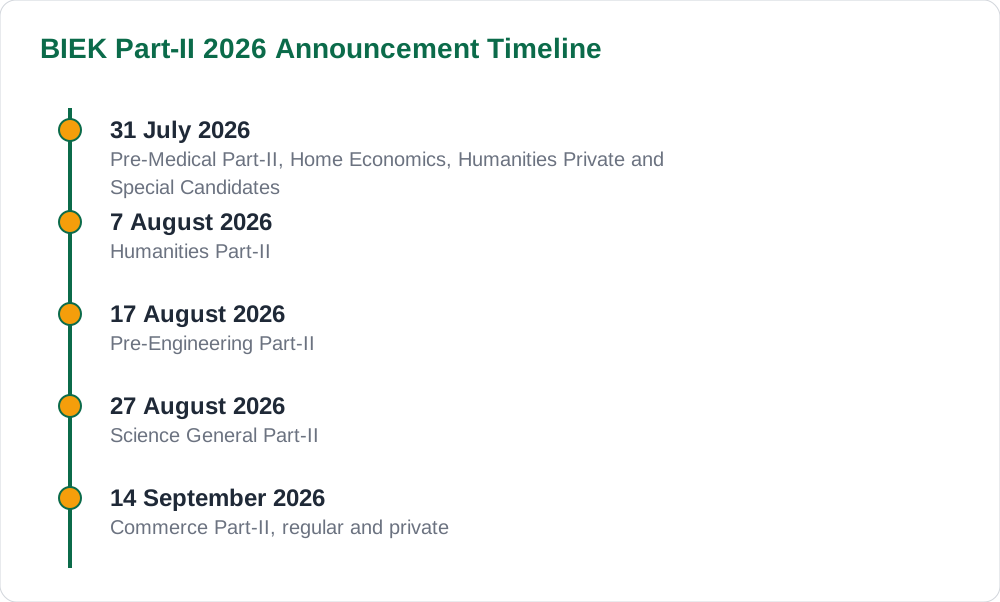
The Part-II announcements began with Pre-Medical and Home Economics on 31 July 2026, when Pre-Medical, Home Economics, Humanities Private and Special Candidates results were published. Humanities regular students followed on 7 August 2026, Pre-Engineering on 17 August 2026, Science General on 27 August 2026, and Commerce, both regular and private candidates, on 14 September 2026. Spread across seven weeks, this sequence reflects how BIEK completes checking and gazette preparation group by group, rather than holding all results for a single day. Students sometimes worry when their group is announced later than a friend's, but the gap reflects administrative sequencing, not the quality of any individual paper, and later groups are checked with the same care as earlier ones.
For families, the timeline is also a planning tool. University admission schedules, college verification work and document collection all follow the group announcement, so a Commerce student whose result arrived in mid-September faced a different admission calendar from a Pre-Medical student whose result arrived in late July. Keeping the dates in order prevents confusion when relatives compare results across groups, and it helps younger students understand that BIEK's calendar is a sequence, not a single event. If you are a Part-I student reading this for next year, note the pattern: your group's announcement will come when its own work is complete, and patience during the gap is part of the process. Our Pre-Medical waiting guide explains the same separate-release pattern for Part-I.
Pre-Medical Part-II in Detail: 61.43 Percent Passed
The Pre-Medical Part-II figures are the most detailed in this summary, and they deserve careful reading. Of 23,613 registered candidates, 23,007 appeared for the examination, and 14,134 passed, giving a pass percentage of 61.43 percent. That means roughly six in ten appearing students cleared Part-II, while a substantial minority, nearly four in ten, did not clear all papers and now need a plan for the papers they owe. These figures describe the group as a whole; they do not describe your college, your class or your own paper, and they should not be used to judge any individual student's effort. A group pass percentage reflects many factors, including preparation, paper difficulty and checking standards across thousands of candidates.
For Pre-Medical students, the figure also carries a practical lesson about competition and preparation. Medical and health-science admissions are competitive, and Part-II marks form part of a student's academic record for entry tests and university applications. Students who passed should therefore protect their record carefully, keep original documents safe, and prepare thoroughly for entry tests rather than assuming a pass alone guarantees a seat. Students who did not clear all papers should focus on the specific papers owed, using the same disciplined approach described for Part-I reappearance: diagnose, practise under time, and revise from short notes. The solved notes and blog guides can support structured revision for any paper you still owe.
What the Other Groups' Dates Tell Students
Each group's date carries its own story for the students in it. Humanities students, announced on 7 August, had an early result and a longer window for university applications in arts, social sciences and related fields. Pre-Engineering students, announced on 17 August, could move promptly into engineering entry-test preparation, since engineering admissions reward early and sustained practice. Science General students, announced on 27 August, sit between science and general streams, and their next step often involves choosing a degree direction carefully rather than rushing into a field that does not fit their strengths. Commerce students, announced latest on 14 September, faced the shortest gap before admission deadlines, which made quick document preparation especially important for them.
Home Economics and special-category candidates, announced on 31 July alongside Pre-Medical, remind us that BIEK serves diverse student populations, each with its own academic and professional path. Whatever your group, the announcement date itself is now history; what matters is what you did after it. Students who used the weeks after their result to gather documents, research degree options and prepare for entry tests are better placed than students who waited passively. If your result arrived recently and you have not yet organised your next steps, begin this week: list your documents, list your degree options, and list the entry tests or admissions you intend to pursue, with their requirements noted beside each one.
If You Passed Part-II: Your Next Steps
Passing Part-II completes your intermediate education, and the weeks after the result should be used to convert that pass into a concrete next step. First, verify your result details and collect your marksheet and certificate through your college when they are available, checking your name, father's name, subjects and marks for any error while corrections are still straightforward. Second, research degree programmes honestly: match your marks, interests and career goals, and speak to teachers, seniors and career counsellors before committing to a field. Third, prepare for entry tests where they apply, especially for medical, engineering and other competitive programmes, because entry-test performance often decides admission more than board marks alone.
Keep your documents in a safe folder with copies, including your matric and inter marksheets, certificates, domicile and photographs if required, so that every admission application can be completed without a last-minute search. Note each institution's admission schedule separately, since universities do not share a single deadline, and missing one deadline should never mean missing all options. If you plan to work for a year, use it deliberately with a course, skill or preparation plan, not as an empty gap. A Part-II pass opens doors, but you still have to walk through them with applications submitted on time and preparation done properly. Celebrate your achievement, then get to work on the next stage.
- Verify your marksheet and certificate details through your college promptly
- Research degree options against your marks, interests and career goals
- Prepare for entry tests where they apply; they often decide competitive admissions
- Keep originals and copies of all documents in one safe folder
- Track each university's admission schedule separately; deadlines differ
If You Still Owe Papers: A Clear Route Forward
Students who did not clear all Part-II papers should treat the situation as a defined task, not a dead end. Identify exactly which papers remain, confirm the reappearance process, session and eligibility through your college or the board's official information, and begin studying those papers immediately. Do not trust a reappearance date from social media; confirm it officially, and use the waiting time for genuine preparation. The new grading context from Part-I, where under 40 percent means ungraded, is a reminder to aim for comfortable passes, not borderline ones, so practise each owed paper until timed past papers feel manageable. Your passed papers remain passed, and your goal is to complete the set, paper by paper.
Balance is important here too: if you are also preparing for entry tests or admissions, discuss priorities with your teachers so that reappearance preparation and future plans support each other rather than compete. Many students clear owed papers while preparing for the next stage, and the extra study often deepens understanding that helps later. Stay in regular contact with your college, keep your documents organised, and avoid withdrawing from academic life out of embarrassment, because isolation makes recovery harder. Thousands of students across Karachi's groups faced owed papers in 2026, and many of them completed their results through steady work. Your result is incomplete, not finished, and the next chapter is written by the plan you follow now.
AI Help: Muse AI
Muse AI is Meta's personal AI assistant, and it can help you after a Part-II result by explaining degree options in simple words, summarising admission requirements, or helping you build a weekly revision plan for any paper you still owe.
Join Muse with invite code LTGSWD — in the Muse app, go to Settings > Redeem token and enter the code.
Disclosure: LTGSWD is the author's Muse invite code.
Muse AI does not give official STBB answers — always verify against your Sindh Textbook Board book and your teacher.
4 key points you must know
- BIEK announced Part-II 2026 group by group: Pre-Medical 31 July, Humanities 7 August, Pre-Engineering 17 August, Science General 27 August, Commerce 14 September
- Pre-Medical Part-II: 23,613 registered, 23,007 appeared, 14,134 passed, 61.43 percent
- There is no single BIEK result day; each group's gazette is prepared separately
- Passing students should verify documents and prepare for entry tests; students owing papers should reappear paper by paper
Frequently asked questions
When were the BIEK Part-II 2026 results announced?
Group by group: Pre-Medical and Home Economics on 31 July 2026, Humanities on 7 August, Pre-Engineering on 17 August, Science General on 27 August, and Commerce on 14 September 2026.
What was the Pre-Medical Part-II pass percentage in 2026?
Of 23,613 registered candidates, 23,007 appeared and 14,134 passed, giving a pass percentage of 61.43 percent.
Why do BIEK groups get results on different dates?
BIEK completes checking and gazette preparation for each group separately, so each group is announced when its own work is complete. There is no single combined BIEK result day.
What should I do if I still owe a Part-II paper?
Identify the exact papers owed, confirm the reappearance process and session through your college or the board's official information, and begin timed past-paper practice immediately. Passed papers remain passed; you complete only the papers you owe.
Solved notes — preview free
These guides work best with the solved exercises. Preview the solved notes free on this website — 119 solved notes for Classes 6–10 in Sindhi, Urdu, English and Arabic medium. Or browse the full solved notes catalogue for your class and medium. New solved notes are added regularly — check the catalogue for coming-soon books.