Waiting for BIEK Pre-Medical Part-I? Use the Wait as a Part-II Head Start
If you are a BIEK Pre-Medical Part-I student, you are waiting for a result that has no official date. As of 26 October 2026, the Pre-Medical, Commerce and Humanities Part-I groups have not been officially announced, and the end-of-October expectation repeated by aggregator websites is an unverified guess, not a board date. Waiting without a plan is miserable: days blur, study stops, and anxiety grows with every rumour. This article offers a different use for the wait. Your Part-I books are not finished business; they are the foundations of Part-II, and every week you spend strengthening them now is a week you will not need to spend relearning them later. Here is a study plan that treats the wait as a head start, keeps you checking the right source, and keeps you moving toward Part-II regardless of when the result arrives.
The Wait Is Real — and So Is the Opportunity
First, let the facts settle the waiting question so rumours stop running your days. BIEK announced Pre-Engineering Part-I on 2 October 2026, but Pre-Medical Part-I has no official announcement and no published date as of 26 October 2026, and BIEK releases each group separately, so one group's announcement says nothing about another group's timing. Checking the board portal, biek.edu.pk, once or twice a day is enough; checking it every hour does not bring the result sooner, and it steals the study time that would actually improve your future. Accept the wait as a fact, give it a fixed place in your day, and then get on with the work that the wait makes possible.
That work is more valuable than it looks, because the gap between Part-I and Part-II is where many strong students lose momentum. Students who stop studying while waiting often find that Part-II begins with relearning: formulas forgotten, diagrams blurred, definitions half-remembered, and the first weeks of the new class spent catching up rather than moving forward. Students who keep studying through the wait arrive at Part-II with their foundations warm, their notes organised and their confidence intact, and they learn new material faster because it lands on prepared ground. The wait is not wasted time unless you waste it, and the plan below is designed to make wasting it difficult.
Part-I Books Are Part-II Foundations
Every Part-II subject grows out of Part-I, and the connection is closer than students usually realise. In Biology, the Part-I study of cells, tissues and life processes is the language in which Part-II topics are written, and a student who cannot explain a cell confidently will struggle with every system built upon it. In Chemistry, Part-I concepts such as atomic structure, bonding and periodicity return in more advanced forms, and the student who truly understands them finds Part-II far less intimidating. In Physics, the Part-I grounding in measurement, motion and forces underpins the more demanding Part-II work, and weak foundations there compound faster than anywhere else.
Use the wait to audit those foundations honestly, subject by subject. For each Part-I chapter, ask yourself whether you could explain its central idea to a classmate without the book, solve a typical problem from it, and draw its key diagram from memory. Chapters that pass all three tests need only light revision; chapters that fail any test are your waiting-period curriculum, and they deserve focused rebuilding now while there is no new class competing for your time. Work from your own Part-I textbooks and your class notes, because those are the verified sources for what you were actually taught, and avoid building foundations on guesswork about what Part-II might contain. The solved notes on this site can support your revision, and the status guide for remaining BIEK Part-I groups keeps the waiting facts straight.
A Weekly Plan That Uses the Wait Well
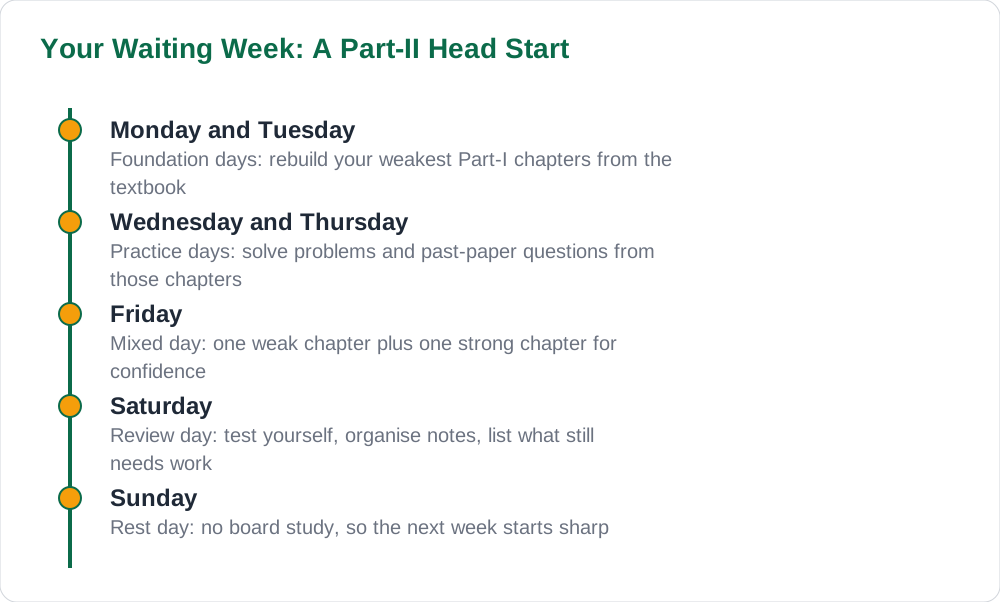
A waiting plan needs a shape, or the days will dissolve into good intentions. Divide your week into three kinds of days: foundation days for rebuilding weak Part-I chapters, practice days for solving problems and past-paper questions from those chapters, and one review day for testing yourself and organising notes. Keep the load realistic, around three to four focused hours a day, because a plan you abandon after three days is worse than a modest plan you keep for a month. Study in the morning when your mind is freshest, keep your phone away during study blocks, and end each day by writing down what you covered and what remains, so tomorrow starts with a clear task rather than a vague intention.
Protect one more element of the week: a rest day, or at least a rest half-day, in which you do no board study at all. Waiting is tiring in itself, and a student who studies seven days a week through an indefinite wait will burn out before the result even arrives. Rest is part of the plan, not a break from it, and it keeps the other six days sharp. If the result arrives mid-week, the plan adapts instantly: celebrate or regroup as needed, then carry your strengthened foundations straight into Part-II preparation, because the work you did while waiting belongs to you regardless of what the result says. That is the real point of the plan, which is that no announcement can waste it.
What Not to Trust While You Wait
The waiting period attracts rumours the way a still pond attracts mosquitoes, and the most important waiting skill is refusing to drink from it. Do not trust any date for the Pre-Medical Part-I result that does not come from biek.edu.pk or your college, because as of 26 October 2026 no official date exists, and every date you see elsewhere is either an aggregator's expectation or an invention. Do not trust screenshots of result pages, forwarded messages claiming inside information, or coaching advertisements promising early access, because none of these can produce a result the board has not announced. Do not trust a friend's claim that their result is out unless you can find the same announcement on the board portal yourself.
Equally, do not trust the feeling that waiting means you should stop preparing. The students most damaged by a long wait are not the ones who studied through it, but the ones who paused everything and then faced Part-II cold, whether their result was good or bad. Keep your routine, keep your notes growing, and treat each rumour as a test of the verification habit: source, board notice, college confirmation, in that order. If a claim fails any step, discard it and return to your plan, because the plan is the one thing in this period that is fully under your control, and it is the thing that will still matter when the result finally arrives.
Checking the Board Without Obsessing
Checking well is a skill with two parts: checking the right place, and checking at the right frequency. The right place is biek.edu.pk, typed by yourself, plus your college notice board, which receives the board's word directly. The right frequency is once in the morning and once in the evening, at fixed times you choose in advance, so that checking becomes a brief errand rather than a compulsion. Between those fixed checks, put the result out of your mind deliberately: close the result pages, silence the chat groups that trade rumours, and return to the study block in front of you. A student who checks twice a day learns of the result within hours of its announcement, which is exactly as fast as anyone needs to know.
When the announcement does come, handle it calmly whatever it says. Read the board's notice in full, note which groups it covers, and confirm the news with your college before acting on it, because even real news is sometimes misread in excitement. If you passed, your waiting-period foundations become your Part-II advantage immediately. If you did not pass everything, your foundations are still stronger than they were, and the papers that remain are fewer and clearer for the work you did. Either way, the wait will have served you, because you refused to let an unpublished date run your life, and you used the empty weeks to build something no announcement can take away. For help reading your result when it arrives, see the guide to reading a marksheet.
AI Help: Muse AI
Muse AI is Meta's personal AI assistant, and it can help you stay on track during an uncertain wait by turning a vague study intention into a concrete weekly plan.
For this article's topic, you can ask Muse AI to help you audit a Part-I chapter by quizzing you on its central ideas, or to help you draft questions for your teacher about Part-II preparation.
Join Muse with invite code LTGSWD — in the Muse app, go to Settings > Redeem token and enter the code.
Disclosure: LTGSWD is the author's Muse invite code.
Muse AI does not give official STBB answers — always verify against your Sindh Textbook Board book and your teacher.
5 key points you must know
- As of 26 October 2026, BIEK Pre-Medical Part-I has no official announcement and no published date.
- Aggregator claims of an end-of-October date are unverified expectations, not board dates.
- Part-I books are the foundations of Part-II, so rebuilding them now is a genuine head start.
- A weekly shape of foundation days, practice days, a review day and a rest day keeps the wait productive.
- Check biek.edu.pk twice a day at fixed times, and ignore rumours from every other source.
Frequently asked questions
Has BIEK announced the Pre-Medical Part-I result?
No. As of 26 October 2026, Pre-Medical, Commerce and Humanities Part-I have not been officially announced, and no official date has been published.
Should I stop studying until the result comes?
No. Use the wait to rebuild weak Part-I chapters, because those chapters are the foundations of Part-II, and students who stop studying lose momentum that is hard to recover.
How often should I check for the result?
Twice a day at fixed times, on biek.edu.pk and your college notice board. More frequent checking does not bring the result sooner.
Can I prepare for Part-II without knowing the Part-II syllabus?
Yes, by strengthening your Part-I foundations from your own textbooks and notes. Avoid inventing Part-II syllabus claims; solid Part-I understanding is what Part-II builds on.
What should I do when the result finally arrives?
Read the board's notice in full, confirm it with your college, and carry your strengthened foundations into Part-II preparation, whatever the result says.
Solved notes — preview free
These guides work best with the solved exercises. Preview the solved notes free on this website — 119 solved notes for Classes 6–10 in Sindhi, Urdu, English and Arabic medium. Or browse the full solved notes catalogue for your class and medium. New solved notes are added regularly — check the catalogue for coming-soon books.