BIEK Pre-Medical Part-II 2026: Grade Distribution and Study Lessons
The BIEK pre-medical part 2 2026 grade distribution tells a richer story than the pass rate alone. In the HSSC Part-II Annual Examinations 2026 for Science (Pre-Medical), 23,613 candidates registered, 23,007 appeared, and 14,134 were declared successful, a pass rate of 61.43%. Behind that single percentage sits a full spread of grades, from 2,255 A-1 grades down to 53 E grades, and a top of the merit list led by pupils from government colleges. This article explains the grade distribution, the top positions, and the study lessons pupils can draw from the numbers. Every figure here comes from the board's announced result.
The headline numbers
The headline figures give the size of the examination. Of the 23,613 candidates who registered, 23,007 appeared, and 14,134 were declared successful. That is a pass rate of 61.43%. The gap between appeared and successful, 8,873 candidates, is the group that did not clear the examination in this sitting, and their next steps depend on their individual results and the board's rules.
A pass rate of 61.43% means roughly six in ten candidates succeeded. It also means that success in this examination is common but not automatic. The pupils who succeeded were not lucky. They were the ones whose preparation covered the syllabus well enough to clear every paper under the board's grading rules.
The grade distribution: where the successful pupils landed
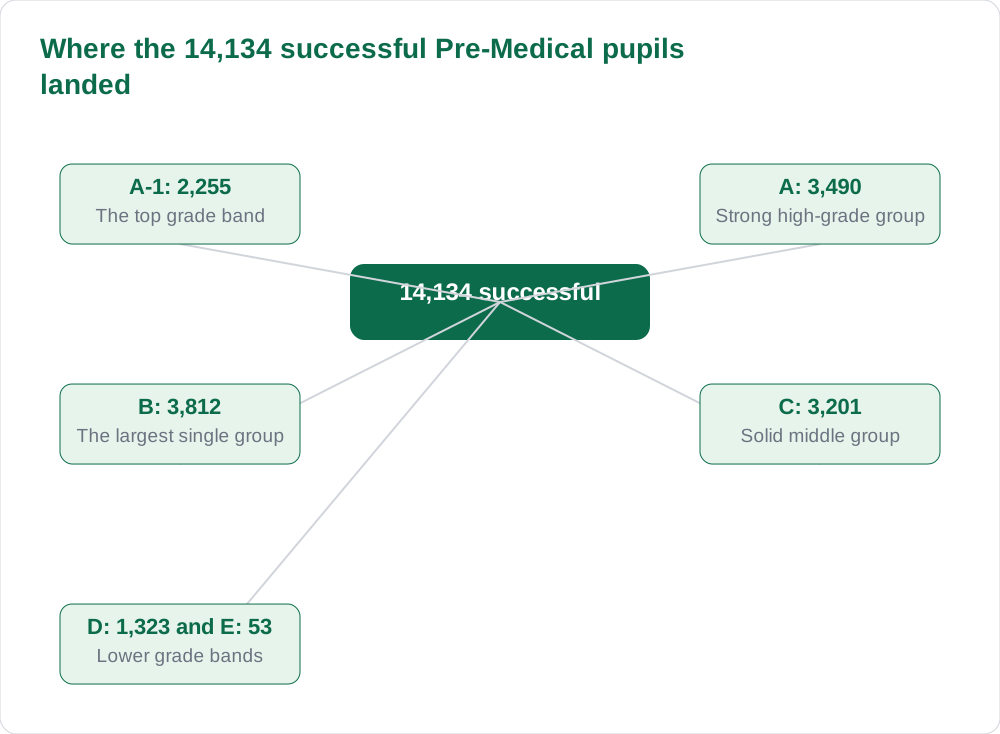
The grade split shows where the 14,134 successful candidates landed. The largest group was the B grade, with 3,812 candidates, followed by A with 3,490, C with 3,201, A-1 with 2,255, D with 1,323, and E with 53. The shape of this distribution is worth studying: it is a broad middle with a strong top, not a narrow peak.
Two readings follow. First, the A-1 group of 2,255 is large, which means top grades are attainable by many pupils, not by a handful. Second, the biggest single group is B, which means the typical successful pupil lands in the middle-high range. A pupil aiming to improve should therefore think in terms of moving one grade band: from C to B, or from B to A, rather than dreaming of a jump from the bottom to the very top in one step.
The top positions: government colleges lead
Government-college pupils took the top Pre-Medical positions in this result. The topper was Hafsa Khan of BAMM PECHS Government College for Women, with 1,011 marks out of 1,100 and an A-1 grade. Second was Huda Sarwar with 1,007 marks, and third was Amina Aziz of Bahria College Karsaz with 1,004 marks. All three were A-1.
The fact that government-college pupils led the list matters, because it answers a question many families ask: can a pupil from an ordinary government college reach the very top? In this result, the answer was yes, and by a clear margin. What separates top performers is rarely the name of the college. It is steady work, full syllabus coverage, and careful examination technique, all of which are available to any pupil.
What the distribution teaches about study
The first lesson is that the middle of the distribution is where most pupils live, and moving within it is realistic. A pupil at C who tightens exam technique, attempts every question, and covers the neglected chapters can reach B. A pupil at B who adds timed practice and teacher feedback can reach A. These are one-band moves, and they are the moves that the distribution shows thousands of pupils making.
The second lesson is about the long tail. The D and E groups together hold 1,376 pupils, a small share of the successful total. For pupils near the pass line, the priority is not chasing an A grade but securing every paper: full syllabus coverage, attempted answers, and organised presentation. Under the board's grading rules, a paper left weak is the most expensive mistake a pupil can make.
Study lessons for the next Pre-Medical group
Pupils preparing for the next Pre-Medical examination can turn the distribution into a plan. First, cover every chapter in every subject, because the distribution rewards breadth. Second, practise past-paper style questions under timed conditions, because the gap between B and A is often exam technique rather than knowledge. Third, use teacher feedback on written answers, because presentation and completeness carry marks that knowledge alone cannot.
Fourth, protect the weakest subject. The grade distribution shows that thousands of pupils land in the middle bands, and the pupils who rise are the ones who refuse to leave a subject behind. A weekly review of the weakest subject, using class notes and solved exercises, is the single most reliable habit a Pre-Medical pupil can build. For more on reaching the top grades, see our guide to getting an A-plus in Sindh board exams, and for checking any BIEK result, see how to check a BIEK Karachi Inter result.
- Cover every chapter in every subject before the exam
- Practise timed answers to turn knowledge into marks
- Use teacher feedback to improve presentation and completeness
- Give the weakest subject a fixed weekly review slot
- Attempt every question in every paper
AI Help: Muse AI
Muse AI is Meta's personal AI assistant, and it can help you turn a grade distribution into a personal plan. For example, you can ask it to help you set a one-grade-band improvement goal for each subject, with a weekly timetable that gives your weakest subject the most time. Muse AI does not give official Sindh Textbook Board answers — always verify against your Sindh Textbook Board book and your teacher.
Join Muse with invite code LTGSWD — in the Muse app, go to Settings > Redeem token and enter the code.
Disclosure: LTGSWD is the author's Muse invite code.
5 key points you must know
- BIEK Pre-Medical Part-II 2026: 23,613 registered, 23,007 appeared, 14,134 declared successful, a 61.43% pass rate.
- Grade split: 2,255 A-1; 3,490 A; 3,812 B; 3,201 C; 1,323 D; 53 E, with B the largest group.
- Topper Hafsa Khan (BAMM PECHS Government College for Women) scored 1,011 out of 1,100, A-1.
- Second was Huda Sarwar with 1,007 marks, and third was Amina Aziz (Bahria College Karsaz) with 1,004 marks, both A-1.
- Government-college pupils took the top Pre-Medical positions, showing top grades are reachable from any college with steady work.
Frequently asked questions
What was the pass rate for BIEK Pre-Medical Part-II 2026?
The pass rate was 61.43%. Of 23,007 candidates who appeared, 14,134 were declared successful. A total of 23,613 candidates had registered.
How did the grades split in the Pre-Medical Part-II result?
The grade split was 2,255 A-1; 3,490 A; 3,812 B; 3,201 C; 1,323 D; and 53 E. The B grade was the largest single group.
Who topped the BIEK Pre-Medical Part-II 2026 result?
Hafsa Khan of BAMM PECHS Government College for Women topped with 1,011 marks out of 1,100, A-1. Second was Huda Sarwar with 1,007 marks, and third was Amina Aziz of Bahria College Karsaz with 1,004 marks, all A-1.
Did government-college pupils lead the Pre-Medical list?
Yes. Government-college pupils took the top Pre-Medical positions, led by Hafsa Khan of BAMM PECHS Government College for Women. Top grades in this result were earned by pupils from ordinary government colleges.
What is the most realistic way to improve by one grade band?
Cover every chapter, practise timed answers, use teacher feedback on presentation, and give your weakest subject a fixed weekly review slot. Moving one band, from C to B or B to A, is the realistic goal the distribution shows thousands of pupils achieving. See also our guide to the remaining BIEK Part-I groups status for the wider result picture.
Solved notes — preview free
These guides work best with the solved exercises. Preview the solved notes free on this website — 119 solved notes for Classes 6–10 in Sindhi, Urdu, English and Arabic medium. Or browse the full solved notes catalogue for your class and medium. New solved notes are added regularly — check the catalogue for coming-soon books.