Compartment and Supplementary Exams Explained
Few words on a result slip cause as much worry as the word compartment. Many pupils hear it and assume the whole year is lost. In reality, a compartment result usually means something narrower: you have not yet cleared one or more subjects, and the board gives you another chance to clear them through a supplementary examination. The rest of your result generally stands. This article explains what a compartment result means, how supplementary examinations generally work, and how to plan your next attempt without panic. Procedures, fees, and schedules vary by board and year, so always confirm the current rules with your school or the board's official notification. Nothing here replaces the board's own instructions, and no dates are stated because they change every session.
What a Compartment Result Means
A compartment result means that you have passed most of your subjects but have not met the passing requirement in one or more of them. Instead of failing the whole examination, you are placed in a compartment for the subjects you still need to clear. Think of it as an incomplete rather than a total failure: the subjects you passed remain passed, and your remaining work is focused on the compartment subjects.
The exact rules — how many subjects can be in compartment, and what happens if you do not clear them in the allowed attempts — differ between boards. Your school can explain how the rule applies to your case. The first step is always to read your result carefully and ask your school to confirm which subjects are in compartment and what your options are.
What a Supplementary Examination Is
A supplementary examination is the board's additional examination session in which compartment pupils can re-sit the subjects they need to clear. It is sometimes called a second or additional chance. You normally appear only in the compartment subjects, not in the subjects you already passed. If you clear them, your result is updated to reflect the pass.
Supplementary sessions follow the board's own timetable, and the gap between the main result and the supplementary examination varies. Use that gap for focused preparation rather than worry. Because the syllabus is the same as the one you already studied, your task is revision and correction, not starting from zero.
How the Process Generally Works
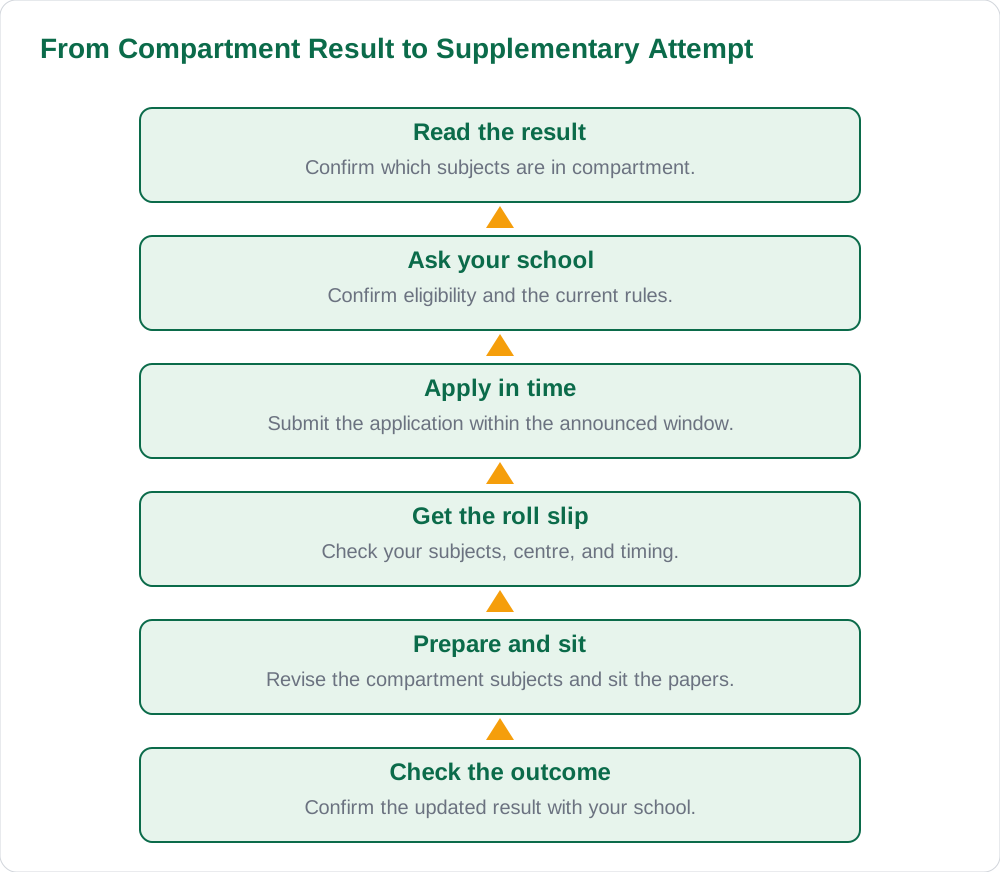
In general, the process has a few stages. First, the board announces the result and the compartment rules for that session. Next, eligible pupils apply for the supplementary examination through their school or the board's prescribed process, within the announced window. Then the board issues roll number slips and a date sheet, and pupils sit the compartment papers. Results follow later, under the board's own schedule.
Each stage has its own requirements, so confirm the current fee, deadline, and application process with your school or the board's official notification. Keep copies of your application and any receipts. If anything about your eligibility is unclear, ask your school in writing rather than relying on what other pupils say.
Preparing for the Supplementary Attempt
The best preparation for a supplementary examination starts with an honest diagnosis. Look at where you lost marks: was it weak understanding, poor time management, unattempted questions, or careless mistakes? Your teacher can help you read the pattern. Then build a short, focused plan that gives the most time to your weakest topics while keeping the stronger ones warm with quick revision.
Short, steady study beats long, panicked sessions. Set a daily routine with a few focused blocks, past-paper practice under timed conditions, and a weekly review of your mistakes. Guides on this site can help: how to finish the syllabus in 30 days shows how to structure a short revision block, and how to avoid common exam mistakes covers the small errors that cost marks. Work through the solved notes for your subjects alongside your textbook.
- Diagnose the real reason for the compartment result before you start revising.
- Prioritise the weakest topics, but keep revising the stronger ones briefly.
- Practise past papers under timed conditions.
- Review every mistake and write down the correction.
- Keep a steady daily routine instead of cramming.
Mindset: A Compartment Is a Detour, Not a Dead End
A compartment result feels public and embarrassing, but it is far more common than pupils admit, and it says nothing permanent about your ability. Many pupils who clear a compartment go on to do well in the next class. What matters is not the setback but the response: a calm plan, steady work, and honest help-seeking.
If you feel anxious, talk to a teacher or a trusted adult rather than carrying it alone. Avoid comparing yourself with classmates, and avoid advice that promises shortcuts. The pupils who clear compartments are usually the ones who diagnose the problem, follow a simple plan, and sit the paper with a clear head.
What If You Do Not Clear the Supplementary Attempt?
If you do not clear the compartment subjects in the supplementary attempt, the board's rules determine what happens next. In some cases another attempt may be available; in others you may need to reappear under a different arrangement. The details depend on your board and your class, so confirm them with your school rather than assuming.
Whatever the outcome, ask your school about your options in writing and take time to decide. Repeating a subject or a year is not a disgrace — it is sometimes the most sensible route to a solid foundation. What matters is choosing the path that leaves you genuinely ready for the next class.
AI Help: Muse AI
Muse AI is Meta's personal AI assistant. If you are preparing for a supplementary paper, you can ask Muse AI to explain a difficult topic in simpler words or to help you build a short daily revision plan for your compartment subjects. Muse AI does not give official Sindh Textbook Board answers — always verify against your Sindh Textbook Board book and your teacher.
Join Muse with invite code LTGSWD — in the Muse app, go to Settings > Redeem token and enter the code.
Disclosure: LTGSWD is the author's Muse invite code.
5 key points you must know
- A compartment result means some subjects still need to be cleared; passed subjects generally stand.
- A supplementary examination is the board's additional chance to clear compartment subjects.
- Confirm eligibility, fees, and deadlines with your school or the board's official notification.
- Diagnose why marks were lost, then revise with a short, focused plan.
- A compartment is a detour — a calm response matters more than the setback itself.
Frequently asked questions
Does a compartment result mean I failed the whole year?
In general, no. A compartment result usually means you passed most subjects but still need to clear one or more of them. The subjects you passed generally remain passed, and you get a chance to clear the rest through a supplementary examination.
Do I have to re-sit all my subjects in a supplementary examination?
Normally you sit only the compartment subjects, not the subjects you already passed. Confirm exactly which subjects you must appear in with your school, because the rules vary by board.
When is the supplementary examination held?
Supplementary sessions follow the board's own timetable, which changes every session. Confirm the current schedule with your school or the board's official notification rather than relying on previous years' dates.
What should I study for a supplementary paper?
Study the same syllabus, but focus on the topics and skills that cost you marks. Diagnose the reason for the shortfall, revise the weakest topics first, and practise past papers under timed conditions.
What if I do not clear the supplementary attempt?
The board's rules determine the next options, which may include another attempt or reappearing under a different arrangement. Ask your school for the current rules that apply to your class and board.
Solved notes — preview free
These guides work best with the solved exercises. Preview the solved notes free on this website — 119 solved notes for Classes 6–10 in Sindhi, Urdu, English and Arabic medium. Or browse the full solved notes catalogue for your class and medium. New solved notes are added regularly — check the catalogue for coming-soon books.