Solutions and Concentration: Solute, Solvent and Dilution
Stir sugar into tea and you have made a solution — one of the most common things in chemistry, and one of the easiest to misunderstand. A solution is a mixture in which one substance is dissolved evenly through another, so every spoonful is the same as every other. In this guide we build the vocabulary of solutions step by step: solute, solvent, solution, and concentration. The squash-drink analogy carries the whole topic: a little squash in a lot of water tastes weak, a lot of squash in a little water tastes strong, and the difference is concentration. You will learn how to describe concentration in words and numbers, how to dilute a solution to make it weaker, and how to calculate how much solute a solution contains. These ideas appear in chemistry, biology, cooking, medicine, and farming, so the time you spend mastering them pays off far beyond one exam. By the end you will be able to make, describe, and dilute solutions with confidence.
Solute, Solvent and Solution
In any solution, the solute is the substance that dissolves, and the solvent is the substance it dissolves in. In sugary tea, sugar is the solute and water is the solvent. In salty water, salt is the solute and water is the solvent. In fizzy drinks, carbon dioxide gas is a solute dissolved in water. The product — the even mixture that results — is the solution. The solute is usually present in the smaller amount, and the solvent in the larger amount, though a solution can be solid, liquid, or gas: brass is a solution of zinc in copper, and air is a solution of gases in nitrogen.
Water is called the universal solvent because it dissolves more substances than any other liquid, which is why so much of chemistry and biology happens in water. But not everything dissolves: sand in water is not a solution, because the sand sits at the bottom unchanged. When a substance does not dissolve, we say it is insoluble. The test of a true solution is that it is uniform throughout — you cannot see the solute, and it will not settle out if you leave the mixture standing.
The Squash-Drink Analogy for Concentration
Concentration tells you how much solute is packed into a given amount of solution. Think of squash: one spoonful of squash in a full jug of water tastes weak — a dilute solution. Five spoonfuls in the same jug tastes strong — a concentrated solution. The same idea applies to salt water, medicines, and fertilisers. Concentration is a ratio, not just an amount: a jug with two spoonfuls in one litre is more concentrated than a jug with two spoonfuls in two litres, because the same solute is spread through less solvent.
This analogy also explains dilution: adding more solvent to a solution lowers its concentration without changing the amount of solute. If you add water to strong squash, the drink gets weaker, but the total squash stays the same — it is just spread thinner. Dilution is how chemists prepare weaker solutions from strong stock solutions, and it is why the instruction on a bottle of squash or medicine says to add a certain amount of water. When you describe concentration in an exam, always state both parts of the ratio: how much solute, in how much solution.
- Dilute solution: little solute in a lot of solvent (weak squash).
- Concentrated solution: a lot of solute in a little solvent (strong squash).
- Dilution: adding solvent lowers concentration; the amount of solute stays the same.
- Saturated solution: no more solute will dissolve at that temperature.
Measuring Concentration in Numbers
Chemists measure concentration in grams per litre (g/L): the mass of solute dissolved in one litre of solution. If 20 grams of salt are dissolved to make one litre of solution, the concentration is 20 g/L. If 20 grams are dissolved to make two litres, the concentration is 10 g/L — the same solute spread through twice the volume. The formula is simple: concentration = mass of solute divided by volume of solution. Always use the volume of the whole solution, not just the water added, and always include the units.
Worked example: a pupil dissolves 15 g of sugar and adds water until the total volume is 500 mL, which is 0.5 L. Concentration = 15 / 0.5 = 30 g/L. Another example: how much salt is needed to make 2 L of a 25 g/L solution? Mass = concentration x volume = 25 x 2 = 50 g. Practise these two rearrangements — finding concentration, and finding mass — until both feel automatic, because exam questions use both directions and the arithmetic is simple once the formula is secure.
Dilution Calculations Step by Step
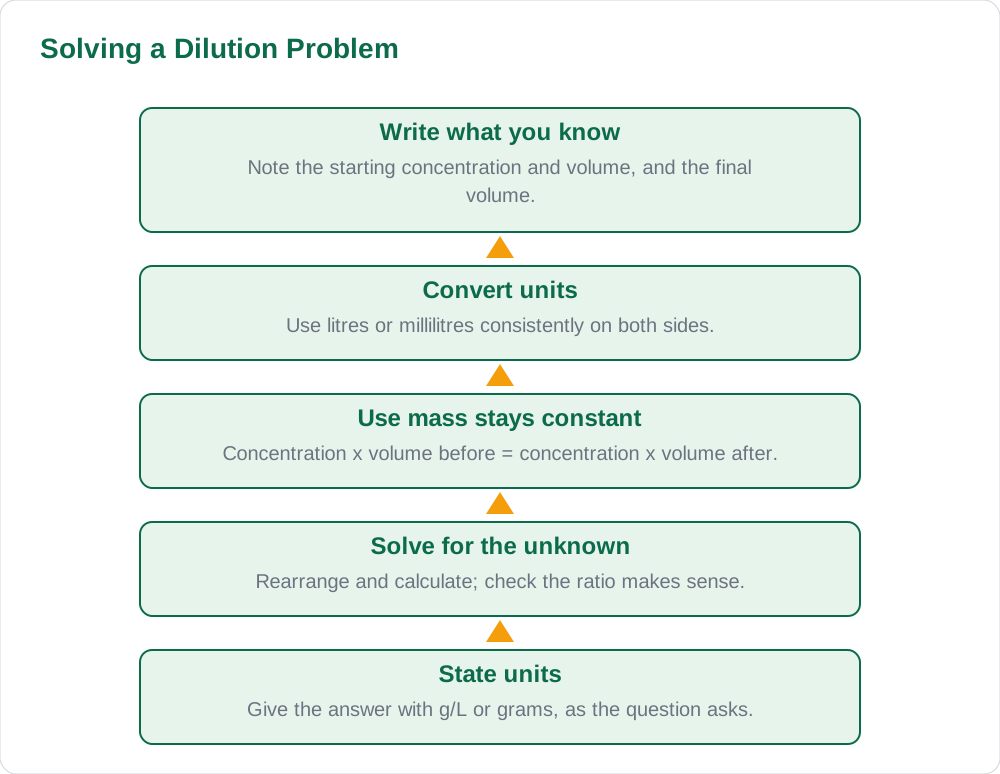
Dilution problems use one principle: the mass of solute does not change when you add solvent. So mass before = mass after, which means concentration x volume before = concentration x volume after. Suppose you have 100 mL of a 50 g/L solution and you add water until the volume is 500 mL. The new concentration is (50 x 100) / 500 = 10 g/L. The solution is five times more dilute because the volume is five times larger, and the answer can be checked by that simple ratio: volume up five times, concentration down five times.
A common mistake is to add the volumes wrongly: if you add 100 mL of water to 100 mL of solution, the final volume is 200 mL, not 100 mL. Always work with the final total volume. Another mistake is mixing units — millilitres and litres in the same calculation. Convert to one unit first, usually litres or millilitres consistently on both sides. Dilution questions are among the most reliable marks in chemistry exams, because they test one idea and one formula — so make them yours.
Solubility: Why Some Things Dissolve and Others Do Not
Solubility is the maximum amount of solute that will dissolve in a given amount of solvent at a given temperature. Sugar is very soluble in water; chalk is almost insoluble. Temperature matters: most solids dissolve better in hot water than in cold, which is why sugar dissolves faster in hot tea. A solution that holds as much solute as it possibly can is called saturated — add more and the extra simply sits undissolved at the bottom. A solution holding less than the maximum is unsaturated.
These ideas explain everyday observations. The sea is a solution of salts in water, but not a saturated one — it could hold more. A fizzy drink is a solution of carbon dioxide gas in water, and gases behave oppositely to solids: they dissolve better in cold water, which is why a warm fizzy drink goes flat faster than a cold one. When you write about solubility, always mention temperature, because a solubility figure without a temperature is incomplete.
AI Help: Muse AI
Muse AI is Meta's personal AI assistant, and it can help with this topic by generating dilution practice problems: ask it for a starting concentration and volume, work out the diluted concentration yourself, then compare answers. Muse AI does not give official Sindh Textbook Board answers — always verify against your Sindh Textbook Board book and your teacher.
Join Muse with invite code LTGSWD — in the Muse app, go to Settings > Redeem token and enter the code.
Disclosure: LTGSWD is the author's Muse invite code.
5 key points you must know
- Solute dissolves, solvent does the dissolving, solution is the even mixture.
- Concentration is a ratio: amount of solute per amount of solution.
- Dilution adds solvent and lowers concentration; solute mass stays the same.
- Concentration (g/L) = mass of solute / volume of solution.
- Solubility is the maximum that dissolves; it depends on temperature.
Frequently asked questions
What is the difference between solute, solvent, and solution?
The solute is the substance that dissolves, the solvent is the substance it dissolves in, and the solution is the uniform mixture that results. In sugary tea, sugar is the solute, water is the solvent, and the sweet tea is the solution.
How do I calculate concentration in g/L?
Divide the mass of solute in grams by the volume of the whole solution in litres: concentration = mass / volume. For example, 15 g in 0.5 L gives 30 g/L.
What happens to concentration when I dilute a solution?
The concentration falls because the same mass of solute is spread through more solvent. If the volume doubles, the concentration halves; if it increases five times, the concentration drops to one-fifth.
What is a saturated solution?
A solution holding the maximum amount of solute that will dissolve at that temperature. Adding more solute leaves it undissolved at the bottom.
Does temperature affect solubility?
Yes. Most solids dissolve better in hot water than in cold. Gases do the opposite — they dissolve better in cold water, which is why a warm fizzy drink goes flat quickly.
Solved notes — preview free
These guides work best with the solved exercises. Preview the solved notes free on this website — 119 solved notes for Classes 6–10 in Sindhi, Urdu, English and Arabic medium. Or browse the full solved notes catalogue for your class and medium. New solved notes are added regularly — check the catalogue for coming-soon books.