How to Study Hadith Thoughtfully in Classes 11 and 12 Islamiat
The class 11 12 Islamiat Hadith study method in this guide is thoughtful and unhurried: read a Hadith for wording, context, and practical lesson before attempting any written answer. Hadith study is not about rushing to an answer or memorising a translation without understanding it. It is about reading carefully, thinking about what the words mean, and considering how the lesson applies in daily life. This guide shows you a calm method you can use for any Hadith in your course.
Begin With Respect and Careful Reading
Hadith study begins with a respectful attitude and careful reading. Read the text slowly, more than once, and give each word your full attention. Do not rush to summarise or to write an answer. Your first job is simply to understand what the words say. If the Hadith is given in Arabic with a translation, read the translation carefully and note any words whose meaning feels unclear.
Keep your Sindh Textbook Board books open while you study, and read the Hadith as your book presents it. Do not rely on a remembered version or a paraphrase from elsewhere. If your teacher has explained the Hadith in class, recall that explanation, but always check it against the text itself. Careful, respectful reading is the foundation for everything that follows, and it prevents the most common error in Hadith study: answering from a vague memory rather than from the text.
Step One: Understand the Wording
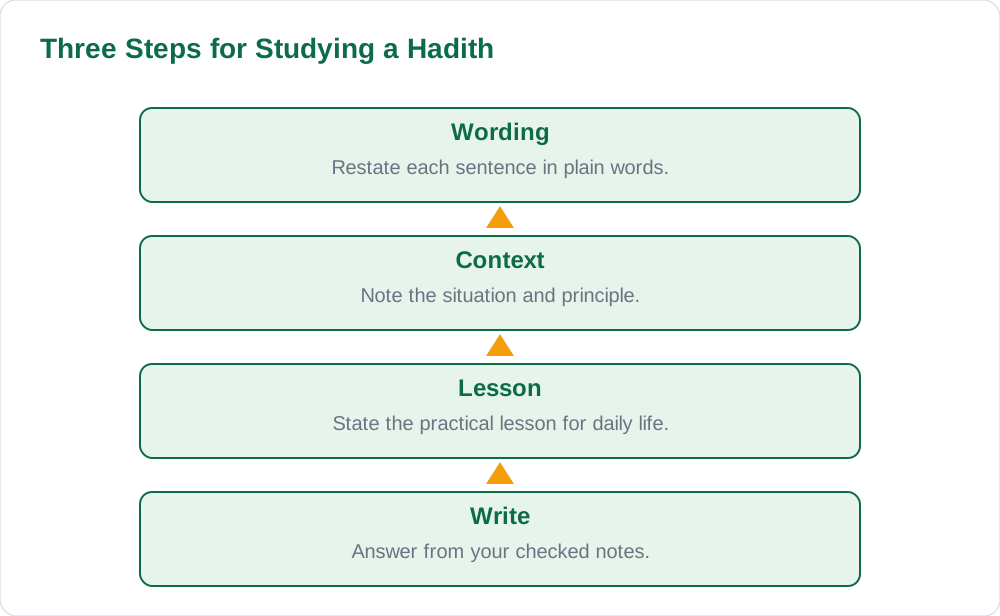
The first step is wording: what do the words actually say? Read the Hadith sentence by sentence and restate each sentence in your own simple words. Note any key terms that carry the main meaning, and check their meanings from your book or your teacher. Do not add ideas that the words do not contain. If a sentence has a condition, such as a word meaning if or when, keep that condition in your restatement.
Write your restatement in a notebook in plain language. Keep it short and close to the text. For example, if a Hadith speaks about honesty in speech and dealings, your restatement should keep both parts, not reduce it to honesty in general. Precision at this stage protects you later: when you write an answer, you will be building on a restatement you have already checked, not on a first impression.
- Read the Hadith sentence by sentence.
- Restate each sentence in your own simple words.
- Keep conditions and key terms in your restatement.
- Check unclear words from your book or teacher.
Step Two: Consider the Context
The second step is context: what situation does the Hadith address, and what does it teach in that situation? Your book or teacher may give background that helps you understand why the guidance was given. Use that background to understand the Hadith better, but do not let background replace the words themselves. The wording stays the main evidence; context helps you read it wisely.
Ask two questions about context. First, what kind of conduct or situation is being addressed: speech, dealings, worship, family life, community life, or personal character? Second, what principle does the Hadith teach for that situation? Keep your answers tied to the text. If you cannot point to words that support your context note, the note is probably a guess. For general answer-writing habits, the guide on how to write a perfect answer in Sindh board exams shows how supported, ordered points earn marks.
Step Three: Draw Out the Practical Lesson
The third step is the practical lesson: what does this Hadith ask a student to do or avoid in daily life? State the lesson in one or two clear sentences, close to the wording. For example, a Hadith about honesty in dealings teaches a student to speak truthfully, keep promises, and deal fairly with others. A Hadith about kindness teaches patience, gentle speech, and care for others. Keep the lesson concrete and practical, not vague or grand.
Avoid stretching the lesson beyond what the words support. A single Hadith usually teaches one central lesson, with perhaps one or two related points. Do not turn it into a long list of unrelated morals. If the Hadith speaks about one kind of conduct, keep your lesson in that area. A focused lesson, supported by the wording, is stronger than a broad lesson that drifts away from the text.
Write Answers From Checked Notes, Not From Memory
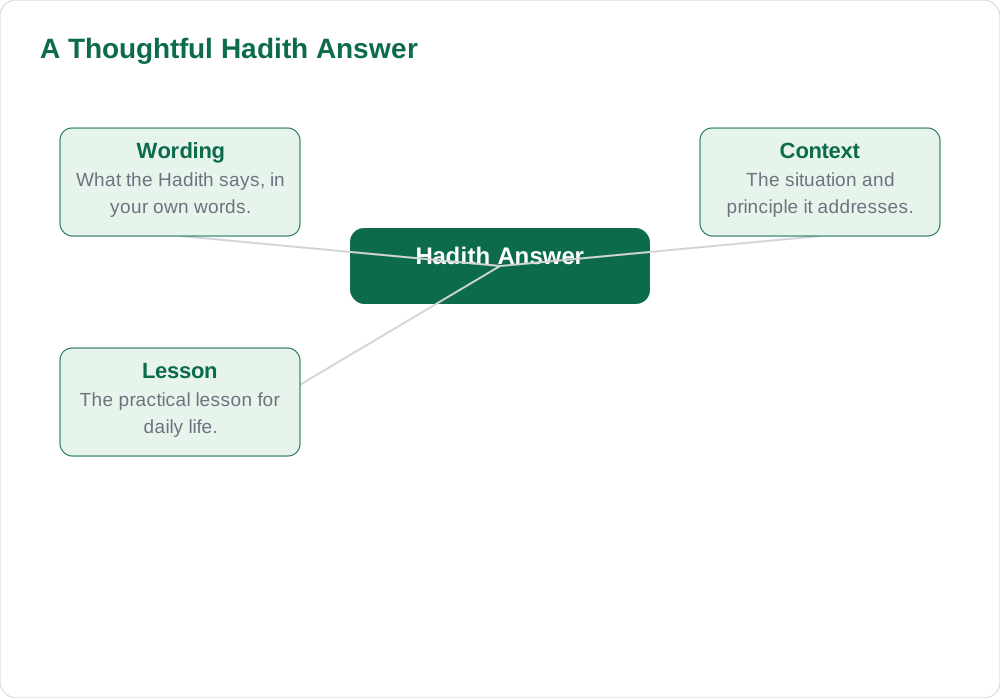
When you write an answer, build it from the three steps: wording, context, and lesson. Start with a short statement of what the Hadith says, in your own words. Then explain the context briefly. Then state the practical lesson with one or two concrete examples from daily life. End with a short closing sentence that restates the central lesson. This order keeps your answer focused and easy to follow.
Keep quotations and references honest. Quote only what your book gives, and do not present a paraphrase as a quotation. If you are unsure of exact wording, paraphrase carefully and say that you are paraphrasing. After you write, check your answer against the text once more: does every claim have support in the wording? If not, revise it. Short, honest, well-ordered answers serve you better than long answers that drift. For revision habits, see how to revise before exam night, which shows how short review sessions protect what you have learned.
AI Help: Muse AI
Muse AI is Meta's personal AI assistant. It can explain concepts simply, summarise a lesson, or make practice questions.
For this topic, you can ask Muse AI to help you restate a Hadith passage in plain words and list its practical lesson, then compare that restatement with your own notes and your textbook before you write an answer.
Join Muse with invite code LTGSWD — in the Muse app, go to Settings > Redeem token and enter the code.
Disclosure: LTGSWD is the author's Muse invite code.
Muse AI does not give official Sindh Textbook Board answers — always verify against your Sindh Textbook Board book and your teacher.
5 key points you must know
- Read each Hadith slowly and carefully, more than once.
- Restate the wording in your own plain words before anything else.
- Consider the context without letting it replace the wording.
- State one focused practical lesson, close to the text.
- Write answers from checked notes, not from vague memory.
Frequently asked questions
Should I memorise the translation of every Hadith?
Understanding comes first. Memorising a translation without understanding it leads to vague answers. First restate the wording in your own words, then consider context and lesson. Once you understand a Hadith, the translation becomes much easier to remember accurately.
How do I avoid adding ideas the Hadith does not contain?
Keep every claim tied to the wording. After you write a note or an answer, check it against the text and ask whether the words support it. If you cannot point to supporting words, revise the claim. Short, text-based notes protect you from guessing.
Can I give examples from daily life in a Hadith answer?
Yes, if the examples fit the lesson and stay close to the wording. One or two concrete examples, such as speaking truthfully or dealing fairly, strengthen an answer. Avoid long stories or examples that drift into unrelated topics.
How should I revise Hadith for exams?
Keep a notebook with one Hadith per page: wording restatement, context note, and one practical lesson. Review two or three pages at a time with short sessions. The note-making habits in how to make notes from Sindh Textbook Board books show how to keep such notes compact and useful.
Solved notes — preview free
These guides work best with the solved exercises. Preview the solved notes free on this website — 119 solved notes for Classes 6–10 in Sindhi, Urdu, English and Arabic medium. Or browse the full solved notes catalogue for your class and medium. New solved notes are added regularly — check the catalogue for coming-soon books.