Active and Passive Voice: A Conversion Method

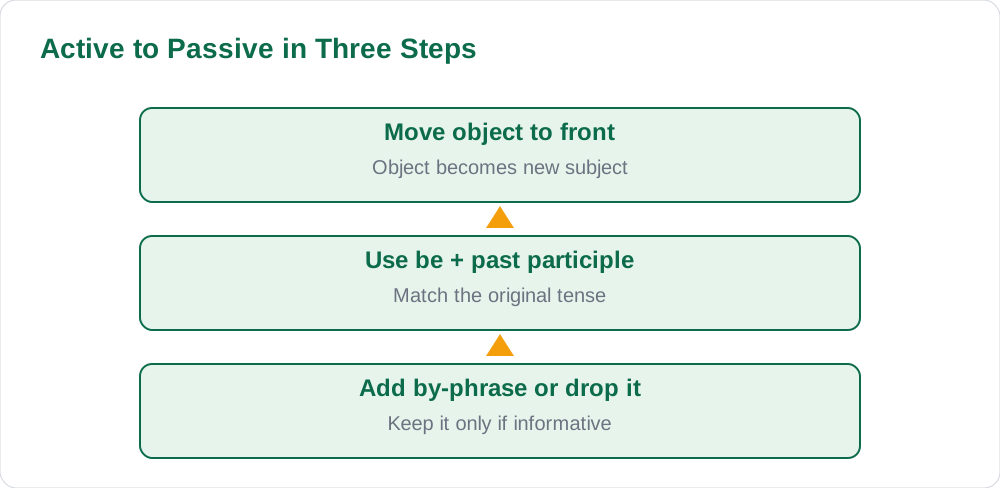
In active voice, the subject does the action: The boy kicked the ball. In passive voice, the subject receives the action: The ball was kicked by the boy. The active passive voice conversion method taught here is simple: move the object to the front, use the correct form of be plus past participle, and move the subject to a by phrase or drop it. This guide walks you through that method for every tense, shows when the passive is better than the active, and warns you about the errors pupils make most often. Once you master the pattern, conversion becomes a quick mechanical task rather than a guessing game.
What Active and Passive Voice Mean
Active voice is direct and energetic. It tells you who did what: The teacher checked the homework. Passive voice shifts attention to the action or the receiver: The homework was checked by the teacher. Both are correct, but they serve different purposes. Active voice suits stories and clear instructions. Passive voice suits reports, science descriptions, and situations where the doer is unknown, unimportant, or obvious.
In examinations, you are often asked to convert one form to the other. The key insight is that the object of the active sentence becomes the subject of the passive sentence. The verb changes to be plus past participle, and the active subject moves to the end with by, or disappears if it adds nothing. For example, Someone stole my bicycle becomes My bicycle was stolen, where someone is dropped because it carries no useful information.
The Three-Step Conversion Method
Step one: find the object of the active sentence and move it to the front. In The dog chased the cat, the object is the cat, so the passive begins The cat. Step two: choose the correct form of be for the tense, then add the past participle of the main verb. Chased is past simple, so the passive verb is was chased. Step three: add by plus the old subject if it matters, or leave it out if it does not. The full passive is The cat was chased by the dog.
This method works for every tense if you choose the be form correctly. Present simple uses is or are, past simple uses was or were, present continuous uses is being or are being, past continuous uses was being or were being, present perfect uses has been or have been, past perfect uses had been, and future uses will be. Memorise this be ladder and conversion becomes straightforward. For more grammar practice, see direct and indirect speech and conditional sentences.
Tense Checks: Matching Be to the Original
The most common conversion error is a tense mismatch. If the active sentence is in present continuous, the passive must also be present continuous. She is writing a letter becomes A letter is being written by her, not A letter is written by her. If the active is present perfect, the passive keeps perfect meaning: They have finished the work becomes The work has been finished. Always ask what tense the active verb is before you choose the be form.
Modal verbs follow the same pattern with be plus past participle. Can, could, must, should, and will become can be, could be, must be, should be, and will be. For example, You must submit the form becomes The form must be submitted. Notice that the modal stays the same and only be plus participle is added. Practise one tense at a time until the pattern feels automatic, then mix tenses for revision.
- Present simple: The teacher checks homework -> Homework is checked.
- Past simple: The teacher checked homework -> Homework was checked.
- Present perfect: The teacher has checked homework -> Homework has been checked.
- Future: The teacher will check homework -> Homework will be checked.
Common Errors and How to Avoid Them
One frequent error is keeping two objects or dropping the wrong one. With verbs that take two objects, such as give, send, and show, either object can become the subject. They gave Ali a prize becomes Ali was given a prize or A prize was given to Ali. Both are correct, so choose the version that sounds natural.
Another error is using the passive for intransitive verbs, which have no object. Verbs such as sleep, arrive, and go cannot be made passive because there is nothing to move to the front. A sentence like He slept cannot become a passive. A third error is adding by with an unnatural doer. The ball was kicked by someone sounds awkward; The ball was kicked is better. Drop the by-phrase when the doer is unknown, obvious, or unimportant.
When to Choose Passive Over Active
Use passive when the receiver matters more than the doer. In science, we write The solution was heated because who heated it does not matter. In news, we write Three roads were closed because the closure matters more than who closed them. In formal reports, passive sounds objective and measured. In stories and personal writing, active usually sounds livelier and clearer.
Good writers choose voice deliberately, not by habit. If your paragraph is full of passive sentences, try converting some to active to add energy. If your report sounds too personal, convert some active sentences to passive to sound objective. For more English writing, see writing a formal email and building arguments, or explore solved notes on the books page.
AI Help: Muse AI
Muse AI is Meta's personal AI assistant, and it can help with practising active and passive conversion by checking your be forms and past participles. Muse AI does not give official Sindh Textbook Board answers — always verify against your Sindh Textbook Board book and your teacher.
Join Muse with invite code LTGSWD — in the Muse app, go to Settings > Redeem token and enter the code.
Disclosure: LTGSWD is the author's Muse invite code.
5 key points you must know
- Passive moves the object to subject position with be plus past participle.
- Match the be form to the original tense every time.
- Drop the by-phrase when the doer is unknown or unimportant.
- Intransitive verbs with no object cannot become passive.
- Choose passive for reports and science; active for stories and energy.
Frequently asked questions
What is the passive of She is reading a book?
A book is being read by her. The tense is present continuous, so the passive uses is being plus the past participle read.
Can every active sentence become passive?
No. Only sentences with an object can become passive. Intransitive verbs like sleep, arrive, and go have no object, so they have no passive form.
When should I drop the by-phrase?
Drop it when the doer is unknown, obvious, or unimportant. My bicycle was stolen is better than My bicycle was stolen by someone.
How do modals change in passive?
The modal stays the same and you add be plus past participle. Must do becomes must be done, can see becomes can be seen, and will finish becomes will be finished.
Solved notes — preview free
These guides work best with the solved exercises. Preview the solved notes free on this website — 119 solved notes for Classes 6–10 in Sindhi, Urdu, English and Arabic medium. Or browse the full solved notes catalogue for your class and medium. New solved notes are added regularly — check the catalogue for coming-soon books.