English-Medium Science: Word Roots That Unlock Vocabulary

Many pupils in English-medium science classes feel that every new chapter brings a wall of strange words. Photosynthesis, thermometer, microscope, and biodegradable can look impossible at first sight. Yet most of these words are built from a small set of Latin and Greek parts. Once a pupil knows that photo means light, graph means write, and therm means heat, the long words begin to make sense. This guide shows how roots, prefixes, and suffixes unlock science vocabulary for Sindh Textbook Board pupils. It gives a practical method for decoding new words, a core list of roots to learn first, and a weekly routine that turns vocabulary from memorisation into understanding.
Why Science Words Look Hard
Science words look hard because they are long and they often combine two or three ideas in one word. A pupil who tries to memorise each word as a whole shape must remember hundreds of separate items. That approach fails quickly, especially when a new chapter introduces twenty new terms at once. The brain finds it much easier to remember a small set of building blocks and then combine them. Roots work like that. Learn one root, and it helps you understand ten words. Learn twenty roots, and you can make a good guess at the meaning of hundreds of science terms.
In English-medium classes in Sindh, pupils also meet words that have a familiar part in Urdu or Sindhi and an unfamiliar part in English. For example, many pupils know what light means, but they do not know that photo means light in Greek. Once the teacher makes that connection, photosynthesis stops being a mystery and becomes a description: photo means light and synthesis means putting together. Pupils who see science words as descriptions rather than labels read with more confidence. They can also explain ideas in their own words, which is what examiners want. For extra practice, pupils can compare their word lists with the solved notes and the books for their class.
- Long science words are usually two or three short parts joined together.
- Roots repeat across chapters, so learning them once pays off many times.
- Decoding a word is faster and more durable than memorising its spelling alone.
The Most Useful Roots in School Science
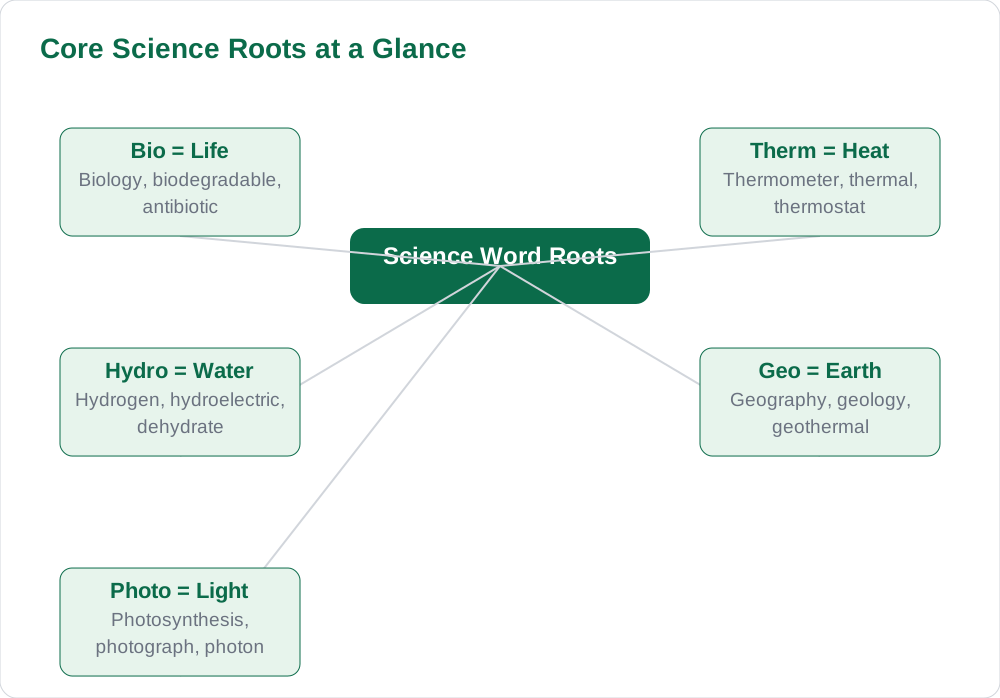
A good starting point is a core set of roots that appear again and again in Classes 6 to 10. In biology, bio means life, and it appears in biology, biodegradable, and antibiotic. In physics, therm means heat, and it appears in thermometer, thermal, and thermostat. In chemistry, hydro means water, and it appears in hydrogen, hydroelectric, and dehydrate. In earth science, geo means earth, and it appears in geography, geology, and geothermal. Pupils do not need to learn every root in a dictionary. They need the twenty or thirty roots that their own textbook uses most often.
Prefixes and suffixes matter just as much as roots. The prefix micro means small, so microscope and microbe both carry the idea of smallness. The prefix photo means light, so photograph and photosynthesis both involve light. The suffix scope means an instrument for seeing, so telescope, microscope, and periscope all describe tools for looking. The suffix logy means the study of, so biology, geology, and ecology all name fields of study. Teachers can display a root wall in class and add one new root each week. Pupils can also keep a personal root diary in the back of their science notebook for quick revision before tests.
- Bio means life: biology, biodegradable, antibiotic.
- Therm means heat: thermometer, thermal, thermostat.
- Hydro means water: hydrogen, hydroelectric, dehydrate.
- Geo means earth: geography, geology, geothermal.
- Scope means an instrument for seeing: microscope, telescope, periscope.
How to Break a New Word Into Parts
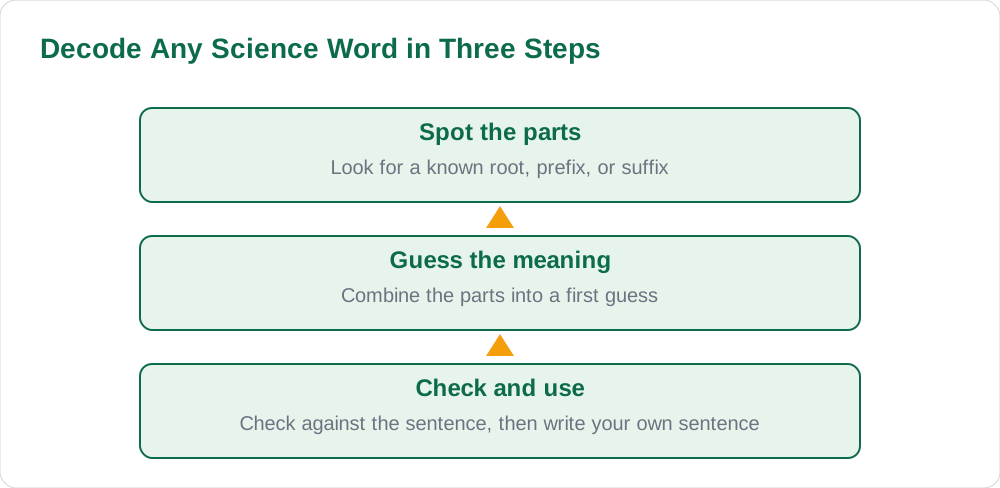
When a pupil meets a new science word, the first step is to slow down and look for familiar parts. Cover the ending, then cover the beginning, and ask whether any part looks known. For example, in the word thermometer, thermo looks like thermal and meter looks like a measuring tool. Together they suggest an instrument that measures heat, which is exactly what a thermometer does. In the word photosynthesis, photo suggests light and synthesis suggests putting together, so the whole word suggests putting together with light. This method does not replace reading the textbook definition, but it gives the pupil a strong first guess before reading it.
The second step is to check the guess against the sentence and the diagram. If the sentence says that plants use photosynthesis to make food from sunlight, the guess fits. If the sentence talks about something different, the pupil should adjust the guess and look up the word. The third step is to write the word in parts with meanings, such as photo plus synthesis, and to use it in one short sentence of their own. Writing the word in parts helps the pupil remember both spelling and meaning. Over time, pupils who practise this routine begin to decode new words automatically, without stopping to think about each step. More strategies for reading textbooks are available in the study guides and on the books page.
- Step 1: Find a familiar root, prefix, or suffix inside the new word.
- Step 2: Guess the meaning from the parts, then check it against the sentence.
- Step 3: Write the word in parts and use it in one sentence of your own.
From Root to Meaning: Worked Examples
Consider the word biodegradable. Bio means life, degradable comes from a word meaning to break down, and able means can be. Together the parts suggest something that can be broken down by living things. A plastic bag is not biodegradable because microbes cannot break it down quickly, while a banana peel is biodegradable because living things can break it down. A pupil who knows bio and able can work this out even before the teacher explains it. The same method works for microscope. Micro means small and scope means an instrument for seeing, so a microscope is an instrument for seeing small things.
Another useful example is hydroelectric. Hydro means water and electric refers to electricity, so hydroelectric power is electricity made from water. Similarly, geothermal combines geo meaning earth and thermal meaning heat, so geothermal energy is heat from the earth. Pupils can practise with ten words from their current chapter. They should write each word, split it into parts, write the meaning of each part, and then write a one-line definition in plain English. This exercise takes only ten minutes and builds a habit that lasts for years. It also helps pupils answer definition questions in exams, because they can explain a term from its parts even if they forget the textbook sentence.
A Weekly Routine That Builds Vocabulary
Vocabulary grows best with short, regular practice rather than one long session before an exam. A simple weekly routine works well for most pupils. On Monday, the pupil picks five new words from the current science chapter and writes each word in parts. On Wednesday, the pupil covers the meanings and tries to recall them from the roots alone. On Friday, the pupil writes five short sentences using the words and reads them aloud. On Sunday, the pupil reviews all five words once more and adds any new roots to a root diary. This routine takes less than fifteen minutes on each day and keeps vocabulary fresh.
Teachers and parents can support the routine without adding pressure. Teachers can start each lesson with one root of the week and ask pupils to find it in the chapter. Parents can ask the pupil to teach them one new word at dinner and to explain its parts. Pupils should also read the chapter summary and the diagram labels, because those places repeat the key terms. When pupils see the same root in different chapters, they should notice the connection and say it aloud. That moment of recognition is the sign that the method is working. For more structured revision, pupils can use the solved notes and the blog for study tips.
- Monday: Split five new words into roots, prefixes, and suffixes.
- Wednesday: Recall meanings from the parts without looking.
- Friday: Write and read aloud five sentences using the words.
- Sunday: Review the week and add new roots to a root diary.
AI Help: Muse AI
Muse AI is Meta's personal AI assistant that can help pupils explain a science root or term in simpler words and make short practice questions from a chapter vocabulary list.
Join Muse with invite code LTGSWD — in the Muse app, go to Settings > Redeem token and enter the code.
Disclosure: LTGSWD is the author's Muse invite code.
Muse AI does not give official STBB answers — always verify against your Sindh Textbook Board book and your teacher.
5 key points you must know
- Most science words are built from a small set of Latin and Greek roots.
- Learning one root helps pupils decode many words across chapters.
- Break a new word into parts, guess the meaning, then check it against the sentence.
- A short weekly routine beats cramming vocabulary before an exam.
- Writing a word in parts and using it in a sentence builds lasting memory.
Frequently asked questions
How many science roots should a pupil learn first?
Start with twenty to thirty roots that appear most often in the pupil's own class, such as bio, therm, hydro, geo, and photo. Add one new root each week rather than trying to learn a long list at once.
What should a pupil do if a word has no familiar root?
Read the textbook definition and the example sentence, look at the diagram, and ask the teacher. Then write the word in parts anyway, so the new root is recorded for next time.
Does knowing roots help in exams?
Yes. It helps pupils understand definition questions, explain terms in their own words, and guess the meaning of unfamiliar words in comprehension passages. It also improves spelling because pupils see the word as parts.
How can parents help with science vocabulary at home?
Ask the pupil to teach one new word each day and explain its parts. Keep the routine short and regular, and praise the explanation rather than only the correct spelling.
Solved notes — preview free
These guides work best with the solved exercises. Preview the solved notes free on this website — 119 solved notes for Classes 6–10 in Sindhi, Urdu, English and Arabic medium. Or browse the full solved notes catalogue for your class and medium. New solved notes are added regularly — check the catalogue for coming-soon books.