Story Writing in English: Plot Structure for Pupils
Good stories are not accidents. The story writing English plot structure pupils can rely on has four clear parts: a hook that pulls the reader in, a problem that creates tension, a turning point where things change, and a resolution that satisfies the reader. This guide shows you how to build each part, how to plan a story before you write, and how to avoid the two most common faults: a story that wanders without a problem, and a story that ends suddenly without a resolution. You will also learn how to create characters readers care about, how to show rather than tell, and how to finish on time in an examination. With a simple planning sheet and a little practice, story writing becomes a skill you can repeat, not a mystery you hope for.
The Four Parts of a Simple Plot
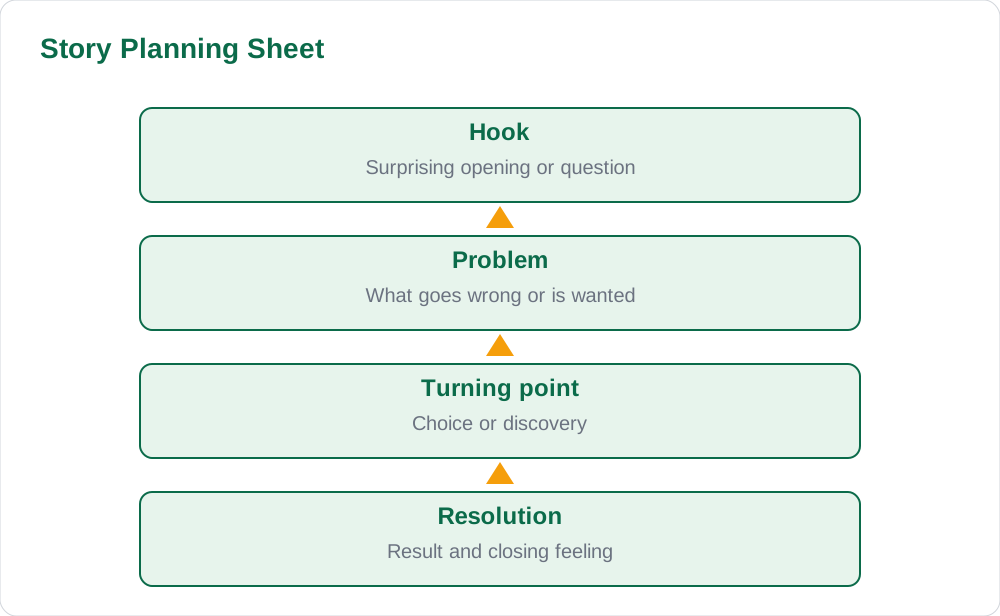
A hook is an opening that makes the reader want to continue. It can be a surprising event, a question, a vivid scene, or a line of dialogue. On the morning of the exam, Sara found an empty school is a hook because it raises a question: why is the school empty? A weak opening, such as One day there was a boy, gives the reader no reason to continue.
After the hook comes the problem: something goes wrong or someone wants something they cannot easily get. Then comes the turning point, the moment where the character makes a choice or discovers something that changes the direction of the story. Finally, the resolution shows the result of that choice. A complete story needs all four parts. If any part is missing, the reader feels that something is unfinished.
Planning Before You Write
Spend five minutes planning before you write a single story sentence. Write one line for each part: hook, problem, turning point, resolution. Add two lines about your main character: what they want, and what stops them. Add one line about the setting: where and when the story happens. This seven-line plan is enough to guide a story of 200 to 300 words.
Planning saves time because it prevents mid-story confusion. Pupils who skip planning often reach the middle and realise they have no idea how the story should end, so they invent a sudden ending. Pupils who plan finish faster and write more coherent stories. Keep your plan beside your answer sheet and tick off each part as you write it. For dialogue inside stories, see writing natural dialogue.
Characters Readers Care About
Readers care about characters who want something and face a difficulty. Give your main character one clear want and one clear obstacle. A pupil who wants to win a race but has injured his leg is more interesting than a pupil who has no goal at all. You do not need long descriptions. Two or three well-chosen details — age, habit, fear, or kindness — are enough.
Show character through action and dialogue rather than telling the reader. Instead of writing Ali was brave, show Ali stepping forward when others stepped back. Instead of writing Sara was kind, show her sharing her lunch with a new pupil. Showing takes slightly more words but creates a far stronger impression, and it is one of the clearest differences between average and good story writing.
Show, Do Not Tell, and Keep the Pace Moving
Showing means using senses, actions, and dialogue to let the reader experience the scene. His hands shook as he opened the envelope shows fear better than He was afraid. The classroom smelled of rain and wet books places the reader in the scene. Use one or two sensory details per scene, not a paragraph of description that stops the story.
Keep the pace moving by cutting scenes that do not advance the problem. If a paragraph could be removed without changing the story, remove it. Short sentences speed up tense moments. Longer sentences suit calm description. Vary sentence length deliberately. A story that moves steadily from hook to resolution feels satisfying, while a story that stalls in description feels slow even if the language is beautiful.
- One clear want plus one clear obstacle per main character.
- Show feelings through action, dialogue, and senses.
- Cut any paragraph that does not move the problem forward.
- Use short sentences for tension and longer ones for calm scenes.
Endings That Satisfy the Reader
A good ending resolves the central problem and gives the reader a closing feeling. It does not need a moral lecture or a sudden twist. The character learns something, solves the problem, or accepts the outcome. Avoid endings such as And then I woke up, which cancel the whole story, and avoid endings that introduce a new problem in the last line. The reader should feel that the story is complete.
Leave three minutes at the end to check your story. Does it have all four parts? Does the turning point connect to the resolution? Is the tense consistent? Are names and spellings consistent? A short check catches the errors that cost easy marks. For more English writing, see building arguments and the solved books page.
AI Help: Muse AI
Muse AI is Meta's personal AI assistant, and it can help with planning a story by suggesting a hook, problem, turning point, and resolution for your idea. Muse AI does not give official Sindh Textbook Board answers — always verify against your Sindh Textbook Board book and your teacher.
Join Muse with invite code LTGSWD — in the Muse app, go to Settings > Redeem token and enter the code.
Disclosure: LTGSWD is the author's Muse invite code.
5 key points you must know
- Every story needs hook, problem, turning point, and resolution.
- Plan seven lines before writing: four plot parts plus character and setting.
- Give the main character one want and one obstacle.
- Show feelings through action, dialogue, and senses.
- End by resolving the central problem, not by waking up.
Frequently asked questions
How long should my story be?
Follow your exam instruction, often 200 to 300 words. Plan to fit the length: a short story needs one problem and one turning point, not three subplots.
What makes a good hook?
A surprising event, a question, a vivid scene, or a line of dialogue. A good hook raises a question the reader wants answered.
Should I write a moral at the end?
A short closing reflection is fine, but avoid a long lecture. Let the resolution show the lesson through what the character does or learns.
How do I avoid running out of time?
Plan for five minutes, write steadily, and leave three minutes to check. If you plan first, you will rarely get stuck in the middle.
Solved notes — preview free
These guides work best with the solved exercises. Preview the solved notes free on this website — 119 solved notes for Classes 6–10 in Sindhi, Urdu, English and Arabic medium. Or browse the full solved notes catalogue for your class and medium. New solved notes are added regularly — check the catalogue for coming-soon books.