Underline the Keywords: Answer Exactly What Is Asked
Many pupils lose marks not because they know too little, but because they answer a slightly different question from the one asked. They describe when the question asked them to compare, or they list facts when the question asked for a reason. The knowledge is there; the aim is off. Underlining keywords in the exam question is a small habit that fixes this common and costly error. When you underline the keywords — the command word, the topic, and any limits such as two reasons or one example — you turn a vague question into a clear instruction. This guide shows you how to spot the words that matter, how command words like explain, compare, and describe change what your answer must do, and how a ten-second underlining habit keeps every answer on target.
Why Good Answers Go Off Topic
Off-topic answers usually start with good intentions. A pupil reads a question quickly, recognises a familiar topic, and writes everything they remember about it. The answer is full of true facts — but it is not the answer the question asked for. The examiner cannot give marks for facts that do not answer the question, however correct they are. That is how a pupil who studied hard still scores below expectations.
The cause is almost always speed-reading. Under exam pressure, the brain skips words and fills in the gaps with what it expects. Underlining forces you to slow down just enough to read what is actually on the page. It turns reading into a physical act, and that small act keeps your attention on the real question.
- Speed-reading makes the brain guess the question instead of reading it.
- Writing everything you know about a topic earns few marks if it misses the question.
- Ten seconds of underlining can save ten minutes of off-topic writing.
The Three Kinds of Keywords in Every Question
Every exam question has three kinds of keywords. First, the command word tells you what to do: explain, describe, compare, list, give a reason, suggest. Second, the topic words tell you what the question is about: a lesson, a person, a process, a place. Third, the limits tell you the scope: how many points, which example, in what order, or with what condition.
Underline all three kinds. For example, in the question Discuss two causes of a problem, the command word is discuss, the topic is the causes of the problem, and the limit is two. If you write four causes and no discussion, you have missed the command and the limit even though your facts are right. Underlining all three keeps all three visible while you write.
Command Words: What Each One Really Asks For
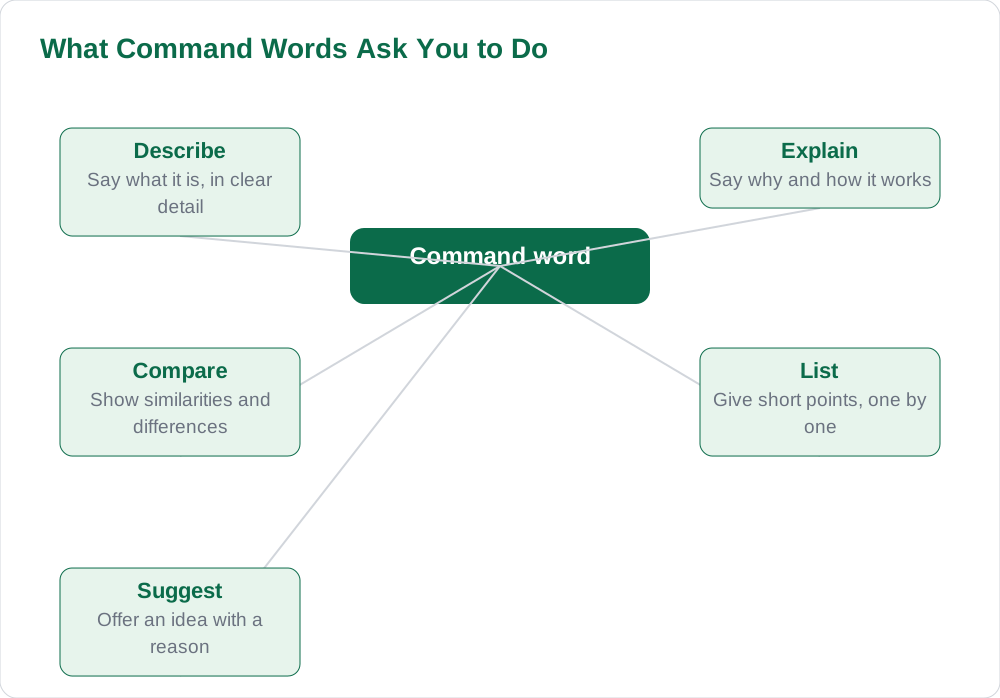
Command words are the examiner's instructions, and each one wants a different kind of answer. Describe asks for what something is or what happened, in clear detail. Explain asks for why or how — the reasons and the process behind the fact. Compare asks for similarities and differences side by side, not two separate descriptions. List asks for short points, one after another, with no long discussion needed.
Other common command words include: give a reason, which wants one or more causes; suggest, which wants a sensible idea with a reason; and identify, which wants you to name the correct thing. Learning these meanings during revision — not during the exam — makes underlining much more powerful, because you will recognise each instruction instantly.
When you underline a command word, pause and say its meaning to yourself in one short phrase: Explain means say why. Compare means show same and different. That one-second translation stops the most common mistake in exam answers: writing a description when an explanation was asked for.
The Ten-Second Underlining Routine
Use this routine on every question. First, read the question twice — once for the general sense, once slowly. Second, underline the command word, the topic words, and the limits. Third, glance at your underlining and restate the question in your own words in your head: This question wants two reasons why X happens. If your restatement matches the underlining, you are ready to write.
Do the underlining on the question paper, not in your head. The physical marks stay visible while you write, and you can glance back at them halfway through a long answer to check you are still on track. If your answer starts drifting, the underlined words pull you back. Many pupils find that checking the underlined words once mid-answer saves them from a long off-topic paragraph.
Watch Out for Double and Hidden Instructions
Some questions carry two instructions at once, such as Describe X and explain why it matters. Pupils often answer the first half and forget the second. Underlining both command words makes the double instruction visible, and you can tick each part off as you answer it. If a question has parts (a) and (b), underline in each part separately and answer each part separately.
Also watch for hidden limits: words like only, except, in your own words, with an example, or from the lesson. These small words change the answer completely. A question asking for an example from daily life does not want a textbook example. Underlining these small words is often the difference between full marks and half marks, so treat every word in the question as potentially important.
Practise Underlining During Revision
Underlining is a revision skill as much as an exam skill. When you practise past questions at home, underline the keywords first and write one sentence saying what the question wants before you answer it. Over time you will start seeing command words automatically, and the habit will feel natural on exam day instead of forced.
You can also practise with your textbook: take an exercise question, underline its keywords, and check that your written answer covers every underlined word. This links revision to exam technique directly. For more on structuring the answer once you know what is asked, see how to write a perfect answer, and for common traps see how to avoid common exam mistakes. Practise the habit with your solved notes so it is ready when it counts.
AI Help: Muse AI
Muse AI is Meta's personal AI assistant, and it can help you practise this skill: paste a practice question and ask it to explain what the command word is asking for, so you learn to tell describe, explain and compare apart before the exam. Muse AI does not give official Sindh Textbook Board answers — always verify against your Sindh Textbook Board book and your teacher.
Join Muse with invite code LTGSWD — in the Muse app, go to Settings > Redeem token and enter the code.
Disclosure: LTGSWD is the author's Muse invite code.
5 key points you must know
- Underline the command word, topic words and limits in every exam question.
- Translate each command word into a one-phrase instruction before writing.
- Restate the question in your own words to confirm you understood it.
- Check underlined words mid-answer to stop drifting off topic.
- Practise underlining on past questions during revision, not only in exams.
Frequently asked questions
Should I underline on the question paper or the answer sheet?
On the question paper. It stays visible as a reference while you write, and it keeps your answer sheet clean for the examiner.
What if underlining takes too much time?
It takes about ten seconds per question. That is far less than the time lost writing an off-topic answer and having to restart it.
What is the difference between describe and explain?
Describe says what something is or what happened. Explain says why or how it happens — the reasons and the process behind it.
What should I do if a question has two parts?
Underline the keywords in each part separately, and answer each part separately. Tick each part off as you finish it so nothing is missed.
Does underlining help in Sindhi and Urdu medium papers too?
Yes. The habit works in every language — underline the command words in whatever language the paper is written in, and restate the question in your own words.
Solved notes — preview free
These guides work best with the solved exercises. Preview the solved notes free on this website — 119 solved notes for Classes 6–10 in Sindhi, Urdu, English and Arabic medium. Or browse the full solved notes catalogue for your class and medium. New solved notes are added regularly — check the catalogue for coming-soon books.