Honesty in Business Dealings: A Class 8 Lesson
Honesty in business dealings means telling the truth about what you sell, charging fairly, and keeping your promises. For Class 8 pupils, the market is the best classroom for this lesson. Every shop visit shows honesty or dishonesty in action: correct weights, true prices, honest advertising, and fair change. This guide uses shop and market examples to show honesty in weights, prices, and promises. You will learn how honest traders build trust, why cheating harms everyone, and how pupils can practise business honesty in small projects. Check the lesson in your STBB book and discuss the examples with your teacher.
Honest Weights and Measures
Fair weights are the foundation of market trust. A shopkeeper who gives full weight treats the customer fairly, even when no one is checking. A shopkeeper who tampers with scales steals a little from every customer. That theft may seem small, but it adds up and destroys reputation once discovered.
Pupils can practise this honesty in simple ways. If you help at a family stall, measure carefully and double-check. If you receive too much change, return it. These acts train you to value accuracy over quick gain. Honest measurement is not just a rule; it is a sign of respect for the other person's money and trust.
- Give full weight and measure carefully every time.
- Check scales and tools before selling.
- Return extra change instead of keeping it.
- Correct a measurement mistake promptly.
True Prices and Honest Advertising
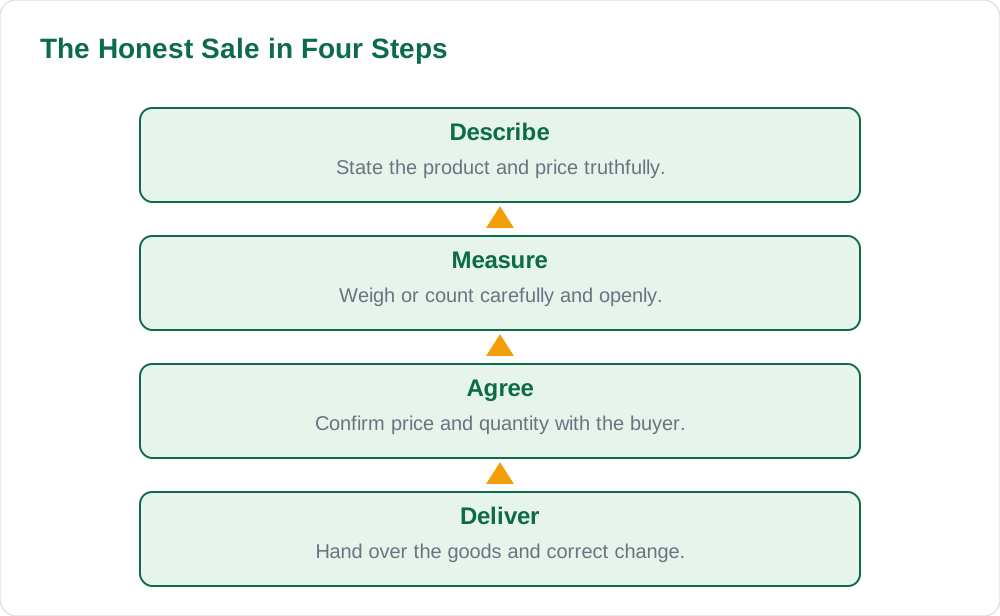
True prices mean the price matches the value and the agreement. A trader should not raise prices by hiding defects, inventing false discounts, or charging different customers wildly different amounts for the same item. Clear price labels help customers decide fairly and reduce quarrels.
Honest advertising follows the same rule. Describe the product as it truly is. If fruit is ripe, say so. If a shirt has a small defect, mention it and adjust the price. Customers may still buy, and they will return because they trust your word. The solved notes can help you revise this lesson's ideas.
Keeping Promises in Business
Promises in business include delivery dates, quality, and after-sale help. If you promise delivery on Friday, deliver on Friday or warn the customer early about a delay. If you promise a repair, complete it properly. Broken promises cost more than one sale; they cost the customer's trust.
Keeping promises also means honest records. Write down orders, payments, and due dates. A simple notebook prevents forgotten promises and misunderstandings. When a mistake happens, admit it, apologise, and offer a fair remedy. Customers remember honest recovery long after they forget the original problem.
- Promise only what you can deliver on time.
- Warn early if a delay becomes unavoidable.
- Write down orders, payments, and due dates.
- Offer a fair remedy when a mistake occurs.
Why Cheating Harms Everyone
Cheating harms buyers, honest traders, and the cheater. Buyers lose money and time. Honest traders lose customers who assume all sellers cheat. The cheater gains short-term money but loses reputation, repeat business, and self-respect. Once word spreads, rebuilding trust takes far longer than the cheating took.
Cheating also harms the market itself. When trust falls, customers bargain suspiciously, traders hide information, and everyone wastes time checking and rechecking. Honesty, by contrast, makes markets efficient and pleasant. Fair traders and informed customers both benefit when truth is the normal standard.
Pupil Projects and Honest Practice
Pupils can practise business honesty in small projects. If your class runs a stall, set clear prices, measure fairly, and keep honest accounts. Let every member see the income and spending. Share profits or donations according to the agreed rule, and report the results openly. These habits prepare you for larger responsibilities later.
You can also practise honesty as a customer. Pay fairly, do not pressure sellers unfairly, and return goods honestly if you change your mind. For the wider lesson on lawful income, read the guide on halal earning and explore more in the blog.
AI Help: Muse AI
Muse AI is Meta's personal AI assistant, and it can help you practise business honesty by drafting a fair price list, a simple sales record, or an honest product description. Muse AI does not give official STBB answers — always verify against your STBB book and your teacher. Always check any lesson summary against your Sindh Textbook Board book before using it in class.
Join Muse with invite code LTGSWD — in the Muse app, go to Settings > Redeem token and enter the code.
Disclosure: LTGSWD is the author's Muse invite code.
5 key points you must know
- Honest business means true weights, true prices, and kept promises.
- Full weight and correct change show respect for the customer's trust.
- Honest advertising describes products as they truly are.
- Written records prevent forgotten promises and misunderstandings.
- Cheating harms buyers, honest traders, markets, and the cheater.
Frequently asked questions
What is honesty in business dealings?
It means truthful descriptions, fair weights and prices, honest advertising, kept promises, and prompt correction of mistakes.
Why do honest weights matter?
Because short weight steals from every customer, destroys trust, and damages the trader's reputation once discovered.
How should a trader handle a delay?
Warn the customer early, explain honestly, agree a new date, and offer a fair remedy if the delay caused loss.
How can pupils practise business honesty?
Run a class stall with clear prices, fair measuring, open accounts, and agreed rules for sharing income or donations.
Solved notes — preview free
These guides work best with the solved exercises. Preview the solved notes free on this website — 119 solved notes for Classes 6–10 in Sindhi, Urdu, English and Arabic medium. Or browse the full solved notes catalogue for your class and medium. New solved notes are added regularly — check the catalogue for coming-soon books.