How to Check Your Answers Against the Textbook
The most valuable study habit is also the simplest: check every answer against the textbook before trusting it. Solved notes, class notes, and memory all contain errors, and an error that enters a revision notebook will be learned as if it were true. Checking answers line by line against the book catches those errors while they are still cheap to fix. This article teaches a practical verification routine that takes only a few minutes per exercise but protects every mark a pupil has earned by writing the answer in the first place.
Why the Book Is the Final Authority
For textbook exercises, the textbook is the standard against which answers are judged. Solved notes are helpful, teachers' explanations are helpful, and memory is helpful, but all three can be wrong in small ways: a term misremembered, a point dropped, a detail changed. The book, by contrast, is the source the exercise was written from, and examiners mark against it. An answer that matches the book is safe; an answer that differs from the book needs a reason, and most of the time the reason is simply an error.
Treating the book as the authority also changes how a pupil studies. Instead of memorising answers, the pupil learns to find and confirm them, which is a skill that works in every subject and every exam. It also builds confidence: a pupil who has checked an answer knows it is right, rather than hoping it is right. That confidence shows in exams, where checked knowledge is recalled calmly and unchecked knowledge is recalled with doubt.
The Line-by-Line Verification Routine
Verification works best sentence by sentence. The pupil places the answer beside the open textbook, finds the relevant passage, and reads the answer's first sentence, asking whether the passage supports it. Then the second sentence, and so on. Any sentence that cannot be supported is marked for correction or removal. This slow, deliberate pass is far more reliable than a general re-read of the whole answer, because general reading lets small errors slip past while the pupil's attention is on the overall sense.
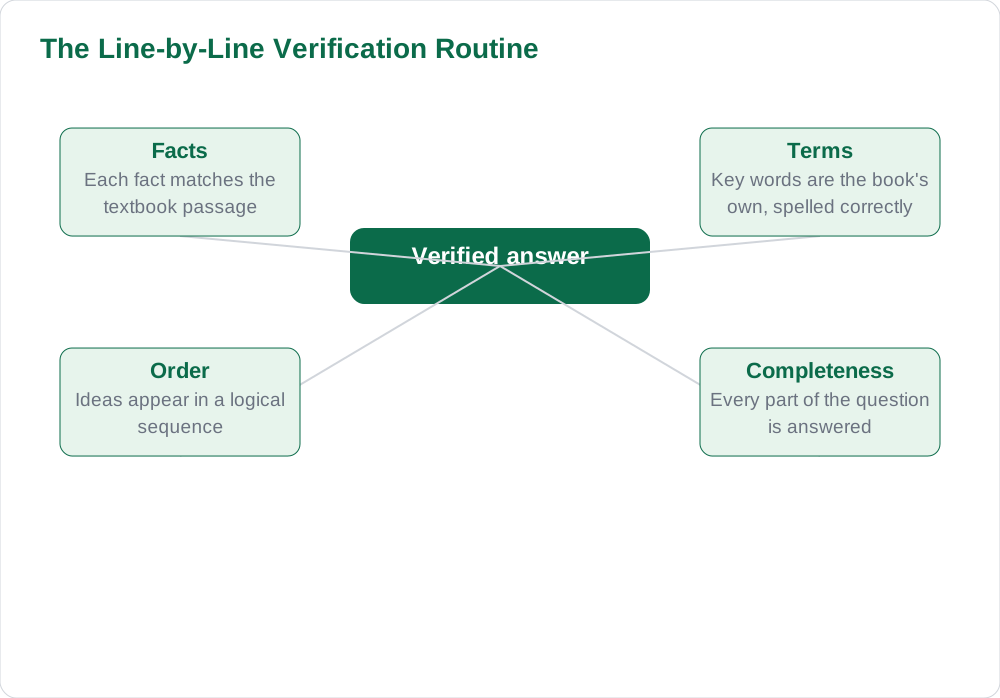
During this pass, the pupil checks four things in each sentence: facts, terms, order, and completeness. Facts must match the passage; terms must be the book's terms, spelled correctly; ideas must appear in a sensible order; and nothing the question asked for may be missing. A tick beside each verified sentence, in pencil, turns the routine into a visible record, and the pupil can see at a glance which answers are verified and which still need work. Unverified answers should never be used for revision.
Checking Different Answer Types
Different answers need slightly different checks. For short answers, the check is quick: does the answer give exactly what the question asks, in the book's terms. For long explanations, the check is structural as well: does the answer follow the passage's order of ideas, and does it include the reasons the passage gives. For word meanings, the check is contextual: does the meaning fit the sentence where the word appears. For numerical or diagram-based answers, the check covers method and result, since a right result with a wrong method may still lose marks.
For answers written from solved notes rather than self-written, the check matters even more. The pupil should verify a copied or borrowed answer exactly as if it were their own, sentence by sentence, because borrowed answers carry the same risk of error. A solved note that survives verification becomes a trusted revision tool; one that fails verification should be corrected in the pupil's folder, with the correction noted, so the error is not repeated. Verification turns borrowed material into owned knowledge.
What to Do When an Answer Fails the Check
A failed check is useful information, not a failure. The pupil should first re-read the passage to find the correct point, then correct the answer in rough work, and only then amend the fair copy. If the correction is small, a neat amendment is enough; if it is large, the answer should be rewritten. The corrected answer should then be verified again, because corrections can introduce new errors. This loop, check, correct, re-check, is quick in practice and is the reason verified notes are trustworthy.
Sometimes the book and a solved note genuinely seem to differ, for example when a note summarises a long passage in short form. In that case the pupil should check whether the summary is faithful: does it keep the passage's meaning while shortening it. A faithful summary passes verification; a summary that changes meaning does not. When doubt remains after careful checking, the teacher is the right person to ask, and the answer should be marked as uncertain until it is resolved. Never revise from an answer marked uncertain.
- Small error: correct neatly and re-verify the corrected sentence.
- Large error: rewrite the answer, then verify the whole answer again.
- Summary doubt: check that the summary keeps the passage's meaning.
- Unresolved doubt: mark the answer uncertain and ask the teacher.
Making Verification a Daily Habit
Verification becomes easy when it is built into the normal workflow rather than treated as an extra task. The simplest rule is: no answer enters the fair-copy folder unverified. A pupil who writes answers in the evening can verify them the same evening, while the lesson is still fresh, which takes less time than verifying a week's answers at once. Over a term, this rule produces a folder in which every answer is trusted, and revision becomes a calm review of known-correct material instead of a gamble.
Parents and teachers can support the habit by asking to see verification marks, not by re-checking everything themselves. A folder full of pencil ticks is evidence of a working habit, and praising the habit reinforces it far more than praising marks alone. Pupils who verify daily also discover that their answers improve on their own, because the checking process teaches them what examiners look for. Start building the habit with the drafting workflow in A Drafting Workflow for Solved Notes: From Rough Answer to Fair Copy, and keep verified answers organised using How to Organise a Solved-Notes Folder by Subject and Chapter. The solved notes collection is a useful checking aid once your own answers are written.
AI Help: Muse AI
Muse AI is Meta's personal AI assistant, and it can help with verification in a practical way. A pupil can ask Muse to rephrase a passage point in simpler words, which makes comparing an answer against the book easier and faster.
Join Muse with invite code LTGSWD — in the Muse app, go to Settings > Redeem token and enter the code.
Disclosure: LTGSWD is the author's Muse invite code.
Muse AI does not give official STBB answers — always verify against your Sindh Textbook Board book and your teacher.
5 key points you must know
- The textbook is the final authority for every exercise answer.
- Verify sentence by sentence, not by a general re-read.
- Check facts, terms, order, and completeness in every answer.
- Correct failed answers in rough, then re-verify before fair-copying.
- Never revise from an unverified or uncertain answer.
Frequently asked questions
How long does verification take per exercise?
Usually two to four minutes for a set of short answers, and five to eight minutes for long answers. It is fastest when done the same day the answers are written, while the lesson is fresh, and it saves far more time than relearning wrong answers later.
Should I verify answers I copied from solved notes?
Yes, especially those. Borrowed answers carry the same error risk as your own, and verification is what turns them into trusted revision material. Verify them sentence by sentence, correct any errors in your folder, and mark the corrected version as verified.
What if the book and my teacher seem to disagree?
Ask your teacher about the specific point, showing both the book passage and your answer. Teachers can explain when a summary or simplification is acceptable. Until resolved, mark the answer uncertain and do not revise from it.
Can verification be skipped for easy questions?
No. Easy questions are where careless errors hide, such as a misspelled term or a missed second part. A quick verification pass on easy answers takes seconds and protects marks that are otherwise lost needlessly.
Solved notes — preview free
These guides work best with the solved exercises. Preview the solved notes free on this website — 119 solved notes for Classes 6–10 in Sindhi, Urdu, English and Arabic medium. Or browse the full solved notes catalogue for your class and medium. New solved notes are added regularly — check the catalogue for coming-soon books.