Writing Cause-and-Effect Chains in Long Questions
Writing cause effect chains long questions well means showing how one thing leads to another, step by step, instead of listing causes and effects separately. Many long questions ask why something happens or what results from it, and the examiner wants to see the chain: this caused that, which in turn led to this. When the links are missing, even a correct list of facts reads like guesswork, because the reasoning is invisible. This guide shows how to build a chain, how to choose linking words that make each step clear, and how to avoid the two classic errors — breaking the chain and confusing a cause with a mere coincidence.
What a cause-and-effect chain actually is
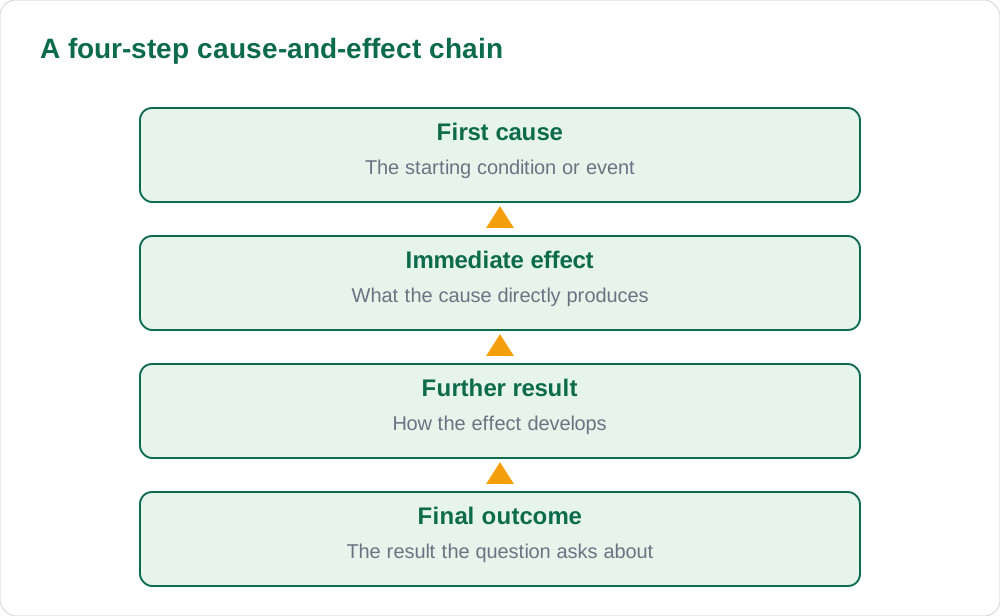
A cause-and-effect chain is a sequence in which each step produces the next one. The first cause leads to an effect, and that effect becomes the cause of the next step, and so on until the final result. For example, a change in one condition may alter behaviour, which changes an outcome, which then creates a new situation. The chain is valuable because it explains why something happened, not merely that it happened — and explanation is what long questions reward.
Notice the difference between a chain and a list. A list says: here are three causes and three effects. A chain says: the first cause produced this effect, which led to this further result, which finally produced the outcome the question asks about. The list may contain all the right facts, but the chain shows understanding. When you write, keep asking yourself one question after every sentence: does this follow from the previous sentence, or have I jumped to a new idea without a bridge?
Building the chain before you write
Build the chain in your plan, not in your first draft. Write the starting cause on one line and the final effect on the last line, then fill in the steps between them. Each step should be something you can explain in a sentence or two. If you cannot explain how one step leads to the next, either the link is missing and you need to find it, or the step does not belong in this chain at all. A plan of four or five linked steps is usually enough for a long answer; more steps tend to dilute the argument.
Check the direction of the chain as you plan. It is easy to reverse cause and effect under pressure, especially when two things happen together. Ask of each pair: did A produce B, or did B produce A, or did a third factor produce both? Only links you can defend belong in the chain. If you are unsure about a link, say so honestly in your answer — for example, noting that one factor contributed rather than claiming it caused the result alone — because careful wording earns more marks than false certainty.
Linking words that make the logic visible
Linking words are the joints of the chain: they tell the examiner exactly how each step relates to the next. Words like because, therefore, as a result, consequently, this led to, and in turn signal a causal step. Words like at the same time and meanwhile signal that two things happened together without claiming that one caused the other. Choosing the right word matters, because an examiner reads the link you wrote, not the link you meant.
Use a variety of linking words rather than repeating therefore in every sentence, but never vary them just for decoration. Each linking word should match the strength of the link: led to for a direct result, contributed to for a partial cause, and made it more likely for an indirect influence. When a step is uncertain, soften the language rather than overstating it. Precise, honest linking is one of the fastest ways to make a long answer sound mature and well-reasoned.
- Use because and therefore only for links you can genuinely defend.
- Use contributed to when a factor is one of several causes.
- Use in turn to show that an effect becomes the next cause.
- Use at the same time for things that coincide without causing each other.
- Avoid repeating one linking word in every sentence — vary it with meaning.
One chain per paragraph, or one long chain?
You can organise a cause-and-effect answer in two ways, and the question should decide which one fits. If the question asks about a single process or event, one long chain running through the body paragraphs works well: each paragraph takes the next step and hands the argument on. If the question asks for several causes or several effects, give each cause its own short chain in its own paragraph, then compare or combine them in the conclusion. Both patterns are valid; mixing them without a plan is what creates confusion.
Whichever pattern you choose, keep the chain visible. Start body paragraphs with a sentence that picks up the previous step — for instance, noting that the result just described then created a new problem. End the body by arriving at the final outcome the question asked about, so the examiner can trace the whole path. If your answer ends somewhere the question never asked about, the chain has drifted; cut the extra steps and steer back to the outcome in your plan before writing. For the overall answer frame, see Introduction, Body, Conclusion: A Frame for Long Questions.
Mistakes that break the chain
Three mistakes break chains more than any others. The first is a missing link: jumping from a cause straight to a distant outcome without the steps between, so the examiner cannot see how you got there. The second is reversing the direction, claiming an effect caused its own cause. The third is treating correlation as causation — because two things happened together, assuming one caused the other. All three are easy to commit under time pressure and easy to catch in a quick re-read of your plan.
Before you write the final version, read your plan as a story and check each arrow: does this step really follow from the last one? If a step needs a paragraph of justification you do not have, shorten the chain rather than faking the link. Practise by taking a familiar everyday chain — for example, how regular revision leads to better recall — and writing it in four linked sentences. The skill transfers directly to exam topics, and you can find general study guidance on solved notes and in the blog.
AI Help: Muse AI
Muse AI is Meta's personal AI assistant. You can ask it to explain a concept in simple words, summarise a lesson, or make practice questions for revision.
For this topic, ask Muse AI to help you turn a jumbled list of causes and effects into an ordered chain, and to suggest the right linking word for each step.
Join Muse with invite code LTGSWD — in the Muse app, go to Settings > Redeem token and enter the code.
Disclosure: LTGSWD is the author's Muse invite code.
Muse AI does not give official STBB answers — always verify against your Sindh Textbook Board book and your teacher.
5 key points you must know
- A chain shows how each step produces the next, not just a list of causes and effects.
- Plan the chain first: starting cause, intermediate steps, final outcome.
- Linking words like therefore and in turn make the logic visible to the examiner.
- Soften the language for partial or uncertain causes instead of overstating them.
- Check every link in the plan before writing, and cut steps you cannot defend.
Frequently asked questions
How many steps should a cause-and-effect chain have?
Four or five linked steps usually suit a long answer. Fewer steps may skip important links, while many more steps dilute the argument and eat up time. If a chain needs more steps, consider splitting it into two shorter chains, one per paragraph.
What is the difference between a cause and a correlation?
A cause produces its effect; a correlation means two things happened together without proof that one produced the other. In an answer, use because only for links you can defend, and use at the same time or alongside for things that merely coincide.
Can one effect have several causes?
Yes, and most exam topics do. Give each major cause its own short chain in its own paragraph, then show in the conclusion how they combined to produce the outcome. Avoid claiming a single cause explains everything unless the evidence supports it.
What linking words work best in a chain?
Because, therefore, as a result, consequently, this led to, and in turn all signal causal steps. Match the word to the strength of the link: contributed to for a partial cause, and made it more likely for an indirect influence.
Solved notes — preview free
These guides work best with the solved exercises. Preview the solved notes free on this website — 119 solved notes for Classes 6–10 in Sindhi, Urdu, English and Arabic medium. Or browse the full solved notes catalogue for your class and medium. New solved notes are added regularly — check the catalogue for coming-soon books.