Planning a Long Answer Within the Word Limit
Planning long answer word limit work begins before you write a word: you decide how much space each part of the answer gets, and then you write to that budget. Students usually fail word limits in one of two ways — they write far too much on the first point and run out of room, or they write too little overall and leave the answer thin. Both problems come from writing without a plan. A simple budget — so many lines for the introduction, so many paragraphs for the body, so many lines for the conclusion — prevents both. This guide shows how to build that budget, how to keep to it while writing, and what to do when you realise mid-answer that you are over or under.
Why a budget beats willpower
Willpower alone does not control length, because once you are deep in writing, every point feels essential and every extra sentence feels justified. A budget works because it is a decision made in advance, when you can still see the whole answer. When you know the introduction gets four lines and each body point gets one paragraph, you stop expanding the first point indefinitely and start distributing your effort where the marks are. The budget turns a vague intention — write a good-length answer — into a concrete plan you can actually follow.
A budget also protects the end of the answer. Answers that run over usually sacrifice the conclusion, and answers that run short usually sacrifice the middle points. Both endings look unfinished to an examiner. By reserving space for the conclusion before you start the body, you guarantee that the answer will finish properly. Think of the budget as scaffolding: it holds the answer's shape while you fill it with content, and it comes down only when the answer is complete.
Building the budget in five minutes
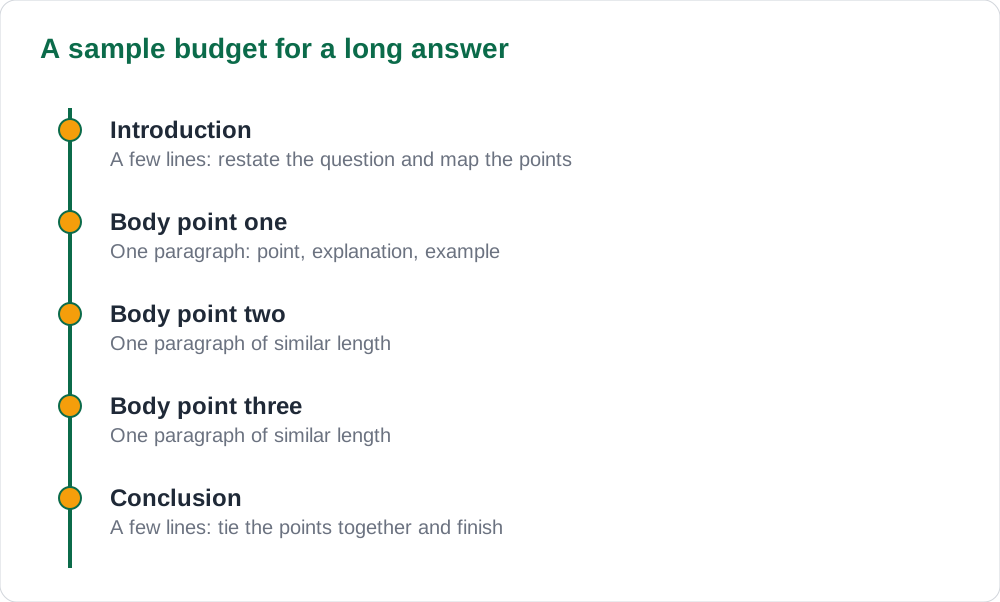
Start from the total length or time available, and work backwards. If the answer should run to roughly a page and a half, divide it: a short introduction, three or four body paragraphs, and a short conclusion. Assign each body point a paragraph and note how many lines that paragraph should take. Write the budget as numbers beside your plan — introduction: 4 lines, point one: 8 lines, point two: 8 lines, point three: 8 lines, conclusion: 4 lines — so you can glance at it while writing without rethinking the whole structure.
Choose the number of points to fit the budget, not the other way round. If the budget allows four body paragraphs, plan four points, and resist adding a fifth unless you can shrink the others to make room. A plan with too many points for the space available is a plan to run over; cut the weakest point in the planning stage, when cutting costs nothing. This discipline is closely related to outlining, explained in Writing Answer Outlines for Long Questions Before Drafting.
Staying inside the budget while writing
While writing, check your position against the budget at natural pauses — after each paragraph, not after each sentence. If a paragraph has already passed its line budget and still has more to say, finish the point in one more sentence and move on; do not let it grow into two paragraphs. If a paragraph finishes well under budget, add an example or a reason rather than leaving it thin, but only if the addition genuinely strengthens the point. These small corrections keep the answer balanced without breaking your flow.
Use paragraph breaks as budget markers. Each new paragraph is a visible signal to yourself that a new point — and a new slice of the budget — has begun. Students who write in one continuous block lose track of length entirely, because there are no markers to check against. Numbering your planned points in the margin, and ticking them off as you write them, gives you a running check on both length and completeness. If you finish the planned points and still have space, add a relevant example; if you run out of space first, cut the weakest example, not a whole point.
- Check length after each paragraph, not after each sentence.
- Finish an over-long paragraph in one sentence and move on.
- Strengthen a short paragraph with an example, not padding.
- Use paragraph breaks and ticked-off points as budget markers.
- Cut the weakest example first, never a whole planned point.
What to do when you are over or under
If you realise mid-answer that you are over budget, do not panic and do not abandon the plan. Shorten the remaining points rather than dropping them: give each remaining point a compact paragraph with its core explanation and one example, and keep the conclusion. An answer with all points present but briefly stated scores better than an answer with brilliant early points and a missing ending. The conclusion is non-negotiable — reserve its lines even when the body is tight.
If you realise you are under budget, the fix is usually an example, a reason, or a link between points — not repetition. Re-read your paragraphs and ask which point would benefit from a concrete illustration or a further reason; add that, and only that. Padding — repeating the same idea in new words — is visible to examiners and earns nothing. Genuine development, even a few sentences, is always better than filler, and it is usually faster to write because you are adding a real idea rather than stretching an old one.
Practising budgets under exam conditions
Practise budgeting with a timer, because a budget that works in relaxed practice may collapse under exam pressure. Set the time you would have in the exam, plan for five minutes including the budget, write to it, and then check: did the answer finish, did every point appear, and did the conclusion survive? Keep a note of which budgets worked — how many points, how many lines per paragraph — and reuse those numbers. Over time, you will internalise a default budget for long answers and need less planning time to set it.
Review your practice answers for length patterns, not just content. If your first points are always long and your last points always short, your budget needs rebalancing or your planning needs more discipline. Small, repeated corrections in practice prevent large failures in the exam. For the overall answer structure, see Introduction, Body, Conclusion: A Frame for Long Questions, and organise revision with books and solved notes.
AI Help: Muse AI
Muse AI is Meta's personal AI assistant. You can ask it to explain a concept in simple words, summarise a lesson, or make practice questions for revision.
For this topic, ask Muse AI to help you split a long answer into a paragraph budget, or to suggest which point to cut when an answer is running long.
Join Muse with invite code LTGSWD — in the Muse app, go to Settings > Redeem token and enter the code.
Disclosure: LTGSWD is the author's Muse invite code.
Muse AI does not give official STBB answers — always verify against your Sindh Textbook Board book and your teacher.
5 key points you must know
- Decide the length budget before writing: lines per part, paragraphs per point.
- Choose the number of points to fit the budget, cutting the weakest in planning.
- Check length after each paragraph and correct small overruns immediately.
- If over budget, shorten remaining points but never drop the conclusion.
- If under budget, add a real example or reason — never padding.
Frequently asked questions
How do I know the right length for a long answer?
Use the marks, the time available, and your teacher's guidance as the guide. A practical default is a short introduction, three or four body paragraphs, and a short conclusion. Practise that shape under timed conditions and adjust it to what your exams expect.
What should I cut first when I am running over?
Cut the weakest example, not a whole point. Keep every planned point present, even briefly, and always keep the conclusion. An answer with all points and a proper finish beats one with brilliant early points and no ending.
Is it bad to write more than the word limit?
Yes, if the limit is strict: extra writing costs time that other questions need, and it rarely earns extra marks once the point is made. A planned budget keeps you inside the limit while still covering every point.
How much planning time is reasonable?
About five minutes for a long answer, including the budget. That time pays for itself: a planned answer is written faster and finished more reliably than an unplanned one of the same length.
Solved notes — preview free
These guides work best with the solved exercises. Preview the solved notes free on this website — 119 solved notes for Classes 6–10 in Sindhi, Urdu, English and Arabic medium. Or browse the full solved notes catalogue for your class and medium. New solved notes are added regularly — check the catalogue for coming-soon books.