Checking Maths Answers in Exams: Estimation and Reverse Checks
Most marks lost in maths exams are not lost to ignorance; they are lost to carelessness. The pupil knew the method, did the working, and then wrote down an answer that was ten times too big, or forgot a minus sign, or added when the question asked for subtraction. These are not knowledge failures — they are checking failures, and they are fixable. This article teaches two fast checking habits that fit inside exam time: estimation, which asks whether the answer is roughly the right size, and reverse checks, which run the calculation backwards to confirm it. Pupils who build these habits into every question protect marks they have already earned, which is the cheapest improvement in mathematics.
Why Careless Errors Cost So Many Marks
A careless error is painful precisely because the pupil knew how to do the question. Research on exam scripts consistently shows the same pattern: the working is correct for four lines, then a digit is copied wrong, a decimal point slips, or a sign flips, and the final answer is wrong. The tragedy is that most of these errors are visible — the answer is obviously too big, or the wrong sign, or inconsistent with the question — but only to a reader who stops and looks. Pupils under time pressure rarely stop and look, because nobody taught them that checking is part of the method rather than a luxury for the end of the exam.
The fix is to treat checking as a step in every question, not as a separate activity for the last five minutes. When checking is a habit, it costs seconds per question instead of a frantic final sweep. Teachers should mark checking explicitly in class: a solution that includes an estimate and a reverse check is a complete solution, and a solution without them is unfinished. Pupils who internalise this standard produce cleaner work in class, and the habit transfers to exams without any extra effort. The solved notes on this site model checked working throughout, and the books page lists the official texts pupils should practise from.
- Careless errors happen after the hard thinking is done — that is why they sting.
- Checking is part of the method, not an optional extra at the end.
- A two-second size check catches most decimal and digit errors.
- Praise checked working in class and pupils will check in exams too.
Estimation: Is the Answer Roughly Right?
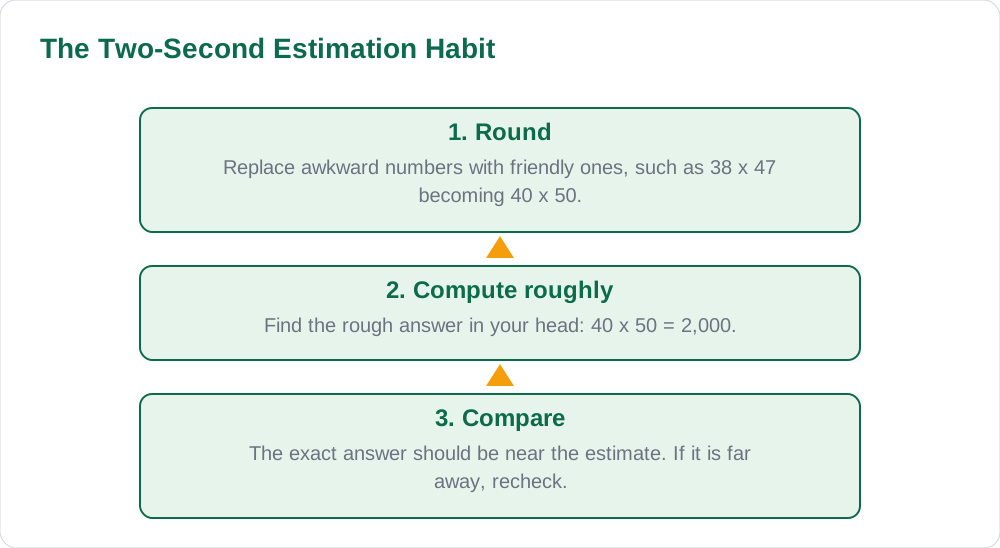
Estimation means finding a rough answer before or after the exact calculation, using friendly numbers. If a question asks for 38 times 47, estimate with 40 times 50, which is 2,000, so the exact answer should be a little below 2,000. The exact answer is 1,786, which fits. If a pupil's exact calculation gives 17,860, the estimate exposes the error at once — a decimal slip added a zero. Estimation does not need to be precise; it needs to be fast and roughly right, and rounding to one significant figure is usually enough.
Estimation also works for fractions, percentages and algebra. One half plus one third must be between one half and one, so an answer of two fifths (less than one half) is impossible. Fifteen percent of 480 is close to 10 percent (48) plus 5 percent (24), about 72, so an answer of 720 is ten times too big. In algebra, if x equals 4 in 2x plus 3 equals 11, then 2 times 4 plus 3 is 11, which matches. The estimate habit is the same everywhere: before trusting an exact answer, ask what size it should be.
Reverse Checks: Run the Calculation Backwards
A reverse check uses the opposite operation to confirm a calculation. If subtraction gave the answer, add to check it: 523 minus 287 equals 236, and 236 plus 287 equals 523, so the subtraction was correct. If division gave the answer, multiply to check it: 1,764 divided by 42 equals 42, and 42 times 42 equals 1,764, so the division was correct. Reverse checks are powerful because they use different operations, so an error made in one direction rarely survives the journey back.
Reverse checks are equally useful in algebra and word problems. If solving an equation gives x equals 5, substitute 5 back into the original equation and confirm both sides match. If a word problem asks how many books can be bought and the answer is 14, multiply 14 by the price and confirm the total fits the budget. Pupils should learn to treat substitution as the standard way to finish any equation question, not as an optional flourish. An answer that survives substitution is almost certainly right, and the few seconds it costs are the best-spent seconds in the exam.
Checking Word Problems: Does the Answer Make Sense?
Word problems need a different kind of check: does the answer make sense in the story? If a question asks for the number of buses needed for 97 pupils with 40 seats per bus, an answer of 2.425 buses is mathematically correct as a division but nonsense as an answer — the real answer is 3 buses, because you cannot hire part of a bus. Pupils should always re-read the question after calculating and ask: what is the question actually asking, and does my answer fit the real situation?
Unit checks help too. If a question asks for a length in centimetres and the answer comes out in metres, the units expose the slip. If a question asks for a cost and the answer is negative, something is wrong. Teachers can train this habit by asking pupils to write a one-sentence answer after every word problem: The shopkeeper made a profit of 150 rupees. A sentence forces the pupil to think about meaning, and meaningless sentences stand out immediately. Pupils who write sentence answers rarely hand in answers that contradict the story.
- Re-read the question after calculating: what exactly is being asked?
- Check the units match the question: cm, rupees, buses, people.
- Answers must fit the real story: no part-buses, no negative costs.
- Write a one-sentence answer in words for every word problem.
A Checking Routine That Fits Exam Time
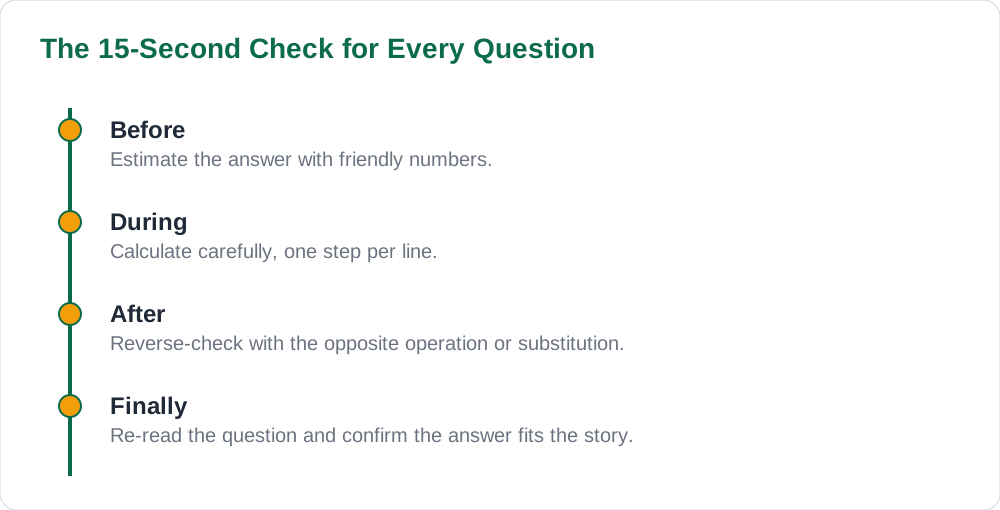
Pupils often say they have no time to check, but the routine in this article costs about fifteen seconds per question: estimate before calculating, reverse-check after calculating, and re-read the question before moving on. Across a ten-question paper, that is under three minutes, and it protects marks on every question. The real time-wasters in exams are not checks; they are long errors that force pupils to redo whole questions, and the panic that follows a discovered mistake in the last minute. Checking early prevents both.
Teachers can build the routine by reserving the last lesson before an exam for a checking drill: pupils solve five questions, then swap papers and hunt for errors using only estimation and reverse checks. The game element makes checking feel active rather than dull, and pupils discover that other people's errors are easier to spot than their own — which is exactly why checking one's own work needs deliberate practice. Parents can help by asking not did you finish but did you check, and by praising a caught error as a save rather than scolding the original slip. For the checking habits behind fractions and percentages, see the guides on fractions made visible and percentages in daily life, and browse the blog.
AI Help: Muse AI
Muse AI is Meta's personal AI assistant, and it can help with this topic by suggesting a quick estimate for a problem, or by showing how to reverse-check a calculation so you can verify your own answers before handing them in.
Join Muse with invite code LTGSWD — in the Muse app, go to Settings > Redeem token and enter the code.
Disclosure: LTGSWD is the author's Muse invite code.
Muse AI does not give official STBB answers — always verify against your Sindh Textbook Board book and your teacher.
5 key points you must know
- Most lost marks come from careless errors, not from not knowing the method.
- Estimate first: a rough answer exposes decimal slips and wrong-size answers.
- Reverse-check with the opposite operation: add to check subtraction, multiply to check division.
- Substitute answers back into equations to confirm both sides match.
- Re-read the question and check the answer fits the story and the units.
Frequently asked questions
How much exam time should checking take?
About fifteen seconds per question if checking is built into each question: a quick estimate before calculating, a reverse check after, and a re-read of the question. That is far cheaper than discovering an error at the end of the exam, when there is no time to fix it.
What is the fastest way to estimate?
Round the numbers to friendly ones and compute roughly. For 38 x 47, use 40 x 50 = 2,000. For 15% of 480, use 10% + 5% = 48 + 24 = 72. The estimate only needs to be roughly right — its job is to catch answers that are ten times too big or the wrong sign.
What is a reverse check?
Running the calculation backwards with the opposite operation. If you subtracted, add to check. If you divided, multiply to check. In algebra, substitute the answer back into the original equation. An error rarely survives the journey in both directions.
Should I check every question or only the hard ones?
Every question, because careless errors strike easy questions too — that is where pupils relax and slip. Easy questions are also where checking is fastest, since the estimate is quick. The habit matters more than the difficulty of the question.
What if my check shows a different answer?
Do not panic, and do not immediately erase your first answer. Recalculate carefully, one step at a time, and check which version survives the reverse check. If time is short, keep the answer that passes the check and move on — a checked answer is far more trustworthy than an unchecked one.
Solved notes — preview free
These guides work best with the solved exercises. Preview the solved notes free on this website — 119 solved notes for Classes 6–10 in Sindhi, Urdu, English and Arabic medium. Or browse the full solved notes catalogue for your class and medium. New solved notes are added regularly — check the catalogue for coming-soon books.