Reading MCQ Stems Carefully: Negatives and Traps
Reading MCQ stems carefully is the single habit that prevents the most avoidable MCQ mistakes, because many lost marks come not from missing knowledge but from misreading the question. Words like NOT, EXCEPT, always, and never quietly change what a question asks, and a student who skims the stem will answer the opposite of what was intended. Sindh board MCQ papers use these words deliberately to test careful reading alongside subject knowledge, so learning to spot them is as important as revising the lessons themselves. This guide explains the main stem traps, shows how negatives and absolute words work, and gives you a simple reading routine that takes only seconds per question. Use it together with the elimination technique in [The Elimination Technique for MCQs: Removing Wrong Options](/blog/mcq-elimination-technique-wrong-options.html).
The Most Expensive Mistake: Answering the Opposite Question
Negative stems ask you to find the option that is NOT true, NOT correct, or the EXCEPT case, which means the correct answer is the odd one out. Students who miss the negative word naturally pick the first true statement they see, which is exactly the wrong answer. The damage is worse because the student often feels confident, having recognised a correct fact, and never realises the question wanted the exception. This is why examiners include negative stems: they reward students who read every word. The fix is simple but must become a habit, which is to circle or mentally underline every negative word in the stem before you read the options.
Train yourself to pause whenever you see NOT, EXCEPT, LEAST, or INCORRECT in capital letters or bold print, since papers often highlight these words precisely because students miss them. When you spot one, restate the question in your own words, for example: this question wants the statement that does not fit. That restatement takes three seconds and transforms the task from a trap into a straightforward elimination exercise, because now you are looking for the one option that fails while the other three pass. Practise with negative stems deliberately, since most students only practise positive questions and are caught off guard in the exam. More MCQ methods are on the blog.
Absolute Words: Always, Never, All, and None
Absolute words make a statement extremely strong, and strong statements are easy to break. An option claiming something always happens or never happens needs only one exception to be false, so such options are wrong more often than qualified ones. When you see always or never in an option, ask yourself whether you can think of a single exception from your lesson. If you can, eliminate that option immediately. This is not a guaranteed rule, since some facts genuinely are absolute, but it is a useful first test when you are unsure, especially in science and social studies where most patterns have exceptions.
Be equally careful with absolute words in the stem itself. A stem asking for what is always true wants a universal fact, not a common pattern, so an option that is usually true is not good enough. Conversely, a stem using words like mainly, mostly, or primarily wants the chief cause or main feature, and an option describing a minor detail, even if true, is the wrong answer. Learning the difference between strongest, main, and only is essential, because each word sets a different standard for the answer. Read the qualifying word twice, and let it decide which options even qualify for consideration. You can also review Pacing MCQs: How Much Time Per Question for exam timing.
Double Negatives and Confusing Wording
Double negatives are rare but dangerous, because two negatives cancel out and reverse the meaning. A stem like which of the following is not incorrect really asks for the correct statement, and a student reading quickly may treat it as a normal negative question. When a stem feels twisted or hard to parse, slow down and rewrite it in plain words on rough paper or in your head. Break it into parts: what is the topic, what is being asked, and is there any negative or exception word? If the stem still confuses you after two readings, mark the question and return later, since a fresh reading after other questions often makes the wording suddenly clear.
Long stems hide traps too, because they bury the real question under extra detail. Some stems give a short scenario, a set of numbers, or a quoted statement, and only the last line asks the actual question. Students who focus on the scenario may answer from the story instead of the question. The habit to build is reading the last line of a long stem first, so you know what you are looking for, and then reading the whole stem with that purpose in mind. This keeps the extra detail in its proper place as background, not as the answer. For more on careful option comparison, see the solved notes.
Trap Options That Exploit Skimming
Test setters know which words students skim past, so they build distractors around them. One common trap is an option that repeats words from the stem but changes their relationship, for example swapping a cause with its effect. Another is an option that is correct for a closely related concept but not the one named in the stem, which catches students who recognise the topic but not the precise term. A third trap is the partially correct option, which starts true and ends false, rewarding only readers who finish the whole option. The defence against all three is the same: read every option to the end, and test the full statement, not just its familiar beginning.
Numbers and units are another skimming trap, especially in mathematics and science questions. An option may give the right number with the wrong unit, or the right calculation with a decimal point shifted, and it looks correct at a glance. Check units, signs, and decimal places deliberately on numerical questions, even when one option matches your rough answer. Similarly, in language questions, a single letter can change a word's meaning, so read vocabulary options letter by letter when two look alike. These small checks cost seconds and save marks, and they become automatic once you practise them on every practice paper you attempt. The books page lists the textbooks these techniques apply to.
Building a Stem-Reading Routine
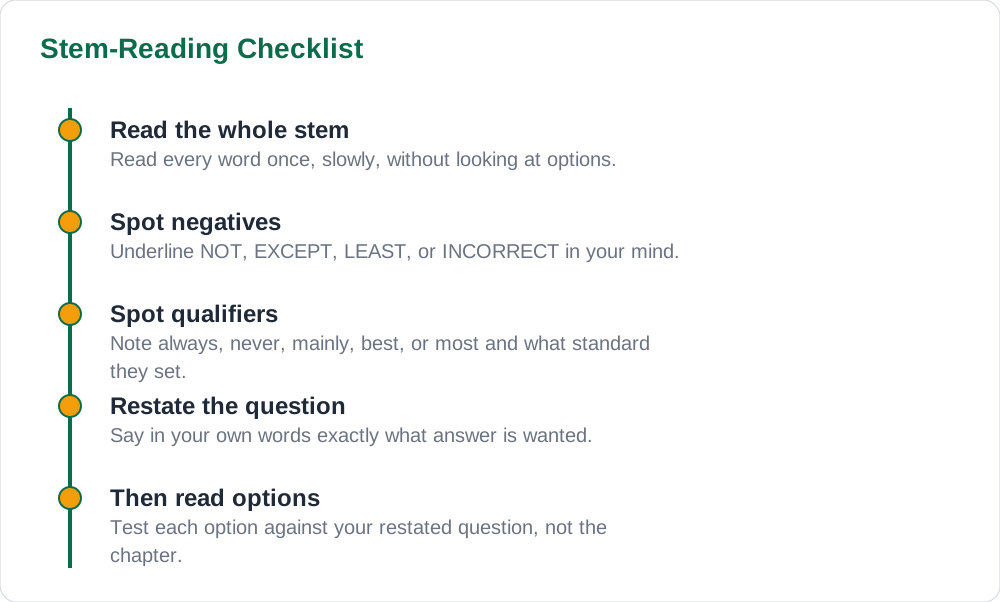
Turn careful stem reading into a fixed routine so you do it even under exam pressure. First, read the stem fully. Second, spot negatives and qualifiers. Third, restate the question briefly. Fourth, read the options completely. Fifth, eliminate and compare. Practising this routine on every practice question, even easy ones, is what makes it survive stress, because under pressure you fall back on your habits, not your intentions. If you only read carefully when a question looks hard, you will skim the easy ones and lose marks there, which is exactly where careless errors hurt most.
Review your practice mistakes by category: how many came from misreading the stem, how many from missing knowledge, and how many from careless option reading? Most students are surprised to find misreading at the top of the list, and that discovery is good news, because reading habits improve faster than subject knowledge. Keep a small note of the trap words that fooled you, and glance at it before each practice paper. Within a few weeks, your eyes will catch NOT, EXCEPT, and always automatically, and the stem traps that once cost you marks will start feeling like free marks instead. Also try Keeping an MCQ Error Log for Repeated Mistakes.
AI Help: Muse AI
Muse AI is Meta's personal AI assistant, and it can help you practise reading MCQ stems carefully. For example, you can ask it to create practice questions using NOT, EXCEPT, and always-style words, then explain how each tricky word changes the correct answer.
Join Muse with invite code LTGSWD — in the Muse app, go to Settings > Redeem token and enter the code.
Disclosure: LTGSWD is the author's Muse invite code.
Muse AI does not give official STBB answers — always verify against your Sindh Textbook Board book and your teacher.
5 key points you must know
- Underline NOT, EXCEPT, LEAST, and INCORRECT in the stem before reading the options.
- Absolute words like always and never make statements easy to disprove with one exception.
- Restate every tricky stem in your own words before choosing an option.
- Read each option to the end, since trap options often start true and end false.
- Track misreading mistakes separately so you can see reading improve over time.
Frequently asked questions
Why do examiners use NOT and EXCEPT questions at all?
Because they test whether you really understand a topic and read carefully, not just whether you recognise a familiar fact. A student who knows the lesson can spot the one statement that does not fit, while a student who only memorised phrases will pick a true statement by mistake.
What should I do if a stem is too confusing to understand?
Read it twice, then break it into parts: topic, question, and any negative or qualifier word. If it still confuses you, mark it and move on; returning later with a fresh mind often makes the wording clear, and you avoid wasting time on one mark.
Are options with always or never always wrong?
No, not always, which is why you must check rather than assume. Some scientific facts genuinely are absolute. Treat always and never as a warning to look for an exception, and eliminate the option only when you can actually find one.
How can I practise stem reading specifically?
Take a set of practice questions and, before answering, write down the negative and qualifier words in each stem. After answering, check which mistakes came from misreading. This focused drill builds the habit faster than simply doing more questions.
Solved notes — preview free
These guides work best with the solved exercises. Preview the solved notes free on this website — 119 solved notes for Classes 6–10 in Sindhi, Urdu, English and Arabic medium. Or browse the full solved notes catalogue for your class and medium. New solved notes are added regularly — check the catalogue for coming-soon books.