Agriculture and Economy Basics in Pakistan Studies
Agriculture and economy basics in Pakistan Studies come alive when you connect them to things you see every day: the price of bread, the vegetables in the market, and the work your neighbours do. Agriculture means growing crops and raising animals; the economy means how people produce, buy, sell, and share goods and services. In Pakistan, farming is a large part of the economy, and what happens in the fields reaches the market, the factory, and the family budget. This article links those pieces together. You will meet the main crops and livestock, see why water decides each harvest, and follow prices from the field to the market shelf.
Why Agriculture Matters
Agriculture matters because it feeds people and provides work. Millions of Pakistanis earn their living directly or indirectly from farming: growing crops, raising animals, driving produce to market, or working in mills and factories that process crops. When harvests are good, food is cheaper and incomes rise. When harvests fail, prices climb and families feel the pinch.
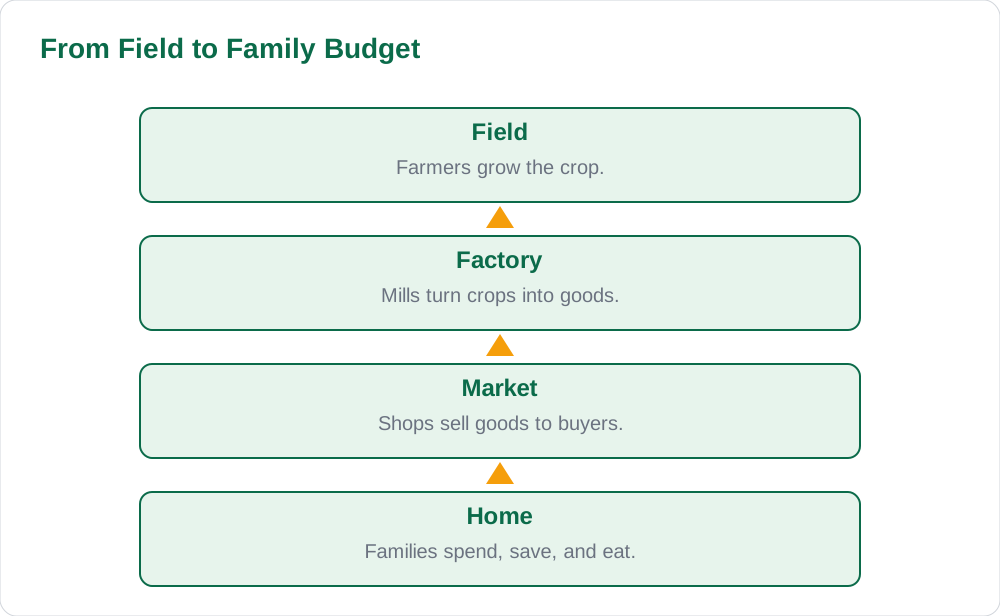
Farming also supplies industry with raw materials: cotton feeds textile mills, sugarcane feeds sugar mills, and milk feeds dairy plants. This field-to-factory-to-market chain is the backbone of the economy. A pupil who can trace one crop from field to finished product already understands how the economy works. Browse the blog listing for more Pakistan Studies guides.
Main Crops and Livestock
Pakistan grows two kinds of crops: food crops and cash crops. Food crops, such as wheat and rice, feed people directly; cash crops, such as cotton and sugarcane, are grown mainly to sell, often to factories. Farmers choose crops by water, soil, season, and market price, and a crop that pays well this year may be replaced next year if prices fall.
Livestock is the other half of farming. Cows, buffaloes, goats, and sheep give milk, meat, wool, and hides, and many small farmers depend on animals for daily income, while poultry farms supply eggs and meat to towns and cities. A milk shop or meat stall is the end of this livestock chain.
- Food crops like wheat and rice feed people directly.
- Cash crops like cotton and sugarcane are grown mainly to sell.
- Livestock gives milk, meat, wool, and daily income.
- Farmers choose crops by water, soil, season, and price.
Water: The Key Input
Water decides how well farming does. Most farms depend on canal water from rivers, on rain, or on tube wells that pump groundwater. When water arrives on time, crops grow well; when it arrives late or runs short, yields fall. This is why water storage, fair canal distribution, and careful use matter so much.
Pupils can see this at home: a family that wastes water wastes the same resource farmers need. Saving water, fixing leaks, and using it wisely are economic acts, not only good habits, and a country that uses water carefully grows more with less.
From Farm to Market: Prices Pupils See
Prices connect field to family. When a harvest is large, supply rises and prices usually fall; when a harvest is small, supply falls and prices rise. Transport costs, storage, and shopkeepers' margins also shape the final price — which is why the same vegetable can cost more in one town than another, or more in winter than in summer.
Try a small observation exercise: note the price of three vegetables in your local market this week, and again next week. Ask a shopkeeper, politely, why a price changed. You will hear about supply, transport, and season — the real language of economics. Visit the solved notes and the books page for more study material.
Jobs Beyond the Farm
The economy is bigger than farming. Factories turn crops into cloth, sugar, and food products; shops, transporters, and banks serve farmers and factories; teachers, doctors, and engineers provide services that keep society running. When farming does well, these other jobs usually do well too, because farm incomes are spent in shops and markets.
For pupils, the lesson is hopeful: education opens doors to many kinds of work, and a farmer's child may become a teacher, a technician, or a business owner. Every job in the chain matters, and understanding the chain shows how your studies connect to the country's future.
- Factories turn farm crops into finished goods.
- Transport, shops, and banks serve farms and factories.
- Services like teaching and health care support everyone.
- Education opens doors to many kinds of work.
AI Help: Muse AI
Muse AI is Meta's personal AI assistant, and it can help you trace one crop from field to market in a short chain you can explain in class. Muse AI does not give official STBB answers — always verify against your STBB book and your teacher. For final wording, always check your Sindh Textbook Board book and ask your teacher.
Join Muse with invite code LTGSWD — in the Muse app, go to Settings > Redeem token and enter the code.
Disclosure: LTGSWD is the author's Muse invite code.
5 key points you must know
- Agriculture feeds people, provides work, and supplies industry.
- Food crops feed families; cash crops are grown mainly to sell.
- Water is the key input that decides how well crops grow.
- Prices rise when supply falls and fall when supply rises.
- Farm, factory, market, and services form one connected economy.
Frequently asked questions
What is the difference between food crops and cash crops?
Food crops like wheat and rice are grown mainly to eat. Cash crops like cotton and sugarcane are grown mainly to sell, often to factories that turn them into goods.
Why do vegetable prices change from week to week?
Prices follow supply, transport costs, storage, and season. A large harvest pushes prices down, while a poor harvest or costly transport pushes them up.
Why is water so important for Pakistan's farming?
Most farms depend on canal water, rain, or tube wells. When water arrives on time, crops grow well; when it runs short, yields fall and prices rise.
How does farming help jobs outside the farm?
Farm incomes are spent in shops and markets, and factories process farm crops. Good harvests therefore support transporters, shopkeepers, mill workers, and service jobs.
Solved notes — preview free
These guides work best with the solved exercises. Preview the solved notes free on this website — 119 solved notes for Classes 6–10 in Sindhi, Urdu, English and Arabic medium. Or browse the full solved notes catalogue for your class and medium. New solved notes are added regularly — check the catalogue for coming-soon books.