Population and Census Concepts for Pakistan Studies
Population and census concepts for Pakistan Studies can be learned without memorising a single figure. What matters is understanding the ideas: what a census is, why countries count people, what makes a population grow, and why cities keep getting bigger. This article explains each concept in plain language, shows how they connect, and explains how pupils should handle numbers in exams — by using only figures their teacher or textbook gives, never guessed ones. You will learn what a census counts, why populations grow, what draws people to cities, and how to answer exam questions on these ideas with confidence.
What Is a Census?
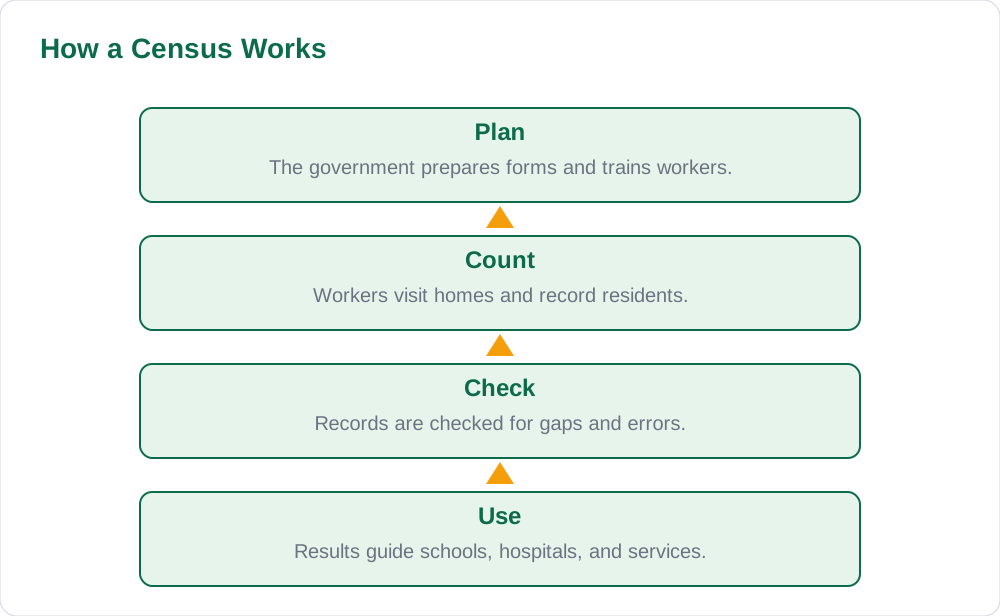
A census is an official count of all the people living in a country at one time. Census workers visit homes and record how many people live there, their ages, and other basic facts. The result is a snapshot of the whole population on one day. Governments use it to plan schools, hospitals, roads, and water supply.
A census is different from a sample survey. A survey asks a small group and guesses about the rest. A census tries to count everyone. That is why it takes so much time, money, and organisation, and why it is held only every several years. Read more concept guides in the blog listing and the solved notes.
Why Do Countries Count People?
Counting people helps a country plan fairly. If a town has many children, it needs more schools. If a district has many elderly people, it needs more health care. If nobody counts, planners must guess, and guesses are often wrong. A census gives planners real information to work with.
Counts also shape representation. Seats in assemblies and shares of funds often depend on how many people live in each area. This is why a fair and honest count matters to every citizen. A missed neighbourhood is a neighbourhood that may get fewer services.
- Planning schools, hospitals, roads, and water needs real counts.
- Representation and funds often follow population size.
- An honest count protects every area's fair share.
- A missed neighbourhood may receive fewer services.
Why Populations Grow
A population grows when more people are born than die, or when more people move in than move out. Two ideas explain this simply. The birth rate is how many babies are born in a year compared to the population. The death rate is how many people die in the same year. When births are higher than deaths, the population grows.
Better health care lowers the death rate, because fewer babies and adults die from illness. At the same time, if families continue to have many children, the population grows quickly. When education and health services spread, family sizes often become smaller over time, and growth slows. Pupils should learn this chain of causes, not a list of numbers.
Urbanisation: Why Cities Grow
Urbanisation means a growing share of people living in towns and cities rather than villages. People move to cities for jobs, schools, hospitals, and services. Factories, markets, and offices cluster in cities, and each new job attracts more families. This is called rural-to-urban migration.
Cities offer opportunity, but they also face pressure. Housing, water, transport, and waste grow into big problems when a city expands fast. A pupil who understands urbanisation can explain both sides: why people move, and what problems the move creates. Visit the books page and the about page for study support.
How to Answer Census Questions in Exams
Exam questions on this topic usually test concepts, not figures. A question may ask: what is a census, why is it held, or what causes urbanisation? Answer with a definition, one cause, and one effect, each in your own words. If a question does give figures, use only those figures and show your working step by step.
Never invent a population figure. If you do not remember an exact number, say what the concept means instead of guessing. Examiners reward clear thinking far more than a made-up number, and a guessed figure can cost marks. Practise by explaining each concept aloud to a friend without looking at the book.
- Answer with definition, cause, and effect in your own words.
- Use only figures the question or textbook provides.
- Never invent a population figure — explain the concept instead.
- Practise explaining each idea aloud without the book.
AI Help: Muse AI
Muse AI is Meta's personal AI assistant, and it can help you practise census concepts by quizzing you on definitions like birth rate, death rate, and urbanisation. Muse AI does not give official STBB answers — always verify against your STBB book and your teacher. For final wording, always check your Sindh Textbook Board book and ask your teacher.
Join Muse with invite code LTGSWD — in the Muse app, go to Settings > Redeem token and enter the code.
Disclosure: LTGSWD is the author's Muse invite code.
5 key points you must know
- A census is an official count of everyone in a country at one time.
- Counts help governments plan schools, hospitals, and services fairly.
- Population grows when births exceed deaths or more people move in.
- Urbanisation is the growing share of people living in cities.
- Never invent population figures in exams — explain concepts instead.
Frequently asked questions
What is the difference between a census and a survey?
A census tries to count everyone in the country. A survey asks a small group and uses their answers to estimate the whole population.
Why does a population grow?
It grows when more people are born than die, or when more people move in than move out. Better health care lowers deaths, which can speed up growth.
What is urbanisation?
It is the process by which a growing share of people live in towns and cities, often because they move from villages seeking jobs, schools, and services.
What should I do if I forget a population figure in an exam?
Do not guess. Explain the concept clearly in your own words and use only figures the question itself provides.
Solved notes — preview free
These guides work best with the solved exercises. Preview the solved notes free on this website — 119 solved notes for Classes 6–10 in Sindhi, Urdu, English and Arabic medium. Or browse the full solved notes catalogue for your class and medium. New solved notes are added regularly — check the catalogue for coming-soon books.