Balancing Screen Time and Study at Home
Screens are now part of every child's life, bringing learning videos, games, and chats with friends, but also endless distraction from homework. Many families swing between total bans that cause daily arguments and total freedom that leaves homework unfinished. Balancing screen time and study at home works better as an agreement than as a battle, with clear rules everyone understands. This article shows how to build a family screen-time agreement, apply study-first rules fairly, and use shared charging spots to protect sleep and focus. The goal is not to remove screens, which children need for learning and fun, but to put them in their proper place: after study, within limits, and never at the cost of sleep or schoolwork.
Start with a Family Agreement, Not a Ban
Rules imposed without discussion are broken in secret, while rules agreed together are far more likely to be followed, so build your screen plan as a family agreement. Sit together and talk honestly about what screens are used for, which uses help learning, and where screens currently cause problems, such as late nights or unfinished homework. Write down the agreement in simple language, covering study time, free screen time, and screen-free times such as meals and bedtime, and display it where everyone can see it. When children help set the limits, they understand the reasons behind them and feel respected rather than controlled.
Keep the agreement realistic and positive, focusing on what screens are for rather than only what is forbidden. Allow generous free time after responsibilities are done, so the agreement feels fair, and include adults in the rules too, such as no phones at dinner, because children copy what they see far more than what they are told. Review the agreement together after a few weeks, adjusting times that prove unworkable, so it stays a living plan rather than a forgotten poster. A family agreement turns screen time from a daily argument into a shared routine. The solved notes can help children see homework as the first priority each evening.
Study First: A Simple Rule That Ends Arguments
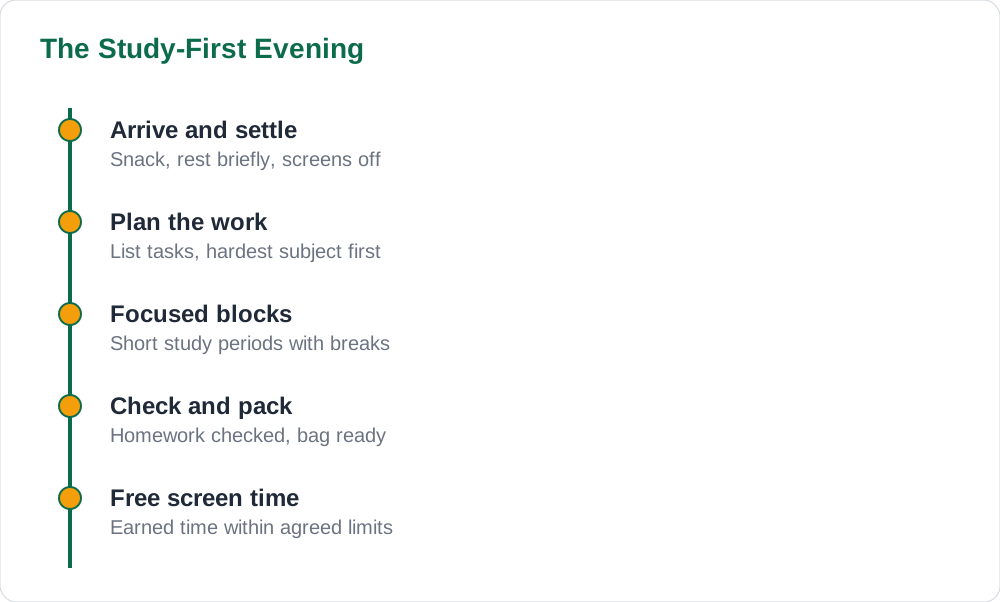
The study-first rule is the simplest screen rule a family can adopt: homework and revision come before entertainment screens, every school day, without exception. Make the rule visible and automatic, so there is no daily negotiation about whether homework can wait until after a game. Help your child plan the order of work, starting with the hardest subject while energy is high, and break study into short focused blocks with brief breaks, so the work feels achievable. When homework is finished and checked, free screen time becomes a reward the child has earned, which feels much better than screen time stolen from unfinished work.
Support the rule with a suitable study space, free from televisions and notifications, where the child can work without constant temptation. If a device is needed for study, such as an online lesson or research, keep that use separate from entertainment by agreeing which apps are for study and for how long. Praise the child for starting homework promptly, not only for finishing it, because starting is the hardest step for most children. Over time, study-first becomes a habit rather than a rule, and children begin to organise their own evenings without reminders. Browse the book collection for study material to plan each evening's work.
Shared Charging Spots Protect Sleep and Focus
One of the most effective screen habits costs nothing: charge all devices in a shared spot outside bedrooms overnight. Phones and tablets in bedrooms invite late-night messages, videos, and games that steal sleep, and tired children cannot learn well the next day. A shared charging station in a living area, where every family member plugs in devices at an agreed bedtime, removes temptation without nightly arguments. Children sleep better, wake fresher, and arrive at school ready to learn, which is worth more than any extra hour of screen time.
Shared charging also protects family time and focus during the day, because devices left in the charging spot cannot interrupt meals, homework, or conversation. Set a simple routine, such as devices docked one hour before bed, with a book or quiet activity replacing the screen, and keep the rule consistent even on weekends, with only small adjustments. If your child needs a device as an alarm, use a simple alarm clock instead, so the excuse for a bedroom phone disappears. This one change often improves sleep, mood, and homework more than any complicated screen-tracking system. More family study ideas appear on the blog.
Make Screen Time Active and Worthwhile
Not all screen time is equal, so help your child choose screen activities that are active, creative, or educational rather than endless passive scrolling. Educational videos, coding games, drawing apps, and documentaries can support learning, while long stretches of short videos and repetitive games mainly consume time. Watch or play together sometimes, asking what your child enjoys and why, so you understand their digital world instead of fearing it. Set limits by activity as well as by time, such as one game session rather than unlimited play, and encourage offline hobbies that compete with screens, like sport, reading, or drawing.
Teach your child to notice how different screen use makes them feel, because a child who recognises that endless scrolling leaves them tired and bored can learn to stop on their own. Talk about online safety in the same calm way, covering kind behaviour, privacy, and what to do if something online feels wrong, without spying or shaming. Model balanced use yourself, by putting your own phone away during family time and study support, since children learn screen habits by watching adults. A balanced approach treats screens as tools for learning and fun, used with purpose and limits. The [home page](/) links to resources for families managing study at home.
When Rules Break: Stay Calm and Restart
Even the best agreement will be broken sometimes, because children test limits and habits take time to form, so plan a calm response in advance. Agree a fair, known consequence, such as losing the next free screen session, and apply it without anger or long lectures, which only turn a small slip into a big fight. Talk briefly about what happened and how to avoid it tomorrow, then restart the routine the next day without holding a grudge. Consistency matters more than severity: a small consequence applied every time teaches far more than a huge punishment applied once and forgotten.
If screen use is seriously harming sleep, schoolwork, or mood over weeks, look for the underlying cause rather than only tightening rules. A child who escapes into screens may be struggling with schoolwork, friendships, or anxiety, and needs support and conversation, not just restriction. Speak to the teacher if homework or attention at school is suffering, and consider professional advice if the pattern is severe. Most families find that a clear agreement, study-first rules, and shared charging spots solve most screen battles, leaving screens as a normal, enjoyable part of a balanced family life. For questions, visit the contact page.
AI Help: Muse AI
Muse AI is Meta's personal AI assistant, and it can help families draft a screen-time agreement, plan a study-first evening schedule, or suggest educational screen activities for a child's age. Ask it for a sample weekly screen plan, then adjust the times together as a family.
Join Muse with invite code LTGSWD — in the Muse app, go to Settings > Redeem token and enter the code.
Disclosure: LTGSWD is the author's Muse invite code.
Muse AI does not give official STBB answers — always verify against your Sindh Textbook Board book and your teacher.
5 key points you must know
- Build a written family agreement together instead of imposing a ban.
- Apply study-first: homework and revision before entertainment screens.
- Charge all devices in a shared spot outside bedrooms overnight.
- Favour active, educational screen use and balance it with offline hobbies.
- Respond to broken rules calmly, consistently, and with a fresh restart.
Frequently asked questions
How much screen time is reasonable for a schoolchild?
There is no single perfect number, so agree a family limit that protects homework, sleep, and outdoor time. Focus on what screens replace: if homework, sleep, and play are protected, the remaining free time is reasonable.
Should children use screens for homework?
Yes, when the device is used for a clear study purpose, such as a lesson or research, for an agreed time. Keep study apps separate from entertainment apps so homework does not drift into games.
What if my child refuses to hand over the device at bedtime?
Stay calm and consistent, and make the shared charging spot part of the nightly routine for everyone, including adults. A rule applied kindly every night soon becomes a habit.
Are bans on screens a good idea?
Total bans usually cause arguments and secret use, and they remove learning benefits too. An agreed limit with study-first rules teaches self-control, which lasts far longer than a ban.
Solved notes — preview free
These guides work best with the solved exercises. Preview the solved notes free on this website — 119 solved notes for Classes 6–10 in Sindhi, Urdu, English and Arabic medium. Or browse the full solved notes catalogue for your class and medium. New solved notes are added regularly — check the catalogue for coming-soon books.