How Colleges Use Your Part-I Marks for Part-II Admission

When Part-I results arrive, most students read them as a verdict on the past year, but colleges read them as a guide to the next one. Your Part-I marks shape the conversations you will have about Part-II subject choices, about which streams remain open to you, and about how much support you may need in the year ahead, and understanding that reading helps you walk into those conversations prepared rather than anxious. This guide explains, in general terms, how colleges use Part-I performance when they talk to students about Part-II admission, set against the October 2026 context in which BIEK's Pre-Engineering Part-I result is out since 2 October while other Part-I groups remain pending. It names no merit percentages, cut-offs or college policies, because those vary by college and must be confirmed with your own college, and it focuses instead on the habits and questions that help every student, whatever their marks.
Why Part-I Marks Matter Beyond the Result Card
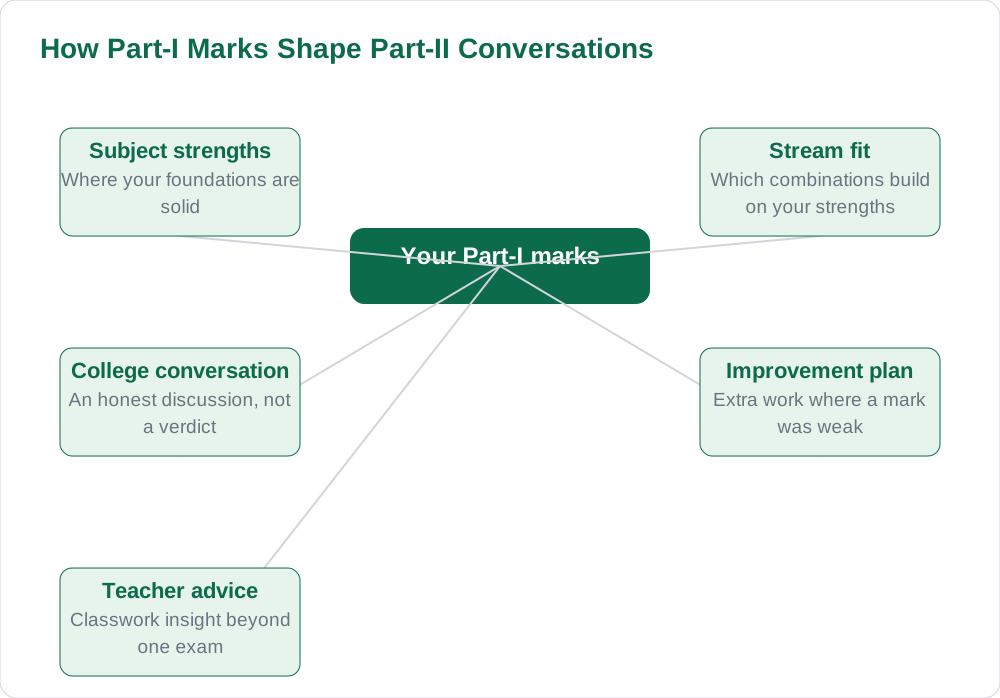
Part-I marks matter for Part-II because Part-II builds directly on Part-I, and colleges know that a student's Part-I record is the best available evidence of how they will handle the harder year ahead. A student with strong Part-I marks in a subject has shown they can handle its concepts, its workload and its examination style, which makes them a safer bet for the advanced version of the same subject. A student with weak Part-I marks in a subject has shown, at minimum, that the subject needs more work, and colleges will want to discuss whether that work is realistic alongside everything else Part-II demands. Neither reading is a judgement of worth; both are practical judgements about readiness, and students who understand that framing can discuss their marks without defensiveness.
Marks also matter because Part-II admission conversations happen quickly and often informally, in a teacher's office or a college corridor, rather than through a single formal announcement. A student who arrives with their marks organised, their strengths and weaknesses honestly assessed, and a clear idea of what they want to study will shape that conversation far better than a student who arrives with only a result slip and anxiety. Preparation for the conversation is therefore part of preparation for Part-II itself, and it costs nothing but an hour of honest reflection. Write down your marks subject by subject, mark the subjects you enjoyed and the subjects you struggled with, and note any subject where your mark surprised you in either direction, because those surprises are exactly what a good college conversation explores.
Subject Choices: Where Part-I Marks Speak Loudest
The loudest voice Part-I marks have is in subject choice, because Part-II subjects are not chosen freely but in streams and combinations that presume certain foundations. A student who excelled in Biology and Chemistry will find the medical stream conversation straightforward, while a student who struggled in Mathematics will face a serious discussion before continuing with a mathematics-heavy combination. That discussion is not a punishment; it is the college protecting the student from a year of struggle in a subject whose foundations are shaky, and students who hear it that way make better decisions than students who hear it as rejection. The honest question to ask yourself is not which subjects sound impressive, but which subjects you can actually build on for another year.
Use your Part-I marks as a map of your foundations, not as a cage. A weak mark in a subject you love is a reason to plan extra work, not necessarily a reason to abandon the subject, provided you are honest about the effort that extra work requires. A strong mark in a subject you dislike is a reason to think carefully, because a year of studying something you dislike, even successfully, is a heavy cost. Talk to the teachers of the subjects in question, because they have seen your classwork as well as your examination marks, and their view of your readiness is often more complete than any single result. Bring your marks, your questions and your willingness to listen, and let the conversation, not the mark alone, decide the choice. For general guidance on reading results, see reading a marksheet.
The College Admission Conversation
Admission conversations for Part-II vary widely between colleges, and this guide deliberately describes them in general terms, because no single description fits every college's policy. Some colleges admit their own Part-I students into Part-II almost automatically, using marks mainly to guide subject choices and support. Others apply stricter internal criteria, particularly for popular streams, and use Part-I marks as one factor among several, alongside attendance, classwork and teacher recommendations. Still others treat Part-II admission as a fresh application, with its own forms and timelines. Because the range is so wide, the only reliable statement about your college's process is the one your college itself gives you, and asking early is always better than assuming.
Prepare for the conversation by preparing questions, not just answers. Ask which subjects your marks qualify you to continue, and what support exists if you want to continue a subject where your mark was weak. Ask about timelines, forms and any documents you need to bring, so that a missed paper does not delay your admission. Ask whether your college offers a probationary or conditional route for students on the borderline of a stream, and what conditions such a route carries. Write the answers down, because admission conversations are easily misremembered under stress, and a written record lets you compare what was said with what later happens. A student who asks clear questions signals seriousness, and colleges notice seriousness.
When Part-I Marks Disappoint
Disappointing Part-I marks hurt, and the first thing to say is that the hurt is legitimate and shared by thousands of students every year, including students who later do very well in Part-II. A weak Part-I result is information, not identity: it tells you where your preparation, your understanding or your examination technique fell short, and each of those causes has a remedy. Preparation gaps are fixed by steady study; understanding gaps are fixed by rebuilding concepts from the textbook with a teacher's help; examination technique gaps are fixed by practising timed answers and learning to read questions carefully. The remedy differs by cause, which is why the most useful response to a disappointing mark is diagnosis, not despair, and why a teacher's help in diagnosing it is worth seeking promptly.
It is also worth remembering, in the October 2026 context, that not every Part-I student even has a result yet: Pre-Engineering Part-I is out since 2 October, but other BIEK Part-I groups remain pending, so some of your classmates are still waiting while you plan. If your result disappointed you, do not let it also isolate you; talk to classmates, teachers and family, and treat the disappointment as a shared, solvable problem rather than a private shame. Students who recover best are usually those who act fastest: they identify the weak subjects within days, arrange support within a week, and start the rebuilding work while the disappointment is still fresh enough to motivate them. Time softens disappointment, but only action converts it into improvement, and the sooner action starts, the more of Part-II it can influence.
Questions to Ask Your College — and Yourself
End your preparation with two lists of questions: one for your college, and one for yourself. For your college, ask how Part-I marks affect Part-II admission in your institution, which subject combinations your marks support, what the admission timeline and documents are, and what help exists for students who want to strengthen a weak subject. For yourself, ask which subjects you genuinely want to study for another year, which weak subjects you are willing to work hard to rebuild, and what kind of support you need to succeed, whether that means tutoring, study groups, or simply a better daily routine. The college's answers tell you what is possible; your answers tell you what is desirable, and a good Part-II choice sits where the two overlap.
Take both lists to your college conversation, and take notes during it, because the combination of a prepared student and a clear college process produces decisions that survive the pressure of results season. If the conversation goes badly, or if you feel pushed toward a choice you do not want, seek a second conversation with another teacher or a senior staff member, because one rushed discussion should not decide a year of your education. And if your result is still pending, use the waiting time to prepare both lists now, so that when your result arrives, you are ready to act within days rather than weeks. Part-I marks open the Part-II conversation, but they do not close it; the student who arrives prepared, honest and curious will always have more room to move than the mark alone suggests. For next-step planning after any result, see after a result: college admission next steps and the solved notes.
AI Help: Muse AI
Muse AI is Meta's personal AI assistant, and it can help you prepare for important conversations by helping you organise your thoughts and draft your questions in advance.
For this article's topic, you can ask Muse AI to help you draft the questions you want to ask your college about Part-II admission, or to practise explaining your subject choices clearly.
Join Muse with invite code LTGSWD — in the Muse app, go to Settings > Redeem token and enter the code.
Disclosure: LTGSWD is the author's Muse invite code.
Muse AI does not give official STBB answers — always verify against your Sindh Textbook Board book and your teacher.
5 key points you must know
- Colleges read Part-I marks as evidence of readiness for Part-II, not as a judgement of worth.
- Part-I marks speak loudest in subject and stream choices for Part-II.
- Admission processes vary by college, so confirm your own college's criteria directly.
- A weak Part-I mark is information to diagnose, not an identity to accept.
- Prepare two question lists: one for your college, and one for yourself.
Frequently asked questions
Do Part-I marks decide my Part-II admission?
They influence it, especially subject and stream choices, but processes vary by college. Some colleges admit their own students largely automatically, while others apply stricter criteria. Confirm your own college's process directly.
Can I continue a subject where my Part-I mark was weak?
Often yes, with extra work and support, but it depends on your college and the subject. Discuss it with the subject teacher, who knows your classwork as well as your examination mark.
Should I choose subjects based only on my marks?
No. Marks show readiness, but your interest matters too, because a year of studying a disliked subject is a heavy cost. Choose where strong marks and genuine interest overlap.
What should I ask my college about Part-II admission?
Ask how Part-I marks affect admission, which combinations your marks support, what the timeline and documents are, and what support exists for strengthening a weak subject.
My Part-I result is still pending. How do I prepare?
Prepare your question lists now and keep strengthening your Part-I foundations, so that when your result arrives you can act within days. BIEK Pre-Engineering Part-I is out since 2 October 2026, while other Part-I groups remain pending.
Solved notes — preview free
These guides work best with the solved exercises. Preview the solved notes free on this website — 119 solved notes for Classes 6–10 in Sindhi, Urdu, English and Arabic medium. Or browse the full solved notes catalogue for your class and medium. New solved notes are added regularly — check the catalogue for coming-soon books.