Heat vs Temperature and How Heat Travels
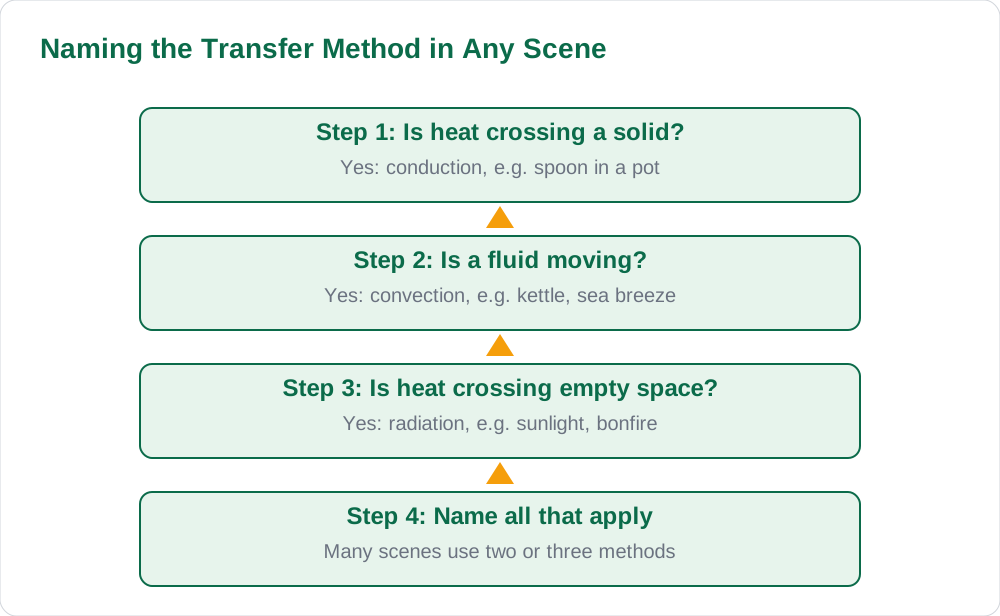
A spark from a match is hotter than a bath full of warm water, yet the bath holds far more heat. That single comparison separates the two ideas that pupils mix up most in thermal physics: temperature and heat. Temperature measures how hot something is, the average energy of its particles. Heat is the energy that transfers from a hotter object to a colder one. The spark has a higher temperature, but the bath has far more particles, so it holds far more total energy. This article separates heat from temperature, then follows heat on its three journeys: conduction through solids, convection through fluids, and radiation through empty space. You will see each one in a kettle, a heated room, and sunlight, and you will learn why a metal spoon feels colder than a wooden one at the same temperature. By the end you will be able to name the transfer method in any everyday scene, and to explain why a thermos flask keeps drinks hot or cold for hours. Everyday thermal examples also appear in [states of matter and changes](/blog/science-matter-states-changes.html). More class material is on the [books page](/books.html) and the [blog index](/blog/).
Temperature: How Hot, Not How Much
Temperature is a measure of the average kinetic energy of the particles in a substance. When particles move faster on average, the temperature is higher. Temperature is measured with a thermometer in degrees Celsius (C) in school work, or in kelvin (K) in advanced work. Two objects can have the same temperature but very different amounts of energy: a cup of tea and a whole kettle of tea at the same temperature hold very different total energies, because the kettle has far more particles.
The match and the bath show why this matters. The spark is at a very high temperature, but it has so few particles that it holds little total energy, and it cannot warm your hands for long. The bath is at a lower temperature, but with its huge number of particles it holds a great deal of energy, enough to warm you for many minutes. When a question asks which object has more heat energy, look at mass and temperature together: more mass at the same temperature means more energy. When it asks which is hotter, look at temperature alone.
Heat: Energy on the Move
Heat is the transfer of thermal energy from a hotter object to a colder one. It is energy in transit, measured in joules, and it always flows from hot to cold, never the other way on its own. When you hold a warm cup, heat flows from the cup into your hands. When you put ice in a drink, heat flows from the drink into the ice, which is why the drink cools: the cold does not flow in; the heat flows out. Heat stops flowing when the two objects reach the same temperature, a state called thermal equilibrium.
Because heat is energy moving, you should not say that an object contains heat. An object contains thermal energy, and heat is the name for that energy while it is moving between objects. This is more than wordplay: it is the distinction examiners test. A hot object has more thermal energy, and when it is placed next to a cold one, heat flows from it to the cold one until both reach the same temperature. The same idea explains why a metal railing feels colder than a wooden bench on a winter morning, even though both are at the same temperature, as the next section shows.
Conduction: Heat Through Solids
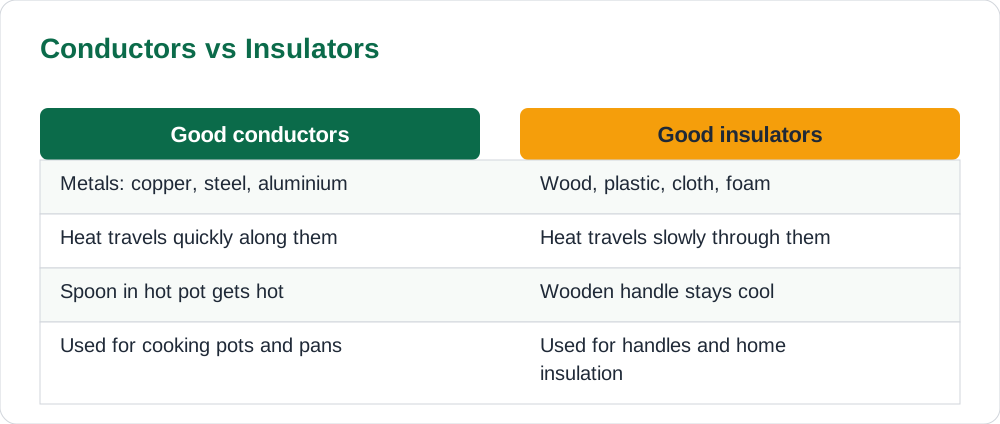
Conduction is the transfer of heat through a solid, or between solids in contact, without the material itself moving. When one end of a metal rod is heated, its particles vibrate faster and pass the vibration to their neighbours, so the heat travels along the rod. Metals are good conductors: a steel spoon in a hot pot soon becomes hot along its whole length. Wood, plastic, and cloth are poor conductors, called insulators: a wooden spoon handle stays cool enough to hold, which is why cooking utensils have wooden or plastic handles.
That explains the cold railing. The metal railing and the wooden bench are at the same temperature on a winter morning, but the metal conducts heat away from your hand much faster, so your hand cools quickly and the metal feels colder. The wood conducts slowly, so your hand stays warm and the bench feels less cold. Your skin senses the rate of heat flow, not the temperature itself. The same idea explains why a tiled floor feels cold under bare feet while a carpet at the same temperature feels warm. In buildings, insulation works by slowing conduction: a layer of foam or fibreglass in a wall keeps heat from escaping in winter and from entering in summer.
Convection: Heat Through Fluids
Convection is the transfer of heat by the movement of a fluid, a liquid or a gas. When a fluid is heated, it expands, becomes less dense, and rises. Cooler, denser fluid sinks to take its place. This circulation is called a convection current. In a kettle, the water at the bottom is heated first, rises, and is replaced by cooler water sinking from the top, so the whole kettle is heated by a steady circulation.
A heated room works the same way. A heater warms the air near it, the warm air rises to the ceiling, cooler air sinks to the floor, and a slow circulation spreads the warmth. That is why heaters are placed low, near the floor: the rising warm air heats the whole room. If the heater were at the ceiling, the warm air would stay at the top and the floor would stay cold. Sea breezes are convection on a grand scale: during the day the land heats faster than the sea, air over the land rises, and cooler air from the sea flows in to replace it. At night the pattern reverses, giving a land breeze. When you see smoke rising and curling in a room, you are watching convection currents in the air.
Radiation: Heat Through Empty Space
Radiation is the transfer of heat by waves, and it needs no material at all. The Sun's heat reaches us through the vacuum of space by radiation, in the form of infrared waves and visible light. Stand in sunlight and your skin warms even though the air around you is cool: the radiation travels straight from the Sun to you. A bonfire warms your face the same way, even from a distance, and a room heater with glowing bars warms you by radiation before the air has time to heat up.
Colour and surface matter for radiation. Dark, dull surfaces absorb radiation well and warm up quickly; light, shiny surfaces reflect it and stay cooler. That is why a black shirt feels hotter in the sun than a white one, and why a shiny kettle loses less heat by radiation than a dull black one. A thermos flask uses all three ideas at once: a vacuum between its double walls stops conduction and convection, because there is no material to carry heat, and a shiny inner surface reflects radiation. That is why a thermos keeps a hot drink hot and a cold drink cold for hours. When a question asks how heat reaches you across empty space, the answer is always radiation.
AI Help: Muse AI
Muse AI is Meta's personal AI assistant, and it can help with this topic by naming the heat transfer method in any everyday scene you describe, from a kettle to a thermos flask. You can ask it to explain why a metal railing feels colder than a wooden bench at the same temperature, in your own words. Muse AI does not give official Sindh Textbook Board answers — always verify against your Sindh Textbook Board book and your teacher.
Join Muse with invite code LTGSWD — in the Muse app, go to Settings > Redeem token and enter the code.
Disclosure: LTGSWD is the author's Muse invite code.
5 key points you must know
- Temperature measures the average energy of particles; heat is energy flowing from hot to cold.
- A spark is hotter than a bath, but the bath holds far more total heat energy.
- Conduction transfers heat through solids without the material moving; metals conduct, wood insulates.
- Convection transfers heat by moving fluids; warm fluid rises, cool fluid sinks.
- Radiation transfers heat by waves through empty space; dark surfaces absorb it, shiny surfaces reflect it.
Frequently asked questions
What is the difference between heat and temperature?
Temperature measures how hot something is, the average kinetic energy of its particles. Heat is the energy that flows from a hotter object to a colder one. A spark has a high temperature but little total energy; a bath has a lower temperature but far more energy because it has far more particles.
Why does a metal spoon feel colder than a wooden spoon at the same temperature?
Because metal conducts heat away from your hand much faster than wood does. Your skin senses the rate of heat flow, not the temperature itself. Both spoons are at the same temperature, but the metal one cools your hand faster, so it feels colder.
Why are heaters placed near the floor?
Because of convection. A heater warms the air near it, the warm air rises, and cooler air sinks to replace it, spreading warmth through the room. A heater at the ceiling would leave warm air at the top and cold air at the floor.
How does heat from the Sun reach us through space?
By radiation. The Sun's energy travels as waves through the vacuum of space, which has no material to carry conduction or convection. Radiation needs no medium, so it works across empty space.
How does a thermos flask keep drinks hot or cold?
Its double walls have a vacuum between them, which stops conduction and convection because there is no material to carry heat. The shiny inner surfaces reflect radiation. With all three transfer methods blocked, the drink keeps its temperature for hours.
Solved notes — preview free
These guides work best with the solved exercises. Preview the solved notes free on this website — 119 solved notes for Classes 6–10 in Sindhi, Urdu, English and Arabic medium. Or browse the full solved notes catalogue for your class and medium. New solved notes are added regularly — check the catalogue for coming-soon books.