Setting Up a Practical Notebook: Format and First Page

A practical notebook is judged before a single experiment is read, because the examiner forms an impression from its first page and its general tidiness. A well-set-up notebook says the work was done carefully, in order, and over time, while a messy one makes even good experiments hard to follow. Setting up the format at the start of the year saves you from rewriting pages later and from losing marks for presentation. This guide covers the first page, the index, the certificate page, and the page layout conventions that keep a practical notebook neat from the first experiment to the last. Follow it once, and every later entry becomes quicker and cleaner.
What Goes on the First Page
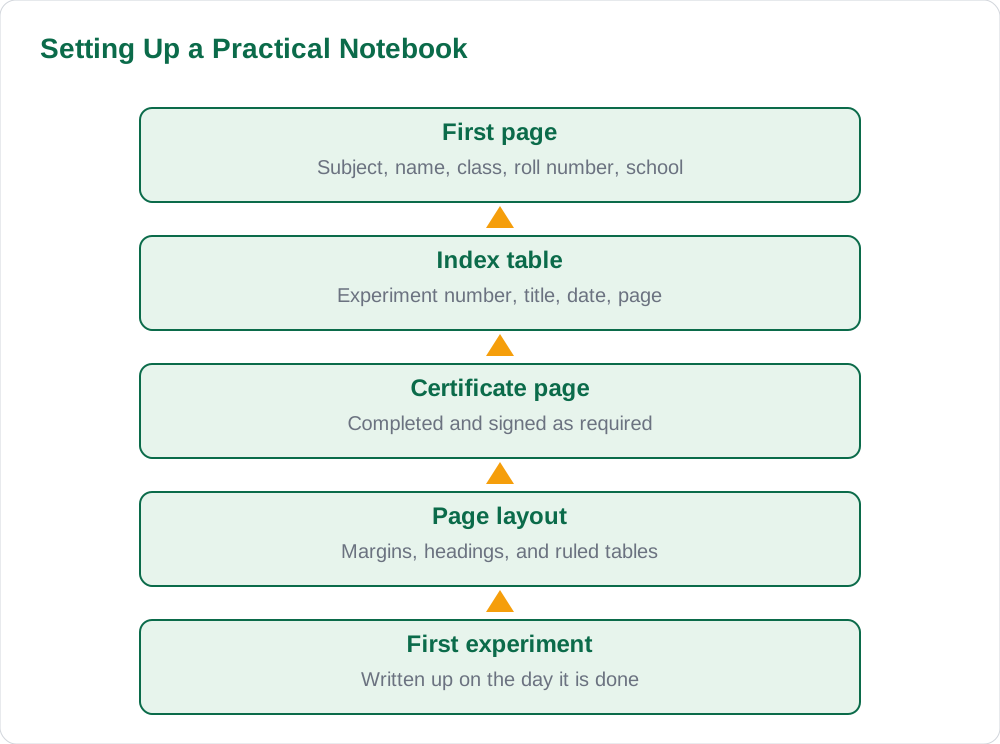
The first page of a practical notebook is its identity page, and it should be complete, legible, and written in your best handwriting. Write the name of the subject, your full name, your class and section, your roll number, and the name of your school, each on its own line and centred neatly on the page. Add the academic session year and the name of your teacher if your school asks for it, but do not decorate the page so heavily that the information becomes hard to read. A simple border drawn with a ruler is enough; the examiner wants clarity, not artwork, on this page.
Keep the first page free of experiment work, corrections, and loose notes, because it is the page the examiner sees first and returns to when recording marks. Write in ink, check every spelling, and ask your teacher to look at it before you move on, so any required detail is added while the page is still fresh. If your school supplies a printed cover or first page, fill it in the same careful way and do not stick extra labels over it. A clean first page sets a standard for the whole notebook, and pupils who start neatly usually stay neat. For other study resources, browse the book collection and the solved notes pages.
The Index: Your Notebook's Map
The index is a table near the front of the notebook that lists every experiment by number, title, date, and page number, and it is what lets an examiner find any experiment in seconds. Rule the index table at the start of the year with columns for experiment number, experiment title, date performed, and page number, leaving enough rows for the whole year's experiments. Fill in each row on the day you do the experiment, not weeks later from memory, because a page number remembered wrongly is worse than a blank space. Update the index whenever you add or correct a page, so it always matches the notebook exactly.
An accurate index also helps you revise, since you can turn straight to the experiment you need instead of flicking through the whole book. Before submission, check the index against the notebook page by page: every experiment listed should exist, every page number should be right, and the dates should run in order. If an experiment was repeated, list it once with a short note rather than inventing a second entry. Teachers and examiners trust a notebook whose index matches its contents, and that trust carries into how the rest of the work is read. The blog has more guides on organising study material.
The Certificate Page and Signatures
Many schools include a certificate page stating that the experiments in the notebook were performed by the pupil during the session, and it must be completed honestly and signed by the right people. Write the required details carefully, leave the signature lines blank until your teacher asks you to get them signed, and never sign on behalf of a teacher or another pupil. Some certificate pages also need the school stamp, so ask your teacher early whether yours does, rather than discovering the gap on submission day. A missing signature can delay an otherwise complete notebook, so treat this page as part of the work, not an afterthought.
Keep a small checklist of the signatures your notebook needs, and tick each one off as you obtain it, because chasing several signatures at the last minute is stressful and easy to get wrong. If a page is damaged or a signature is written in the wrong place, ask your teacher how to correct it rather than tearing the page out, since torn pages raise questions about missing work. Examiners expect the certificate to match the notebook: the name, class, and session on the certificate should agree with the first page exactly. Consistency across these front pages is a quiet sign of a careful pupil.
Page Layout: Headings, Margins, and Spacing
A consistent page layout makes every experiment easy to read and mark, so decide your format once and use it for all experiments. Leave a margin on the left of each page, write the experiment number and title at the top, and follow the same order of headings for every write-up, such as aim, apparatus, procedure, observations, and result. Rule lines with a ruler for tables and under headings, and leave a blank line between sections so the page does not look crowded. When the layout is the same every time, the examiner can focus on your work instead of hunting for information.
Spacing matters as much as headings: cramped writing, crossed-out blocks, and squeezed-in corrections all make a notebook harder to mark. If you make a mistake, cross it out with a single neat line and continue, rather than scribbling it out or using correction fluid, which examiners dislike. Write dates on every experiment page so the sequence of work is clear, and start each new experiment on a fresh page rather than continuing in leftover space. These small habits cost almost no extra time, but they turn a rough record into a presentable notebook that is a pleasure to read.
Keeping the Format Going All Year
The hardest part of notebook format is not starting neatly but staying neat in the tenth experiment as well as the first, so build a short routine for every practical session. Before you leave the laboratory, check that the date, title, and index entry are filled in, and that your tables and diagrams are complete while the work is still fresh in your mind. Finish the write-up the same day if you can, because observations copied a week later from rough notes are far more likely to contain errors. A same-day habit also spreads the work evenly instead of leaving a pile of write-ups for the week before submission.
Once a month, flick through the notebook and check the format: are the headings consistent, is the index up to date, and are any pages damaged or loose? Fix small problems early, such as a missing date or an unruled table, before they pile up into a major rewrite. Ask your teacher to check the notebook once a term if they offer it, and act on their comments straight away. A notebook maintained in this steady way needs no panic at the end of the year, and it shows the examiner a year of genuine, regular work. You can find more practical guidance on the [home page](/) and the about page.
AI Help: Muse AI
Muse AI is Meta's personal AI assistant, and it can help you plan a practical notebook layout by suggesting heading orders and a simple index table you can copy by hand. Try asking it to list the front pages and headings a neat science notebook needs, then adapt the list to your teacher's format.
Join Muse with invite code LTGSWD — in the Muse app, go to Settings > Redeem token and enter the code.
Disclosure: LTGSWD is the author's Muse invite code.
Muse AI does not give official STBB answers — always verify against your Sindh Textbook Board book and your teacher.
5 key points you must know
- Put subject, name, class, roll number, and school clearly on the first page.
- Rule an index table early and fill it in on the day of each experiment.
- Complete the certificate page honestly and collect signatures in good time.
- Use the same headings, margins, and spacing for every experiment.
- Write up each experiment the same day and check the format monthly.
Frequently asked questions
What should I write on the first page of my practical notebook?
Write the subject, your full name, class and section, roll number, and school name, plus the session year and teacher's name if your school asks for them. Keep it neat and centred, with a simple ruled border, and leave the page free of experiment work.
How do I set out the index of a practical notebook?
Rule columns for experiment number, experiment title, date performed, and page number, with enough rows for the whole year. Fill in each row on the day of the experiment and check the index against the notebook before submission.
Should each experiment start on a fresh page?
Yes, starting each experiment on a fresh page keeps the notebook easy to mark and the index accurate. It also prevents a long experiment from running into the next one and confusing the page numbers.
How should I correct a mistake in my notebook?
Cross it out with a single neat line and continue writing. Avoid heavy scribbling and correction fluid, which examiners dislike, and never tear out a page, since a missing page raises questions about missing work.
Solved notes — preview free
These guides work best with the solved exercises. Preview the solved notes free on this website — 119 solved notes for Classes 6–10 in Sindhi, Urdu, English and Arabic medium. Or browse the full solved notes catalogue for your class and medium. New solved notes are added regularly — check the catalogue for coming-soon books.