Rechecking, Scrutiny or Supplementary: Which Option Fits Your Result?
After the Punjab HSSC Part-I result on 22 October 2026, many students face the same confusing question: should I apply for rechecking, ask for scrutiny, or prepare for the supplementary examination? These three options sound similar, but they solve completely different problems, and choosing the wrong one wastes money, wastes time, or both. Rechecking checks whether your paper was totalled correctly and whether any answer went unmarked; it does not re-mark your answers. Scrutiny is a separate Sindh-board process with its own fee and rules, and it is not the same as Punjab rechecking. The supplementary examination, formally called the Second Annual Examination, is a fresh chance to sit the paper, beginning on 3 November 2026. This guide compares the three options side by side so you can match your situation to the right one, and it explains the deadlines and fees you need to know before you decide.
Three Different Tools for Three Different Problems
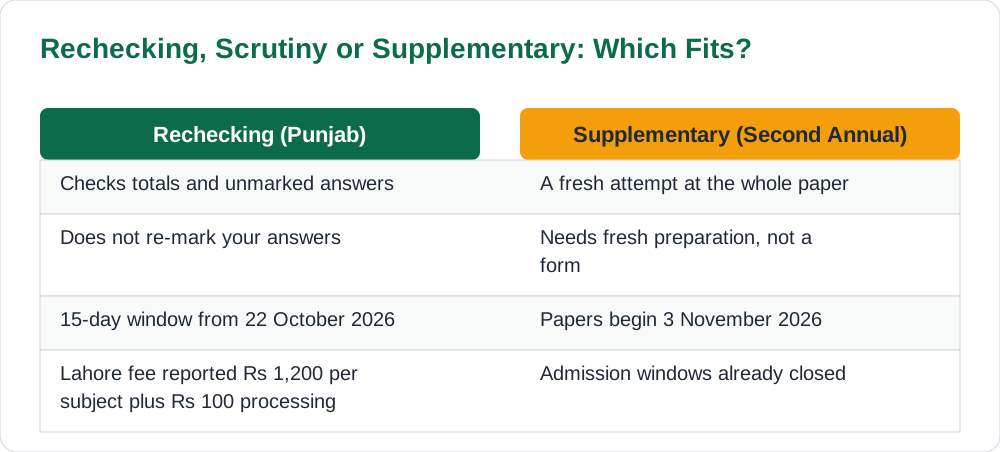
Think of the three options as three different tools, each designed for one job. Rechecking fits the student who believes a mistake happened in the handling of their paper: a total added wrongly, an answer left unmarked, or marks not transferred correctly to the result. It is a checking exercise, not a second opinion on the quality of your answers, and it suits students whose paper felt strong but whose result looks strangely low. The supplementary examination fits the student who knows the paper itself went badly, because it offers a completely fresh attempt at the same paper, with new preparation and a new result.
Scrutiny belongs to a different system and causes the most confusion of the three. In Sindh, BIEK's scrutiny process carries a fee of Rs 1,000 per paper and has its own board procedure, while Punjab's boards operate the rechecking system described in this guide. A Punjab student who searches for scrutiny online may find Sindh's fee and rules and mistake them for their own board's process, which leads to wrong forms, wrong fees and missed deadlines. The rule is simple: follow your own board's process for your own result, and treat any other board's procedure as background information only. When in doubt, your college office can confirm which process your board actually runs, and that single question can save you from applying through the wrong system entirely.
Rechecking: What It Checks and What It Cannot Do
Punjab's rechecking process is narrow by design, and understanding its limits prevents the most common disappointment. The board re-adds your marks, checks that every answer was marked, and confirms that the totals were transferred correctly; it does not ask a new examiner to judge your answers again, and it does not award marks for answers the first examiner judged weak. That means rechecking helps when a clerical error cost you marks, but it cannot rescue a paper where the answers themselves were incomplete or incorrect. Students who apply for rechecking expecting a re-mark usually feel cheated by the outcome, when in fact the process did exactly what it was designed to do.
Before you apply, gather honest evidence that a checking error is plausible. Compare your result with your own sense of the paper, ask your teacher whether your expected performance and your result are far enough apart to suggest an error, and look at your marks across subjects for any single paper that stands out as strangely low. If your whole result is low across subjects, the likelier explanation is preparation rather than a checking error, and the supplementary examination is the better tool. Rechecking is also a limited-window opportunity, so do not spend the whole window debating: decide within a few days, apply properly, and then return to studying for the supplementary paper in parallel, because the two options are not mutually exclusive and preparing for the paper protects you either way. The guide on rechecking versus retotalling explains the checking process in more depth.
The 15-Day Window and the Lahore Fee
Timing is the part of rechecking that students most often get wrong. Punjab boards accept rechecking requests for 15 days after the result, and counted from the 22 October 2026 announcement, that window runs to about 6 November 2026. The word about matters here: BISE Multan's press release No. 693, dated 22 October 2026, confirms the 15-day rule but prints no calendar date, so if your board prints a different date, follow your board's date rather than any date you read online. Do not wait until the final day, because a form rejected for an error on the last day leaves no time to correct it, and a missed window cannot be reopened by argument afterwards.
On fees, the figure most often quoted is BISE Lahore's, reported as Rs 1,200 per subject plus Rs 100 processing, read from the live Lahore form on 24 October 2026. Treat that figure as Lahore's reported fee and confirm your own board's fee on its own form, because fees can differ between boards and an application with the wrong fee is an application delayed or rejected. Apply subject by subject, deciding separately for each paper whether a checking error is plausible, rather than applying for every subject out of frustration, because each subject costs a separate fee and a scattergun application rarely changes a result. Keep copies of everything you submit, including the fee receipt, so you can prove your application if any question arises later.
The Multan Challan Rule You Must Not Miss
BISE Multan adds a condition that has cost careless applicants their rechecking entirely, and it is worth knowing even if you belong to another board, because it shows how seriously boards treat procedure. In Multan, the original paid bank challan must reach the Assistant Controller (Secrecy) by hand or by post within the same 15-day period, and if it does not arrive in time, no action is taken on the application. Paying the fee is therefore not enough on its own: the proof of payment must physically reach the right office inside the window, and an application without that proof is treated as if it never happened. Students who pay online or by bank and then forget the challan step lose both the fee and the opportunity.
The lesson generalises to every board: read the full instructions on your own board's rechecking form, not just the fee and the deadline, and complete every step the form requires. Some boards require submission through the college, some accept direct applications, and the required enclosures differ, so a procedure copied from another board's students can easily miss a step your board requires. After submitting, confirm receipt where the process allows it, whether that means a stamped copy, a tracking number or a college confirmation, and keep that proof with your fee receipt. A rechecking application is only as good as its weakest missing document, and the students who succeed are usually the ones who treated the paperwork as carefully as the paper itself.
Choosing Your Option: A Simple Decision Path
Here is a decision path you can follow in five minutes. First, ask whether you believe a checking error happened in a specific paper: if yes, apply for rechecking for that paper inside the window, following your board's exact procedure. Second, ask whether you failed a paper or scored far below a pass: if yes, prepare for the supplementary examination from 3 November 2026 regardless of any rechecking application, because preparation is the only option that can change a weak paper into a pass. Third, ask whether you are a Sindh student reading about scrutiny: if yes, remember that BIEK scrutiny at Rs 1,000 per paper is a Sindh process with its own rules, and do not confuse it with Punjab rechecking.
The most common mistake is choosing only one option when two are needed, or choosing the dramatic option when the practical one was required. A student who applies for rechecking but does not prepare for the supplementary paper risks having nothing to show if rechecking changes nothing, while a student who prepares for the supplementary paper but never applies for rechecking may miss a genuine checking error. The sensible combination for most students with a failed or strangely low paper is both: apply for rechecking where an error is plausible, and prepare for the supplementary paper as though rechecking will change nothing. That way every outcome leaves you better off, and the decision you make today will still look wise when the results of both processes arrive. For the Sindh process in full, see scrutiny and rechecking in Sindh, and for revision support, see the solved notes.
AI Help: Muse AI
Muse AI is Meta's personal AI assistant, and it can help you compare options by laying out what each one checks, costs and requires.
For this article's topic, you can ask Muse AI to help you work through the decision path for your own papers, so you choose rechecking, supplementary preparation, or both with a clear reason.
Join Muse with invite code LTGSWD — in the Muse app, go to Settings > Redeem token and enter the code.
Disclosure: LTGSWD is the author's Muse invite code.
Muse AI does not give official STBB answers — always verify against your Sindh Textbook Board book and your teacher.
5 key points you must know
- Rechecking checks totals and unmarked answers; it is not a re-mark of your paper.
- The Punjab rechecking window runs 15 days from 22 October 2026, to about 6 November 2026.
- If your board prints a different date, follow your board's date.
- BISE Lahore's fee is reported as Rs 1,200 per subject plus Rs 100 processing.
- BISE Multan requires the original paid challan to reach the Assistant Controller (Secrecy) in the same period, or no action is taken.
Frequently asked questions
Does rechecking mean my paper will be marked again?
No. Rechecking checks that totals were added correctly and that no answer went unmarked. It does not re-judge the quality of your answers.
How long do I have to apply for rechecking in Punjab?
15 days from the result on 22 October 2026, which runs to about 6 November 2026. If your board prints a different date, follow your board's date.
What is the BISE Lahore rechecking fee?
It is reported as Rs 1,200 per subject plus Rs 100 processing, read from the live Lahore form on 24 October 2026. Confirm your own board's fee on its own form.
What happens if my Multan challan arrives late?
Under BISE Multan's condition, if the original paid bank challan does not reach the Assistant Controller (Secrecy) within the period, no action is taken on the application.
Can I apply for rechecking and prepare for the supplementary examination at the same time?
Yes, and for most students with a failed or strangely low paper, doing both is the sensible combination: rechecking covers a possible error, while preparation covers the paper itself.
Solved notes — preview free
These guides work best with the solved exercises. Preview the solved notes free on this website — 119 solved notes for Classes 6–10 in Sindhi, Urdu, English and Arabic medium. Or browse the full solved notes catalogue for your class and medium. New solved notes are added regularly — check the catalogue for coming-soon books.