A Word-by-Word Method for Reading Quran Tarjuma

Quran tarjuma word by word method helps pupils move from fast, forgetful reading to slow, thoughtful understanding. Many pupils read a full page of translation quickly and remember almost nothing. A better way is to read one verse at a time, notice the key words, check their meanings, and then explain the verse in your own words before moving on. In this guide, you will learn a simple five-step method for studying tarjuma, with a notebook routine that makes revision easy. Always study from your own STBB book or a trusted translation with your teacher.
Why Slow Reading Works Better
Slow reading gives your mind time to understand. When you rush through tarjuma, your eyes move faster than your thoughts, and the meaning slips away. When you read word by word, you notice how each word adds to the verse, and you can pause to ask what it means.
Slow reading also helps you spot words you do not know. Instead of skipping them, you can mark them, look up their meaning with your teacher, and write them in a word list. Over weeks, this word list becomes a personal dictionary that makes future tarjuma much easier. You can find more study help in the solved notes and on the books page.
The Five-Step Word-by-Word Method
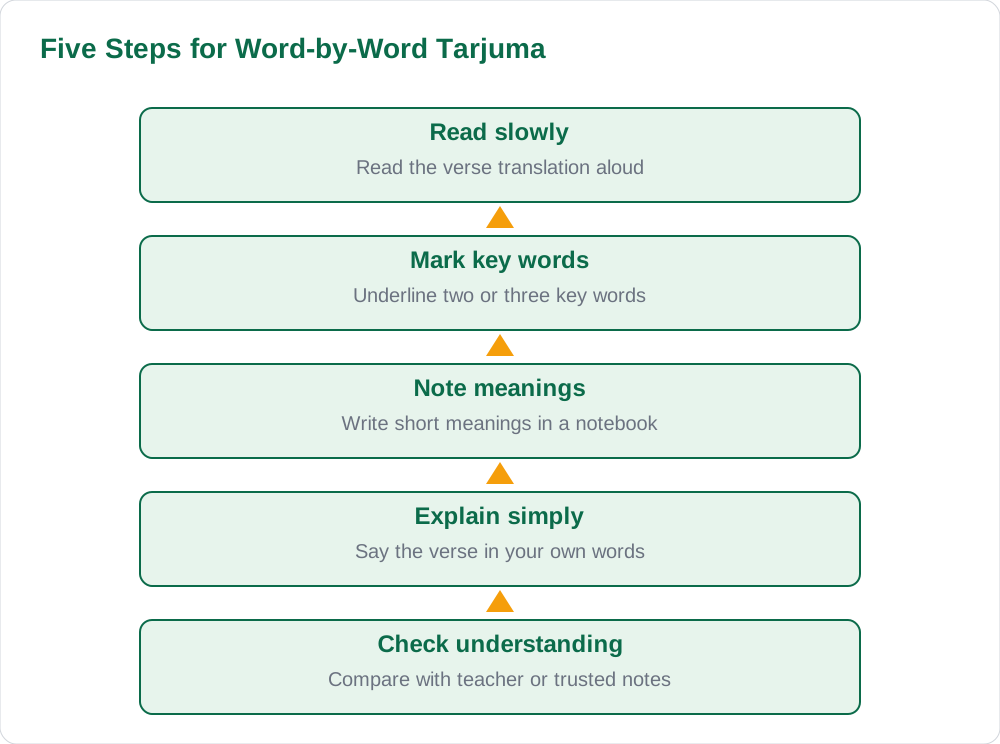
Use five steps for each verse. First, read the verse translation aloud slowly. Second, underline two or three key words that carry the main meaning. Third, write a short meaning for each key word in your notebook. Fourth, explain the whole verse in one or two sentences in your own words.
Do not move to the next verse until you can explain the current one simply. If you cannot explain it, re-read it and ask for help. This check keeps your understanding honest and prevents confusion from building up across many verses.
Building a Key-Word Notebook
A key-word notebook turns tarjuma study into a lasting resource. Divide each page into three columns: key word, short meaning, and an example sentence in your own words. Add only two or three words per verse so the notebook stays useful and not overwhelming. Review the notebook for five minutes before each new study session.
Use colour or symbols to mark words you find difficult. For example, star the words you often forget and review them more often. After a month, you will notice that many words repeat across verses, and your reading speed and understanding will improve together.
- Use three columns: key word, short meaning, and your own example.
- Add only two or three words per verse to keep the notebook useful.
- Star difficult words and review them more often.
- Review the notebook for five minutes before each session.
Checking Meaning Before Moving On
The check step is what makes this method reliable. After explaining a verse in your own words, compare your explanation with your STBB book, your teacher, or a trusted translation. If your explanation misses an important idea, correct it in your notebook. If you are unsure about a word, ask rather than guess.
You can also check understanding by asking yourself two questions: what does this verse teach, and what should I do differently because of it? If you can answer both in simple words, you are ready for the next verse. If not, re-read the verse once more.
- Compare your explanation with your STBB book or teacher.
- Correct any missing idea in your notebook at once.
- Ask about unsure words instead of guessing.
- Answer two questions: what does it teach, and what should I do?
A Weekly Tarjuma Routine
Use a simple weekly routine. Study three verses per session, three sessions per week, with one revision session at the end of the week. In each session, follow the five steps for each verse and add key words to your notebook.
Keep sessions to about twenty minutes so concentration stays high. For a note-taking method that pairs well with tarjuma, see the margin notes guide and browse the blog for more Quran study methods.
AI Help: Muse AI
Muse AI is Meta's personal AI assistant, and it can help you explain a tarjuma verse in simpler words or make short practice questions about its key words. Muse AI does not give official STBB answers — always verify against your STBB book and your teacher. Always check any explanation against your Sindh Textbook Board book and ask your teacher if anything is unclear.
Join Muse with invite code LTGSWD — in the Muse app, go to Settings > Redeem token and enter the code.
Disclosure: LTGSWD is the author's Muse invite code.
5 key points you must know
- Read tarjuma slowly, one verse at a time, instead of rushing pages.
- Mark two or three key words per verse and note their meanings.
- Explain each verse in your own words before moving on.
- Check every explanation against your STBB book or teacher.
- Keep a key-word notebook and review it before each session.
Frequently asked questions
How many verses should I study in one session?
Three verses per session is a good target. Follow the five steps for each verse, add key words to your notebook, and stop while your concentration is still fresh.
What should I do if I do not understand a word in tarjuma?
Mark the word, write it in your key-word notebook, and ask your teacher or check a trusted translation. Do not guess, because guessing creates misunderstandings that are hard to fix later.
How does a key-word notebook help?
It collects the most important words with short meanings and your own examples. Reviewing it for five minutes before each session builds vocabulary, and many words repeat across verses.
How can I test my tarjuma understanding?
Explain each verse in your own words and answer two questions: what does it teach, and what should I do differently? If you can answer both simply, your understanding is solid.
Solved notes — preview free
These guides work best with the solved exercises. Preview the solved notes free on this website — 119 solved notes for Classes 6–10 in Sindhi, Urdu, English and Arabic medium. Or browse the full solved notes catalogue for your class and medium. New solved notes are added regularly — check the catalogue for coming-soon books.