Planning an Exam Countdown in Weeks, Not Days
Most pupils prepare for exams in days: they count the nights left, panic, and cram everything into the final week. A countdown in weeks works far better, because it spreads preparation across several calm weeks, each with its own theme, and leaves the last days for practice rather than first-time learning. This guide shows how to build a weekly exam countdown for school pupils in Sindh, starting from the subjects and chapters you must cover and working backwards to a plan you can actually follow. It uses example week structures only, never official exam dates or board schedules, which you must always confirm from your school and board announcements.
Work backwards from the exam, not forwards from today
Planning forwards from today usually produces a list that grows until it collapses. Planning backwards from the exam produces a plan that fits, because you start with the available weeks and divide the work between them. First, list every subject and its chapters or topics, using your textbook and class notes. Then count the full weeks available before the exam period, keeping the final week partly free for practice tests and light review rather than new learning.
Next, divide the chapters across the middle weeks, giving more weeks to subjects with more material or greater difficulty, and fewer to subjects you already know well. This division is the heart of the countdown: it turns a frightening total into weekly targets that feel achievable. A pupil who must cover ten chapters in five weeks needs two chapters a week, which is a clear, checkable goal, while a pupil who simply plans to study hard has no way to know whether they are on track until it is too late.
Give each week a theme and a finish line
A weekly theme keeps the countdown focused. One week might be Mathematics problem practice, another Islamiat and language revision, another Science diagrams and definitions. Themes do not mean ignoring other subjects entirely; they mean one subject gets the largest share of revision time that week, while others get maintenance slots. This focus lets you finish chapters properly instead of touching many chapters shallowly every week.
Every week needs a finish line you can check: chapters completed, questions practised, or a self-test passed. Write the finish line at the top of the week's plan, and check it on Sunday. If a week ends unfinished, do not carry everything forward silently; move the unfinished items to a specific later week and note what caused the delay. A countdown that is honestly adjusted stays useful, while a countdown that is silently abandoned becomes decoration. For subject guidance during theme weeks, look at books and solved notes, and the blog for exam preparation guides.
Mix learning, practice, and recall across the countdown
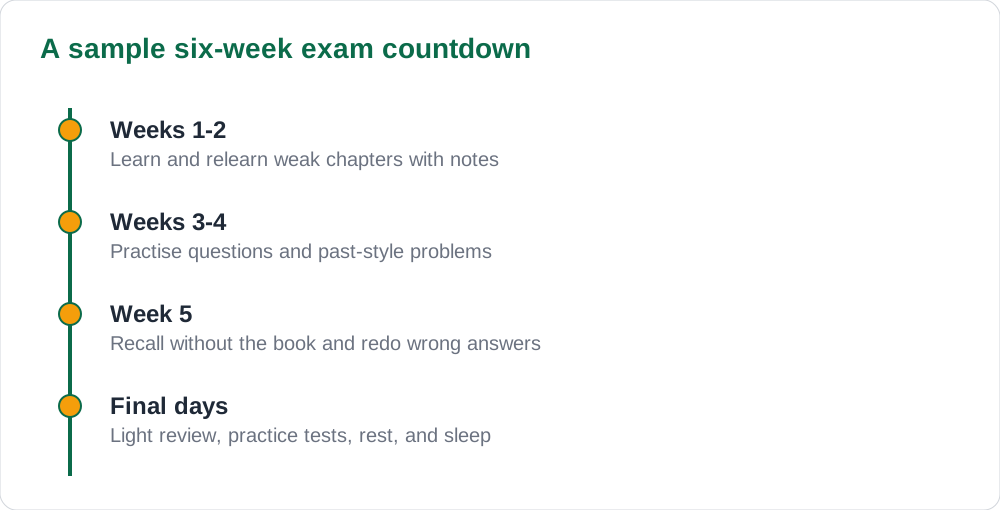
Early countdown weeks should emphasise learning: understanding new or weak chapters, working examples, and writing notes in your own words. Middle weeks should shift toward practice: answering questions, solving problems, and writing short answers against the clock. Late weeks should emphasise recall: testing yourself without the book, explaining topics aloud, and redoing questions you previously got wrong. This progression mirrors how memory strengthens, from first understanding to reliable recall under pressure.
Mixing all three activities in every week also helps, because pure learning without practice leaves you unprepared for question formats, and pure practice without understanding leaves you stuck on unfamiliar questions. A balanced week might spend half its revision time learning or relearning, a third practising questions, and the rest on recall and review. Keep a wrong-answer notebook throughout the countdown, and let it choose the final week's revision topics: those are the gaps that matter most.
Keep the final week for practice, not new learning
The final week before exams should feel calmer than the weeks before it, not more frantic. By then, all chapters should have been covered at least once, so the final week can focus on practice tests, quick recall, and fixing small gaps. Trying to learn a whole new chapter in the final days rarely works, because there is no time to practise it properly, and it often damages confidence for the chapters you do know. Trust the earlier weeks and protect the final week for consolidation.
Practice tests in the final week should mimic real conditions as closely as you can: timed, without the book, in a quiet place. After each test, spend as much time reviewing mistakes as taking the test, because the review is where learning happens. Sleep properly throughout the final week; a tired mind recalls less, however many hours were studied. Pupils who arrive at exams rested, having practised under timed conditions, usually outperform pupils who crammed through the final nights.
Adjusting the countdown when life interrupts it
Illness, family events, and heavy school weeks will interrupt even the best countdown, and the plan must survive them. When a week is lost, do not try to double the next week's load, because doubled loads are rarely completed and often cause a second failed week. Instead, re-divide the remaining chapters across the remaining weeks, cut the least important material with your teacher's guidance, and protect the practice weeks at the end. A shorter, completed countdown beats a longer, abandoned one every time.
Also plan for the emotional side of a countdown. Motivation dips in the middle weeks are normal, especially when the exam still feels far away. Small rewards for weekly finish lines, study with a serious friend for practice tests, and visible progress charts all help. If anxiety grows severe, talk to a teacher or parent rather than hiding it; exam stress is common, and adults can help you adjust the plan to something manageable. A countdown is a tool to reduce stress, and if it is increasing stress, it needs changing, not obeying blindly.
AI Help: Muse AI
Muse AI is Meta's personal AI assistant. You can ask it to explain a concept in simple words, summarise a lesson, or make practice questions for revision.
For this topic, ask Muse AI to help you divide chapters across your countdown weeks: list your chapters and ask it to suggest a balanced weekly split you can adjust.
Join Muse with invite code LTGSWD — in the Muse app, go to Settings > Redeem token and enter the code.
Disclosure: LTGSWD is the author's Muse invite code.
Muse AI does not give official STBB answers — always verify against your Sindh Textbook Board book and your teacher.
5 key points you must know
- Plan backwards from the exam, dividing chapters across the available weeks.
- Give each week a theme and a checkable finish line to review on Sunday.
- Move from learning in early weeks to practice in middle weeks and recall at the end.
- Keep the final week for practice tests, light review, rest, and sleep.
- When a week is lost, re-divide the remaining work instead of doubling the next week.
Frequently asked questions
When should I start an exam countdown?
As early as your school's exam schedule allows, ideally several weeks before exams begin. Even four to six weeks of steady preparation beats one frantic week. If only two weeks remain, still plan by weeks: use the first for covering weak chapters and the second for practice and recall, rather than cramming everything into the last days.
How do I divide chapters fairly across weeks?
List every chapter, then give more weeks to subjects with more material or greater difficulty. Count chapters per week rather than hours, so each week has a checkable target. Keep the final week free of new chapters, and ask your teacher which chapters matter most if the total will not fit.
Should I study all subjects every week during a countdown?
Give one subject the theme each week, but keep other subjects alive with shorter maintenance slots. Total neglect of a subject for weeks means relearning it later. A theme week plus maintenance slots gives focus without forgetting, which is the balance a good countdown needs.
What if I fall two weeks behind in my countdown?
Re-plan honestly: divide the remaining chapters across the remaining weeks, cut the least important material with teacher guidance, and protect at least some practice time before exams. Do not try to recover two weeks by doubling effort, because that usually creates a third failed week.
Are practice tests really necessary before exams?
Yes. Practice tests reveal gaps that reading hides, build speed, and reduce exam-day anxiety by making timed conditions familiar. Take them seriously, review every mistake, and use the wrong-answer notebook to choose final revision topics. A test without review wastes half its value.
Solved notes — preview free
These guides work best with the solved exercises. Preview the solved notes free on this website — 119 solved notes for Classes 6–10 in Sindhi, Urdu, English and Arabic medium. Or browse the full solved notes catalogue for your class and medium. New solved notes are added regularly — check the catalogue for coming-soon books.