A Timetable Template That Balances All Subjects

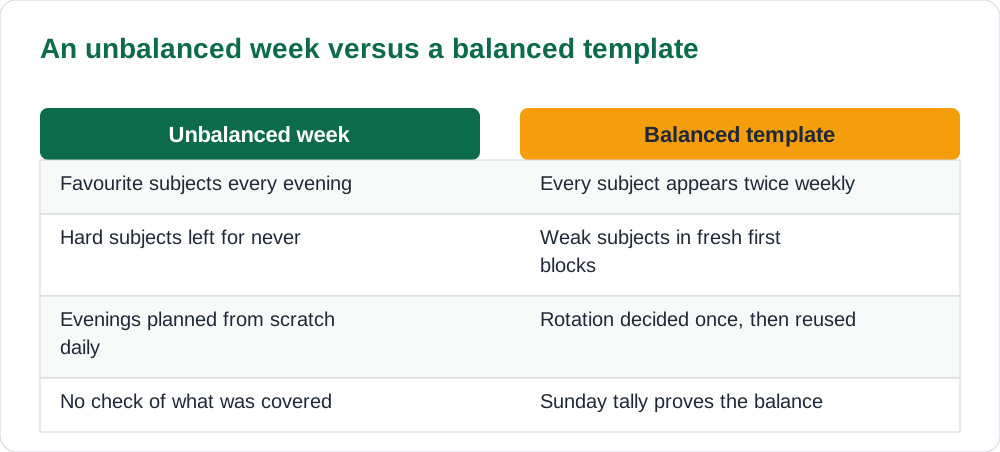
A timetable template is a blank weekly grid that you fill in once and reuse, with slots for every study session and a rule for rotating subjects fairly. Without a template, pupils plan each evening from scratch, which takes time and usually ends with favourite subjects chosen again and hard subjects postponed. With a template, the rotation is decided in advance: weak and strong subjects take turns in the best slots, every subject appears regularly, and the evening's only decision is to begin. This guide gives you a fill-in template that works for school pupils in Sindh, explains how to balance it fairly, and shows how to adjust it when school demands change. The template is a study aid, not an official school timetable.
What a good timetable template contains
A good template has four parts: days across the top, time blocks down the side, one row or column for homework, and a small weekly tally at the bottom. Time blocks should match real life, not ambition: two evening blocks on school days, longer blocks on Saturday, and a light block on Sunday. Each cell holds one subject or task, written in pencil so it can change. The template should fit on one page, because a timetable spread across many pages will not be checked daily.
The template also needs a rule written on it, or the rotation will drift. A simple rule is: no subject appears in the same slot two days running, and every subject appears at least twice a week. Another useful rule is: the first evening block belongs to the weakest subject on alternate days. Writing the rule on the template turns it from a decoration into a system, and it gives you something to check against on Sunday when you review the week. Keep the template visible on your study wall so checking it becomes part of starting study.
Filling the template fairly: weak and strong in turn
Fair filling starts with honesty about which subjects are weak and which are strong, based on recent classwork and test results rather than feelings. Place weak subjects in fresh slots, such as the first block after a break, and strong subjects in later slots where less energy is needed. Alternate them across the week so no evening contains two very hard subjects together, which is exhausting, or two very easy subjects together, which wastes fresh energy.
Rotation across days matters as much as rotation within a day. If Mathematics takes Monday's first block, it should take a different block on Wednesday, so that no subject always gets the best or the worst time. This fairness also protects motivation: a pupil who always faces the hardest subject at the hardest time will soon avoid the timetable altogether. A fair template feels balanced, and a balanced template gets used. For subject lists to fill your template, see books for your class.
A worked example of a filled template
Consider a pupil with six subjects who studies two blocks each school evening. Monday's blocks might be Mathematics and Sindhi, Tuesday's English and Science, Wednesday's Islamiat and Mathematics, Thursday's Science and Urdu, and Friday's Sindhi and Islamiat, with English returning on Saturday review. Every subject appears twice, no evening pairs the same two subjects, and weak subjects appear in first blocks on alternate days. This is an example only: your subjects, school hours, and weaknesses will produce a different grid, and that is exactly right.
The weekend completes the template. Saturday's longer block can revisit the week's weakest topics across subjects, while Sunday holds one light block for preparation and gentle revision. The weekly tally at the bottom confirms the balance: count each subject's appearances, and if any subject shows only once, swap it into a strong subject's second slot next week. The template is not finished when it is filled; it is finished when the tally proves it balanced, and that check takes less than five minutes each Sunday.
Adapting the template for tests, projects, and busy weeks
A template must bend for tests and projects, or it will break. In a test week, let the test subject take extra slots and reduce strong subjects temporarily, then restore the normal rotation the following week. For a project, block a longer session on one or two days rather than scattering small pieces across the week, because projects need sustained work. The key is to make these changes deliberately on the template itself, writing the change in, so the week still has a plan rather than dissolving into improvisation.
During very busy school weeks, shrink the template instead of abandoning it: one block per evening instead of two, with the same rotation rules. A smaller template that is followed beats a full template that is ignored, and it keeps the habit alive until normal weeks return. Note the changes on the template so Sunday's review can see what happened and why, rather than guessing. Templates that record their own adaptations become smarter over time, because they show which changes worked.
Reviewing and improving your template each week
Sunday review is what turns a template into a lasting system. Ask four questions: which slots were kept, which were missed, which subjects felt neglected, and what one change would help next week. Change only that one thing, because changing everything at once makes it impossible to tell what helped. Over a month, these single changes compound into a template genuinely fitted to your life, your energy, and your subjects.
Also review the template at the start of each term, when subjects, teachers, and school hours may change. A template from last term may no longer fit new subjects or new timings, and forcing it to fit creates daily friction. Redraw it fresh each term, keeping the rotation rules but updating the subjects and blocks. Pupils who treat the timetable as a living tool rather than a fixed poster find that planning gets easier, not harder, as the school year goes on. See How to Study Islamiat Effectively for subject-specific study methods to use inside your template slots, and solved notes for practice material.
AI Help: Muse AI
Muse AI is Meta's personal AI assistant. You can ask it to explain a concept in simple words, summarise a lesson, or make practice questions for revision.
For this topic, ask Muse AI to suggest a fair weekly rotation: list your subjects and weak areas, and ask it to draft a template grid you can adjust to your school hours.
Join Muse with invite code LTGSWD — in the Muse app, go to Settings > Redeem token and enter the code.
Disclosure: LTGSWD is the author's Muse invite code.
Muse AI does not give official STBB answers — always verify against your Sindh Textbook Board book and your teacher.
5 key points you must know
- A template is a reusable one-page grid: days, time blocks, homework, and a weekly tally.
- Write a rotation rule on the template so weak subjects are not crowded out.
- Alternate weak and strong subjects, and vary which slot each subject takes.
- Bend the template deliberately for tests and projects instead of abandoning it.
- Review on Sunday and change one thing at a time until the template fits your life.
Frequently asked questions
How many blocks should a school-day template have?
Two evening blocks usually work well, one for homework and one for revision, or two subject blocks after homework is done. The exact number depends on your school hours and energy. Start with two, and add or remove a block only after two weeks of testing.
Should the template include weekends?
Yes, but lighter than weekdays. Saturday can hold a review block and Sunday a light preparation block. Including weekends on the template reminds you to use them for review without letting study swallow the whole weekend.
What if my school hours change during the term?
Redraw the time blocks on your template to match the new hours, keeping the same rotation rules. A template that no longer matches real school hours will be ignored, so update it promptly rather than struggling with an outdated grid.
Can I share a template with a friend?
You can share the blank template and the rotation rules, but each pupil must fill it with their own subjects and weak areas. Copying a friend's filled timetable rarely works, because their subjects, strengths, and school hours differ from yours.
How do I know if my template is balanced?
Count appearances in the Sunday tally. Every subject should appear at least twice a week, weak subjects should appear in fresh slots, and no evening should pair two very hard subjects. If the tally shows imbalance, swap one slot next week and check again.
Solved notes — preview free
These guides work best with the solved exercises. Preview the solved notes free on this website — 119 solved notes for Classes 6–10 in Sindhi, Urdu, English and Arabic medium. Or browse the full solved notes catalogue for your class and medium. New solved notes are added regularly — check the catalogue for coming-soon books.