Questioning Techniques That Get Every Pupil Participating

In many classrooms the same few hands go up while most pupils stay silent, and the teacher mistakes their silence for understanding. Hands-up questioning rewards confidence, not learning, and it lets quiet pupils hide for an entire term. This article shows how questioning techniques can get every pupil participating, using methods such as cold-calling, think-pair-share, and wait time. These techniques spread thinking across the whole class, give slower thinkers a fair chance to answer, and give you honest evidence about who has really understood the lesson. You do not need special equipment or extra time, only a change in habit: ask the question first, give thinking time, then choose who answers. When pupils know anyone may be asked, they listen harder, think deeper, and take part more willingly.
Why Hands-Up Alone Fails Most of the Class
Hands-up questioning feels lively because hands shoot up and answers come fast, but it usually involves only a small group of confident pupils while the rest switch off. The pupils who already know the answer dominate, the pupils who are unsure stay quiet to avoid embarrassment, and the teacher receives a false picture of class understanding. Over weeks this pattern trains the quiet majority to wait for someone else to answer, so their thinking muscles weaken and their confidence drops further. A classroom that depends on volunteers is not really checking learning; it is checking who is brave enough to speak.
The fix is not to ban volunteers but to balance them with techniques that involve everyone. When every pupil expects to think and possibly answer, attention rises across the room and answers become real evidence instead of a performance by a few. Start by explaining the change honestly to your class: tell them you will ask everyone sometimes because every voice matters, and that a wrong answer is useful information, not a failure. Pupils accept new questioning habits quickly when the teacher stays warm, gives thinking time, and never uses a question to embarrass. The solved notes can supply practice questions to use with these techniques in your next lesson.
Cold-Calling Done Kindly: Ask, Pause, Then Name
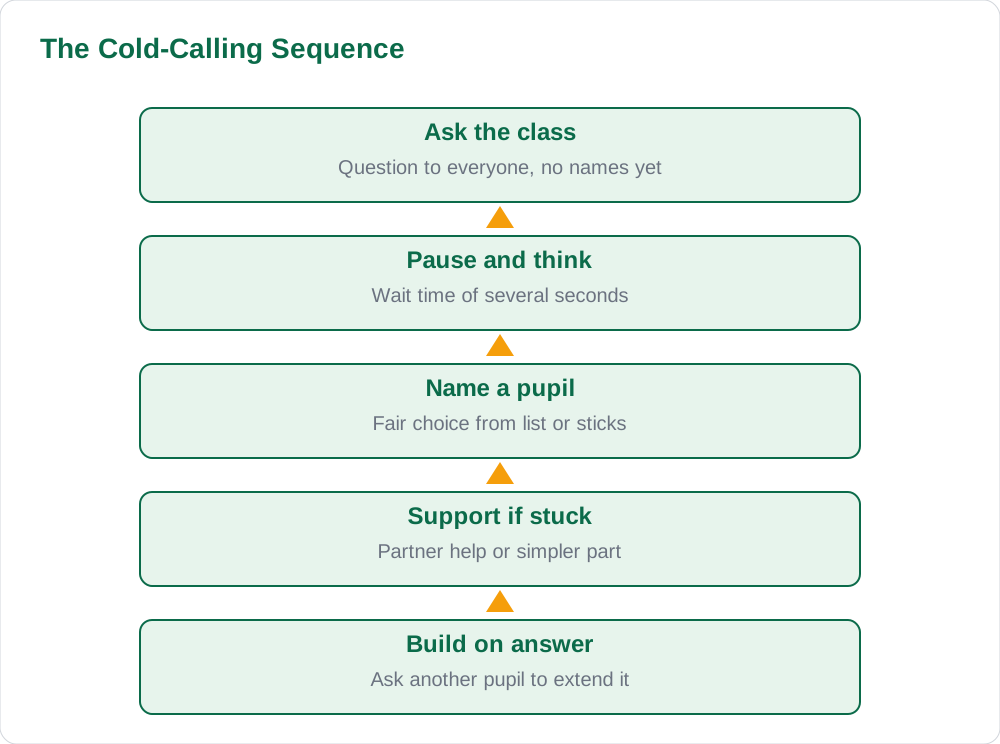
Cold-calling means choosing who answers rather than waiting for volunteers, and it works when it is done kindly and predictably. The key sequence is to ask the question to the whole class first, pause so everyone thinks, and only then name a pupil. This order matters: if you name a pupil before asking, the rest of the class stops thinking, but if everyone hears the question first, everyone practises answering in their head. Use a class list, name sticks, or a simple pattern so pupils see the choice as fair, and keep your tone friendly even when an answer is wrong.
If a pupil cannot answer, protect their dignity by offering a lifeline instead of moving on in embarrassment. Let them ask a partner, choose between two options, or answer a simpler part of the question, and then return to them later with a question they can answer successfully. Praise effort and partial answers, and correct mistakes by explaining the thinking, not by labelling the pupil. Used this way, cold-calling builds a classroom where pupils expect to be asked and are not afraid to try, which is exactly the culture that raises participation. Find lesson material for your subject in the book collection to plan your questions in advance.
Think-Pair-Share: Give Thinking a Partner
Think-pair-share is one of the simplest ways to double participation in any lesson, because it gives every pupil a safe first audience before speaking to the class. First, pupils think silently about the question for a short time, then they discuss it in pairs, and finally a few pairs share their ideas with the whole class. The pair stage is where the real learning happens: pupils rehearse their answer, hear another viewpoint, and fix mistakes before going public. Even pupils who never speak to the full class have still thought, talked, and learned, which is far better than silent waiting.
To make think-pair-share work, keep the question focused enough to discuss in two or three minutes, and give clear instructions such as both partners must speak and each pair must agree on one answer. Walk around during the pair stage, listen for good ideas, and choose which pairs to call on based on what you heard, so sharing reflects real thinking rather than the loudest voices. End by summarising the best ideas on the board and crediting the pairs who offered them. Used once or twice per lesson, this routine turns a passive class into an active one. More classroom ideas appear regularly on the blog for teachers across Sindh.
Wait Time: The Three Seconds That Change Answers
Wait time is the pause after you ask a question, and research and classroom experience both show that a few extra seconds transform the quality of answers. When teachers wait only one second, pupils rush out short, safe answers; when they wait three to five seconds, more pupils volunteer, answers grow longer and more thoughtful, and pupils begin to ask their own questions. Silence feels awkward at first, so teachers often break it too soon, but pupils need that quiet to find words, especially when answering in a second language or about a new concept. Train yourself to count silently after each question before accepting any answer.
Wait time also applies after a pupil answers, because a short pause lets other pupils add, correct, or extend the idea instead of the teacher jumping in immediately. You can support the pause by saying think quietly, or by asking pupils to show a thumbs-up when they are ready, which keeps the silence purposeful rather than empty. Combine wait time with cold-calling and think-pair-share, and you have a questioning system where every pupil gets a fair chance to think. The habit costs nothing and takes no extra lesson time, yet it is often the single biggest improvement a teacher can make. See the [home page](/) for an overview of resources for your classroom.
Ask Better Questions and Use Every Answer
Participation also depends on the questions themselves, because a question with only one obvious answer invites only one voice. Mix quick recall questions that build confidence with open questions that ask why, how, and what if, so pupils must explain their reasoning rather than guess a word. Ask follow-up questions that push thinking further, such as can you give an example, or do you agree with that answer and why, and invite other pupils to respond to a classmate's answer instead of always answering yourself. This chain of questions turns a single answer into a class discussion where many pupils contribute.
Treat wrong answers as useful material rather than mistakes to erase, because a wrong answer often reveals a misunderstanding shared by many pupils. Thank the pupil, explore the thinking behind the answer, and ask the class to help improve it, so the whole class learns from the error without anyone feeling shamed. Keep a small bank of question stems on your desk, such as what do you notice, what would happen if, and how do you know, and vary them across the week. When pupils see that their answers shape the lesson, they participate because their thinking genuinely matters. For help or feedback, visit the contact page.
AI Help: Muse AI
Muse AI is Meta's personal AI assistant, and it can help teachers write open-ended question stems, turn a lesson topic into discussion questions, or suggest think-pair-share prompts matched to a class level. Ask it for five questions of growing difficulty on your topic, then pick the ones that fit your pupils best.
Join Muse with invite code LTGSWD — in the Muse app, go to Settings > Redeem token and enter the code.
Disclosure: LTGSWD is the author's Muse invite code.
Muse AI does not give official STBB answers — always verify against your Sindh Textbook Board book and your teacher.
5 key points you must know
- Hands-up alone lets confident pupils dominate and hides misunderstanding.
- Cold-call kindly: ask the class, pause, then name a pupil fairly.
- Think-pair-share gives every pupil a safe partner before public answers.
- Wait three to five seconds after asking to deepen answers and confidence.
- Use open and follow-up questions, and treat wrong answers as learning material.
Frequently asked questions
Is cold-calling unfair to shy pupils?
Not when done kindly. Ask the question first, give thinking time, and offer lifelines such as partner help or a simpler part, so shy pupils can succeed instead of feeling put on the spot.
How long should wait time be?
Three to five seconds after asking is a good target. It feels long at first, but it lets more pupils form answers, especially when the topic is new or the language is challenging.
How often should I use think-pair-share?
Once or twice per lesson is enough. Use it for questions worth discussing, keep pair talk to two or three minutes, and always bring the best ideas back to the whole class.
What if a pupil gives a completely wrong answer?
Thank them, explore the thinking behind it, and invite the class to improve it together. A wrong answer often reveals a shared misunderstanding, so correcting it openly helps everyone.
Solved notes — preview free
These guides work best with the solved exercises. Preview the solved notes free on this website — 119 solved notes for Classes 6–10 in Sindhi, Urdu, English and Arabic medium. Or browse the full solved notes catalogue for your class and medium. New solved notes are added regularly — check the catalogue for coming-soon books.