How to Analyse Theme and Imagery in an Urdu Nazm

To analyse theme imagery Urdu nazm work well, you need a calm method rather than guesswork. A nazm is a poem built around one central idea, and the poet builds that idea through images: pictures made from words, such as light, a river, a garden, or a journey. Many pupils read a nazm once, feel confused, and then write whatever comes to mind. A better way is to read slowly in three passes, mark the images you notice, and then ask how each image supports the central idea. This guide shows that method step by step, so you can write a clear, organised answer that follows your Sindh Textbook Board book and your teacher's guidance.
What a Nazm Is and Why Theme Matters
A nazm is a poem in which every sher or band works toward one main idea. Unlike a ghazal, where each sher can stand on its own, a nazm moves forward like a short story in verse: it opens with a scene or feeling, develops it, and ends with a message or reflection. When you know this, you stop treating each line as separate and start looking for the thread that joins them. That thread is the theme, the central idea the poet wants the reader to carry away.
Theme matters because it gives your answer a centre. Without a theme, an answer becomes a list of lines with no order. With a theme, every paragraph has a job: it shows one part of the idea. For example, if the theme is patience in hardship, then images of night, waiting, and morning light all point to the same message. Your first job in any nazm question is therefore to name the theme in one clear sentence before you explain anything else.
Finding the Central Idea in Three Passes
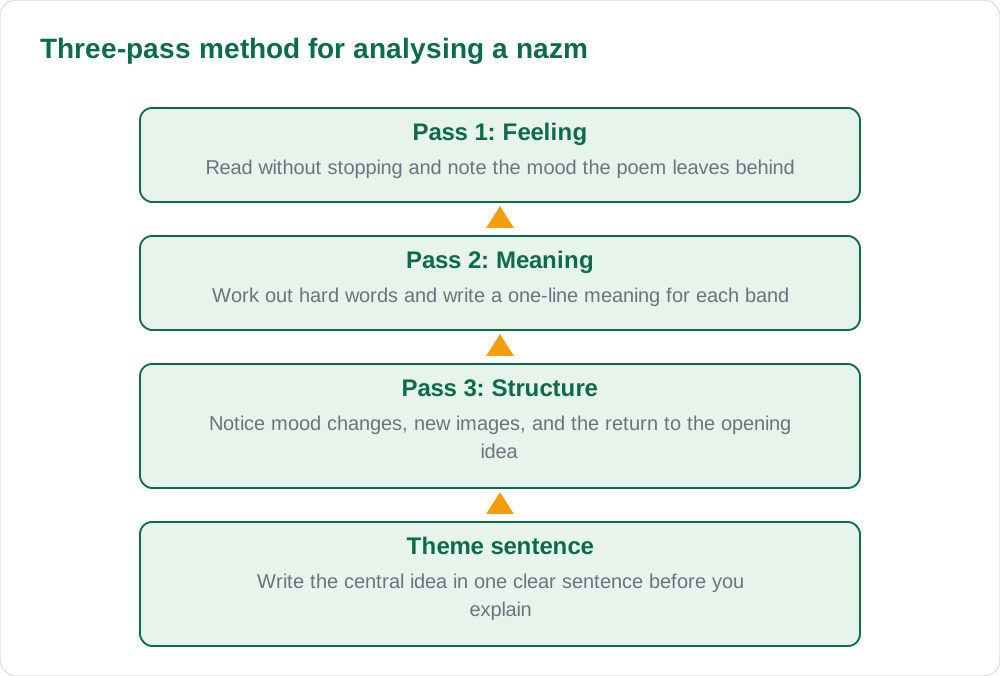
Read the nazm three times, each time with a different job. On the first pass, read for feeling only. Do not stop to look up words. Ask yourself what mood the poem leaves behind: hope, sadness, pride, gratitude, or wonder. On the second pass, read for meaning. Underline hard words, work out their sense from context, and write a one-line meaning for each band in your own words. On the third pass, read for structure. Notice where the mood changes, where a new image appears, and where the poet returns to the opening idea.
After three passes, write the theme as one sentence. A good theme sentence names both the subject and the poet's view of it. Instead of writing only 'the poem is about nature', write something like 'the poem shows that nature teaches patience because seasons change slowly'. That second sentence can guide your whole answer. If you cannot write the theme in one sentence yet, read the opening and closing lines again, because poets often place the clearest statement of theme near the start or the end.
Tracing Images: From Word to Feeling
An image in a nazm is a word picture that appeals to the senses: sight, sound, touch, or movement. To trace images, go through the poem and mark every word or phrase that paints a picture. Common images in Urdu nazms include light and darkness, rivers and deserts, gardens and thorns, birds and cages, and roads and destinations. Write each image in your notebook with the line where it appears. Do not rush to explain yet. Collecting first and explaining second keeps your notes tidy and stops you from forcing a meaning onto an image too early.
Next, ask what feeling each image carries in this poem. Light often suggests hope or knowledge, but in some poems it can mean exposure or harsh truth. Darkness often suggests difficulty, yet it can also mean rest or quiet. The feeling depends on context, so always quote the surrounding words. A useful notebook habit is to make three columns: image, line, and feeling. When you fill that table for a whole nazm, patterns appear. You may notice that images of confinement appear early and images of freedom appear late, which tells you the poem moves from struggle toward hope.
Linking Images to the Message
Once you have listed the images and their feelings, group them. Put images with a similar feeling together and give each group a label, such as hardship, patience, or gratitude. Then ask how each group supports the theme sentence you wrote earlier. If a group does not fit your theme, either your theme needs adjusting or you have misread an image. Both are normal. Adjust the theme sentence until it fits the strongest images, not the weakest ones. This checking step is what turns a list of images into an analysis.
In your written answer, follow a simple order: theme first, then one paragraph per image group, then a closing line. In each paragraph, name the image, quote or describe the line, explain the feeling it creates, and link it to the theme. For example, you might write that the image of a river shows steady effort, because the river keeps moving despite obstacles, and that this supports the theme of patience. This four-step pattern keeps every paragraph focused. You can practise the same pattern when you read how to read a ghazal sher by sher, because both tasks ask you to move from words to meaning.
A Worked Example: Reading a Short Nazm Step by Step
Imagine a short nazm that opens with a traveller walking at night, continues with the traveller noticing a distant lamp, and ends with the traveller reaching a village at dawn. On the first pass, the mood is lonely but hopeful. On the second pass, you work out that the night stands for difficulty, the lamp stands for guidance, and the dawn stands for relief. On the third pass, you notice the structure: night, lamp, dawn. That is a movement from darkness to light, which matches the theme of hope after hardship.
In your answer, you would open with the theme sentence, then write one paragraph on the night image, one on the lamp image, and one on the dawn image. Each paragraph would explain the feeling and link it to the theme. You would close with one line about what the reader should learn. Notice that you did not need to explain every word in the poem. You needed to choose the strongest images and explain them well. Examiners value a focused answer with clear links more than a long answer that repeats the poem without explaining it.
- Theme sentence first, then one paragraph per image group.
- Each paragraph: name the image, describe the line, explain the feeling, link to theme.
- Choose the strongest images rather than explaining every word.
- Close with one line about what the reader should learn.
Common Mistakes and How to Avoid Them
One common mistake is writing a summary instead of an analysis. A summary retells the poem, while an analysis explains how the poem works. To avoid this, check every paragraph: does it explain why the poet chose this image, or does it only repeat what happens? If it only repeats, add one sentence of explanation. A second mistake is inventing a theme that the images do not support. If your theme sentence mentions courage but all the images are about gratitude, change the theme to match the images. The poem leads; your answer follows.
A third mistake is quoting long passages without explaining them. A short quotation with a clear explanation earns more marks than a long quotation with none. Keep quotations brief, and follow each one with your own words. Finally, avoid memorised praise that could fit any poem, such as calling every poem beautiful without saying why. Instead, name the image, explain its effect, and link it to the theme. That habit will serve you in every Urdu poetry question, including tashreeh-e-ashaar, where the same care with imagery is expected. For more Urdu guidance, browse the solved notes and the books catalogue.
AI Help: Muse AI
Muse AI is Meta's personal AI assistant, and it can help you practise naming the theme of a nazm in one sentence. Muse AI does not give official STBB answers — always verify against your STBB book and your teacher.
Join Muse with invite code LTGSWD — in the Muse app, go to Settings > Redeem token and enter the code.
Disclosure: LTGSWD is the author's Muse invite code.
Muse AI does not give official Sindh Textbook Board answers — always verify against your Sindh Textbook Board book and your teacher.
5 key points you must know
- A nazm builds one central idea through images that appeal to the senses.
- Read in three passes: feeling, meaning, then structure.
- Write the theme as one sentence before you explain anything else.
- Collect images first, then group them by feeling and link each group to the theme.
- Each paragraph: name the image, explain the feeling, and link it to the theme.
Frequently asked questions
What is the difference between theme and topic in a nazm?
The topic is what the poem is about, such as nature or patience. The theme is what the poet says about that topic, such as nature teaches patience because seasons change slowly. Your answer should state the theme, not only the topic.
How many images should I discuss in an answer?
Discuss the strongest three or four image groups rather than every image. A focused answer with clear links earns more marks than a long list without explanation.
What if I cannot find the theme?
Re-read the opening and closing lines, then list the images and their feelings. The pattern across the images usually points to the theme. If two themes seem possible, choose the one the strongest images support.
Should I quote the poem in my answer?
Yes, but keep quotations short. Quote a phrase or a line, then explain it in your own words. A short quotation with a clear explanation is better than a long quotation with none.
Solved notes — preview free
These guides work best with the solved exercises. Preview the solved notes free on this website — 119 solved notes for Classes 6–10 in Sindhi, Urdu, English and Arabic medium. Or browse the full solved notes catalogue for your class and medium. New solved notes are added regularly — check the catalogue for coming-soon books.