Attendance and Eligibility Rules for Board Exams
Sitting a board examination is not automatic: a pupil must be eligible, and eligibility is usually tied to attendance, enrolment and completion of the course. Many pupils only hear about attendance rules when a teacher warns them late in the year, by which time the problem is hard to fix. This guide explains, in general terms, how attendance and eligibility relate to board examinations, why boards set a minimum attendance expectation, what short attendance usually means, and what pupils and parents can do to protect eligibility. Boards differ in their exact percentages, condonation rules and procedures, so always confirm the precise rule for your board and class with your school or your board's official notice.
Why Boards Care About Attendance
Boards set attendance expectations because the examination certifies that a pupil has actually studied the course, not merely that they can pass a paper. A pupil who has attended regularly has covered the syllabus, taken class tests, completed practical work and received teacher feedback, all of which the certificate is meant to represent. A pupil who has barely attended may still be able to memorise answers, but the board has no evidence that the course was completed. Attendance is therefore treated as evidence of study, not as a punishment for absence.
Attendance also matters for practical subjects, where marks depend on work done in the laboratory over the year, and for subjects with coursework, projects or oral work. A pupil absent for most practical sessions cannot fairly be awarded practical marks, and a school cannot certify work it never saw. This is why attendance rules usually apply to the whole school year, not only to the weeks before the examination, and why a sudden burst of attendance at the end of the year does not always repair a long gap. Regular attendance from the start is the only reliable approach.
How Eligibility Is Usually Decided
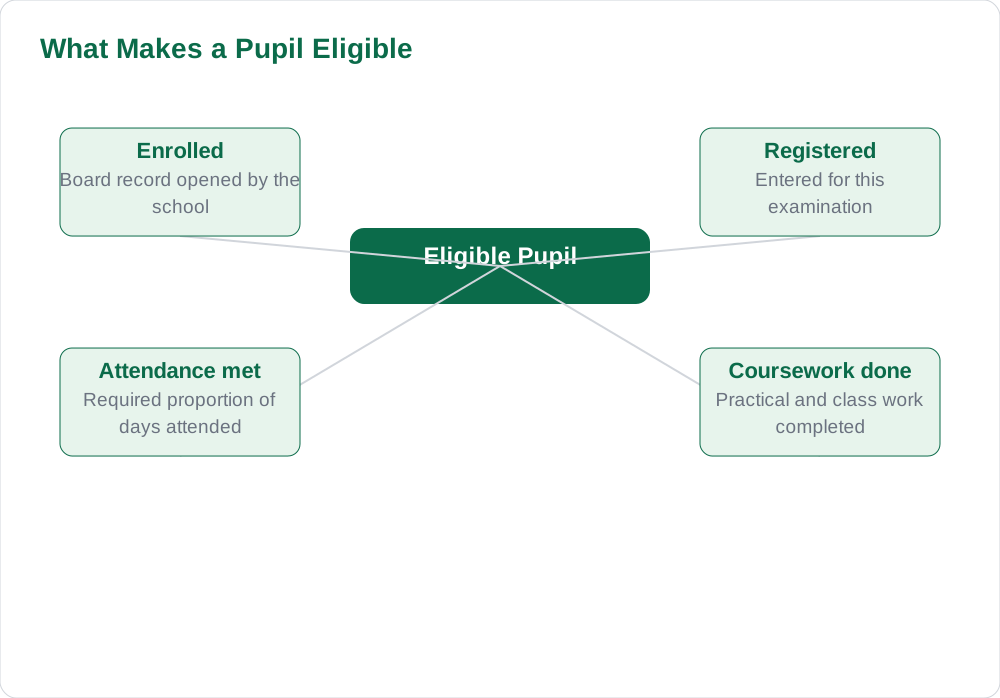
Eligibility normally depends on several conditions together: the pupil is enrolled with the board, registered for the examination, has attended the required proportion of school days, and has completed any required practical or coursework. Schools usually calculate attendance from their own registers and send the board a list of eligible pupils, flagging any pupil whose attendance falls short. The board then decides, under its own rules, whether that pupil may sit the examination, whether a shortfall can be condoned, or whether the pupil must wait for a later examination.
Condonation is the term boards use for excusing a shortfall in attendance for a genuine reason, such as a serious illness, usually up to a limited percentage and usually on production of evidence such as a medical certificate. Condonation is not automatic and not unlimited: it is a discretion the board exercises within its rules, and it usually has to be applied for through the school before a deadline. Pupils should never assume a shortfall will be condoned, and should never rely on a rumour that a particular percentage is always excused. The school office can explain the current rule for your board and class.
What Short Attendance Usually Means
Short attendance means the pupil's recorded attendance falls below the board's required proportion. The usual consequence is that the school flags the pupil and the board decides the case, which may mean the pupil is not allowed to sit that year's examination and must improve attendance and appear later. In some cases the board condones a small shortfall for a genuine reason, and in others the pupil may be allowed to sit some papers but not others, depending on the rules for practical or coursework components. The key point is that the decision belongs to the board, not to the pupil or the school alone.
Short attendance can also affect the result in quieter ways. A pupil who missed large parts of the course often struggles with the paper itself, especially in subjects that build step by step, such as mathematics and science. Missing practical sessions means missing practical marks. And a pupil who is allowed to sit after condonation still has to pass the same paper as everyone else, with no easier standard. The lesson is consistent: attendance is not a formality to be fixed at the end, but the foundation the whole examination rests on.
Protecting Your Attendance Through the Year
The practical routine is simple. Attend every school day unless you are genuinely ill or have an unavoidable reason, and when you are absent, bring the required note or certificate the next day and ask the teacher what work you missed. Keep a personal record of your absences and the reasons, so you are never surprised by the school's figure at the end of the year. If you are ill for a long period, tell the school promptly and keep all medical records, because a documented illness is far easier to present for condonation than an undocumented one.
Parents play a large part here. A parent who checks attendance monthly, rather than at the end of the year, can spot a drift early and talk to the school while there is still time to correct it. If a family must travel or a pupil must miss school for an unavoidable reason, informing the school in advance and asking about the effect on attendance is far better than explaining afterwards. Schools are usually sympathetic to genuine, documented reasons, and a pupil who communicates early is much easier to help than one who appears with a problem in the final term.
If Your Eligibility Is in Doubt
If your school tells you your attendance is short, act at once. Ask the school office for the exact figure, the required proportion, and the procedure for your case, including any condonation application and its deadline. Gather the evidence that supports your case, such as medical certificates or records of approved leave, and submit it through the school, not directly to the board, unless the board's published procedure says otherwise. Keep copies of everything you submit and note the dates, so you can follow up if there is no reply.
Do not pay any unofficial person who promises to fix an attendance record, and do not trust social media claims that attendance rules have been waived for your year, because such claims are frequently false and acting on them wastes the time you need for a real application. If the board's decision is that you cannot sit this year, use the time well: attend regularly, complete the coursework, and prepare thoroughly for the next sitting, so the same problem never recurs. A lost year is painful, but it is recoverable, and pupils who return with full attendance and solid preparation often do very well. For other board processes that follow a result, see supplementary exams explained and how to read a marksheet, and for revision, the solved notes library.
AI Help: Muse AI
Muse AI is Meta's personal AI assistant, and it can help you stay on top of attendance, for example by helping you build a simple weekly routine that tracks school days attended and flags weeks where you are falling behind.
Join Muse with invite code LTGSWD — in the Muse app, go to Settings > Redeem token and enter the code.
Disclosure: LTGSWD is the author's Muse invite code.
Muse AI does not give official STBB answers — always verify against your Sindh Textbook Board book and your teacher.
5 key points you must know
- Eligibility usually combines enrolment, registration, attendance and completed coursework.
- Attendance is evidence that you actually studied the course the certificate represents.
- Condonation for genuine reasons such as illness is possible but limited, not automatic.
- Track your own absences monthly and keep medical or leave documents.
- If attendance is short, ask the school for the exact figure and procedure at once.
Frequently asked questions
What attendance percentage do boards usually require?
The required proportion differs between boards and classes, and condonation rules also differ, so ask your school for the exact figure that applies to you rather than relying on a rumour.
What is condonation of attendance?
It is the board's discretion to excuse a limited shortfall in attendance for a genuine reason, such as serious illness, usually on evidence like a medical certificate and applied for through the school before a deadline.
Does attending only the last few months repair a year's absences?
Usually not — attendance is calculated over the whole school year, and practical and coursework marks depend on work done across the year. Regular attendance from the start is the reliable approach.
What should I do if I am ill for a long period?
Tell your school promptly, keep all medical records, and ask about the condonation procedure and deadline. A documented illness presented early is far easier to deal with than an undocumented gap discovered late.
Can I sit the exam if the board says I am not eligible?
Generally no — the board's decision stands for that sitting. Use the time to attend regularly and complete coursework, and prepare for the next sitting.
Solved notes — preview free
These guides work best with the solved exercises. Preview the solved notes free on this website — 119 solved notes for Classes 6–10 in Sindhi, Urdu, English and Arabic medium. Or browse the full solved notes catalogue for your class and medium. New solved notes are added regularly — check the catalogue for coming-soon books.