How to Turn Textbook Exercises into Flashcards
A solved exercise is useful once, but a flashcard made from it is useful dozens of times. Flashcards turn exercise questions into small question-and-answer cards that a pupil can revise anywhere, in short bursts, with instant feedback. The method is simple: take each exercise question, put the question on the front of a card, and put the verified answer on the back, in short form. Used with spaced revision, returning to cards at increasing intervals, flashcards move knowledge from short-term memory into lasting memory far more effectively than re-reading notes.
Why Flashcards Beat Re-Reading
Re-reading feels productive but is mostly passive: the eyes pass over familiar words and the brain mistakes recognition for knowledge. Flashcards force active recall, because the pupil must produce the answer before turning the card over. That effort is exactly what strengthens memory. Research on learning consistently shows that testing oneself, even briefly, beats re-reading for long-term retention, and flashcards are the simplest form of self-testing available to any pupil, with no technology required.
Flashcards also reveal gaps honestly. A card that cannot be answered shows exactly what needs more study, while a card answered easily can be set aside for longer. This makes revision efficient: time goes to weak cards, not to material already known. Over a term, a pupil who revises with flashcards builds a precise picture of their own knowledge, chapter by chapter, which is far more useful than a vague feeling of having studied.
Turning an Exercise into a Card
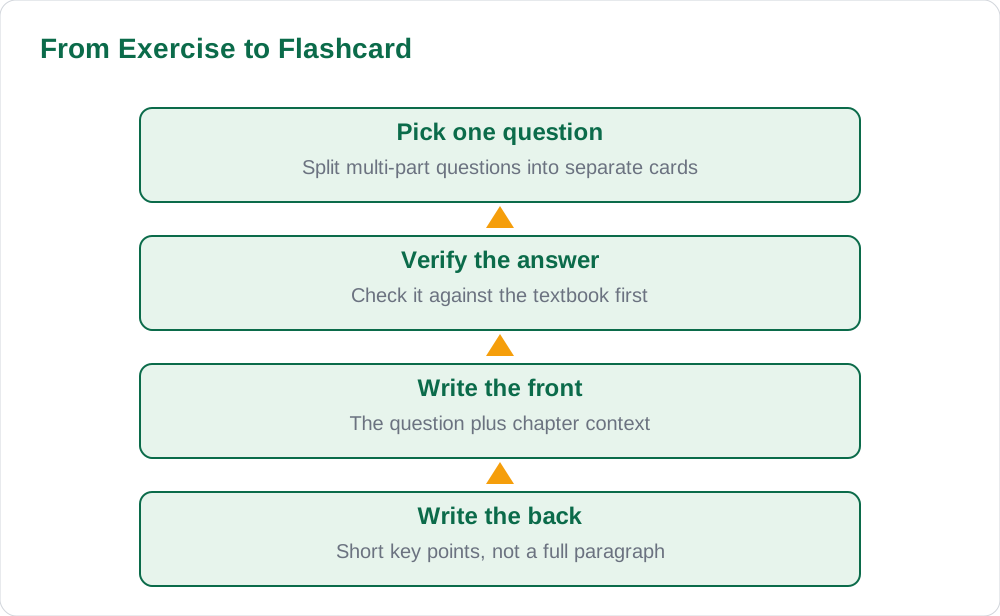
Each flashcard starts with one exercise question, simplified if needed so the card asks a single thing. A question with two parts becomes two cards, because a card that asks two things cannot be marked right or wrong cleanly. The front of the card carries the question plus a small hint of context, such as the chapter or lesson name, so the pupil knows which topic the card belongs to. The back carries the answer in short form: key points, not a full paragraph, since a long back is hard to check at a glance.
Only verified answers belong on cards. Before making a card, the pupil should check the answer against the textbook, using the routine in How to Check Your Answers Against the Textbook, because a flashcard teaches whatever is written on it, right or wrong. A card with an error will be revised repeatedly, which makes the error harder to remove later. Taking a minute to verify before card-making is the most important quality rule in this whole method.
Card Types for Different Subjects
Different subjects suit different card shapes. For language subjects, a card might ask for a word meaning, with the meaning and an example sentence on the back. For Islamiat, a card might ask for an explanation, with two or three key points on the back. For science, a card might ask for a process, with the steps in order on the back. For mathematics, a card might present a problem type, with the method steps on the back rather than only the final answer, since the method is what must be learned.
Diagram questions can become cards too: the front names the diagram and asks for its labels, while the back lists the labels in order. This works well for science topics where labelling is tested. The rule for every type is the same: one question per card, a short checkable answer, and verified content. Pupils should also keep cards grouped by subject and chapter, so a revision session can target exactly the chapter being tested.
- Language cards: word on the front, meaning plus example on the back.
- Explanation cards: question on the front, two or three key points on the back.
- Method cards: problem type on the front, steps in order on the back.
- Diagram cards: diagram name on the front, labels in order on the back.
Spaced Revision: When to Review Cards
Making cards is only half the method; reviewing them at the right times is the other half. Spaced revision means returning to cards at increasing intervals: the next day, then after a few days, then after a week, then after a fortnight. Cards answered correctly move to a longer interval, while cards missed return to daily review until they are known. This schedule matches how memory fades, and it means a pupil can maintain a whole term's knowledge in short daily sessions of ten to fifteen minutes.
A simple physical system works well: three boxes or piles labelled daily, weekly, and known. New cards start in the daily pile. A correct answer moves a card to the next pile; a wrong answer sends it back to daily. Pupils who prefer a phone or computer can use any free flashcard app with the same logic, but paper cards work just as well and have no distractions. The key is consistency: a short daily session beats a long session once a month, because spacing, not total time, is what builds lasting memory.
Keeping Cards Useful All Year
Cards stay useful when they are maintained. Each week, the pupil should remove cards that are fully known and add cards from the newest exercises, so the deck always reflects current learning. Cards for chapters already tested should be kept, not thrown away, because final exams cover the whole year, and a known pile reviewed monthly keeps old chapters alive with almost no effort. A card that is repeatedly missed deserves attention: the pupil should re-read the lesson passage, rewrite the back in simpler words, or split the card into two easier cards.
Cards also pair well with solved notes. The solved-notes folder holds full answers, while the card deck holds quick-recall versions, and the two support each other: notes explain, cards test. Pupils who keep both, organised by subject and chapter as described in How to Organise a Solved-Notes Folder by Subject and Chapter, arrive at exam time with a complete revision system rather than a pile of loose papers. Browse the solved notes collection for more methods that turn homework into lasting learning.
AI Help: Muse AI
Muse AI is Meta's personal AI assistant, and it can help with flashcards in a practical way. A pupil can ask Muse to suggest a shorter way to phrase a card answer, or to turn a long explanation into key points that fit on the back of a card.
Join Muse with invite code LTGSWD — in the Muse app, go to Settings > Redeem token and enter the code.
Disclosure: LTGSWD is the author's Muse invite code.
Muse AI does not give official STBB answers — always verify against your Sindh Textbook Board book and your teacher.
5 key points you must know
- One exercise question becomes one flashcard; split multi-part questions.
- Only verified, textbook-checked answers belong on cards.
- Card backs carry short key points, not full paragraphs.
- Review with spacing: daily, then weekly, then monthly for known cards.
- Keep cards grouped by subject and chapter for targeted revision.
Frequently asked questions
How many flashcards should I make per chapter?
As many as the chapter's exercises require, typically ten to twenty. Cover every important question, but do not make a card for trivial details. Quality matters more than quantity: a deck of verified, single-question cards beats a large deck of vague ones.
Should I use paper cards or an app?
Either works, provided the logic is the same: one question per card, short verified answers, and spaced review. Paper cards suit pupils who are distracted by phones, while apps suit pupils who revise on the move. Choose the one you will actually use daily.
What should I do with a card I keep getting wrong?
Re-read the lesson passage, rewrite the back in simpler words, or split the card into two easier cards. A stubborn card usually means the underlying point is not yet understood, and understanding must be fixed before memorisation can work.
How long should a daily flashcard session last?
Ten to fifteen minutes is enough for most pupils, covering the daily pile plus any cards due from longer intervals. Short daily sessions are the whole point of spaced revision: regular small efforts outperform rare long ones.
Solved notes — preview free
These guides work best with the solved exercises. Preview the solved notes free on this website — 119 solved notes for Classes 6–10 in Sindhi, Urdu, English and Arabic medium. Or browse the full solved notes catalogue for your class and medium. New solved notes are added regularly — check the catalogue for coming-soon books.