Two-Statement and Reason MCQs: A Decision Method
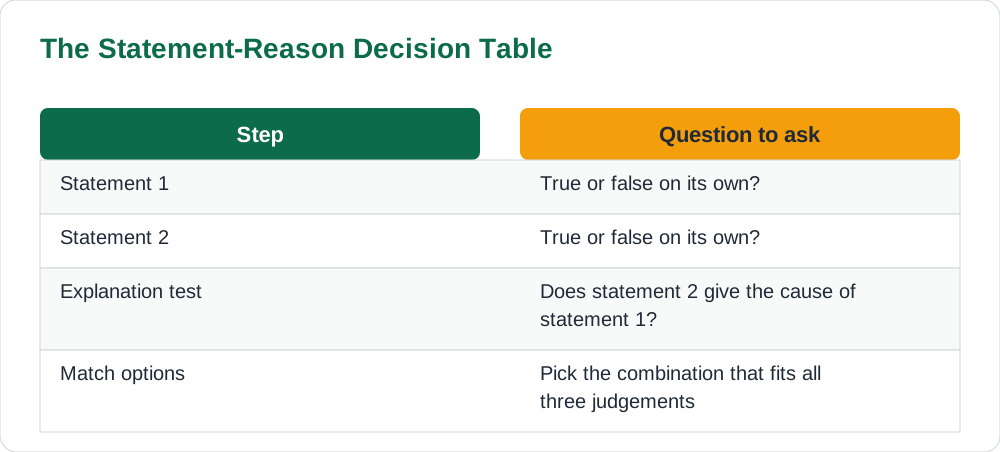
Two-statement and reason MCQs look intimidating, but they become straightforward once you use a decision method instead of trying to judge everything at once. These questions give you two statements, often called statement and reason, and ask whether each is true and whether the second explains the first. Many students read both statements together, form a vague feeling that they seem related, and pick the wrong combination. The reliable method is to separate the task into three small judgements: is the first statement true, is the second statement true, and does the second actually explain the first? This guide teaches you that true-false table method step by step, shows you the common traps in statement-reason questions, and helps you answer them calmly in any subject.
Why These Questions Feel Harder Than They Are
Statement-reason questions feel hard because they combine two judgements into one question, and each judgement can mislead you. A student may know the first statement is true but be unsure about the second, and the uncertainty spreads to the whole answer. Another student may see that both statements are true and assume the second must explain the first, even when the two statements are about unrelated ideas. The question format itself adds pressure, because the options are combinations like both true with explanation, both true without explanation, or one true and one false, and a single wrong judgement changes the answer completely.
The solution is to stop treating the question as one big decision and start treating it as three small ones. Judging one statement at a time is a skill you already have from ordinary MCQs, and combining three small judgements is far easier than making one large judgement under pressure. Once you build the habit of writing a small true-false table beside the question, even mentally, the intimidation fades, and these questions become some of the most predictable marks on the paper. Many students who learn this method find statement-reason questions easier than ordinary MCQs, because the method leaves less room for vague guessing. More methods are on the blog.
Step One: Judge Each Statement Separately
Cover the second statement and judge the first one on its own: is it true or false according to your lesson? Use the same care you would for an ordinary true-false question, checking key words, numbers, and qualifiers. Then cover the first statement and judge the second one independently, without letting the first statement influence you. This independence matters, because a true first statement can make a false second statement feel true, and a familiar second statement can make you overlook an error in the first. Write T or F beside each statement, or hold the two letters firmly in mind, before you even glance at the combination options.
If you are unsure about a statement, look for one clear fact that decides it. A statement is false if any essential part of it is wrong, even if the rest sounds correct, so hunt for the weakest link in the statement rather than its most familiar phrase. Conversely, a statement is true only if all its essential parts hold together, including any cause, condition, or quantity it claims. When a statement is partly true but contains one false detail, mark it false and note the detail, since that detail is usually the point of the question. This strict standard prevents the half-true statements that trap most students. See Reading MCQ Stems Carefully: Negatives and Traps for wording traps.
Step Two: Judge Whether the Reason Explains the Statement
Only after both statements are judged true should you ask whether the second explains the first, because explanation is a separate question from truth. Two statements can both be true yet unrelated, such as two facts from the same chapter that have no causal link, and choosing the explanation option in that case is wrong. To test explanation, ask whether the second statement gives the cause, mechanism, or reason behind the first statement, or whether it merely restates it, describes a different topic, or gives a side effect. A genuine explanation answers the question why the first statement holds, while a non-explanation answers a different question or no question at all.
Watch out for the restatement trap, where the second statement repeats the first in different words and feels like an explanation because it agrees with it. Agreement is not explanation: a true explanation must add the underlying cause or process. Also watch for reversed causation, where the second statement describes an effect of the first rather than its cause, which is not an explanation either. A useful test is to join the statements with because and see whether the combined sentence makes sense as a causal claim. If it sounds forced or circular, the reason does not explain the statement, even though both are true. The solved notes include practice with such questions.
Matching Your Judgements to the Options
With your three judgements in hand, matching the options becomes mechanical. If either statement is false, eliminate every option claiming both are true, which usually removes half the options at once. If both are true but the second does not explain the first, choose the both-true-without-explanation option. Only when both are true and the second genuinely explains the first should you choose the explanation option. Work through the options by elimination rather than searching for one that feels right, because the combination format makes feeling-based choices unreliable. This mechanical matching is the method's great strength: it replaces anxiety with procedure.
Be careful with options that differ only in the explanation claim, since that is where most remaining errors happen. Re-read the two statements together once more before finalising an explanation choice, and ask the because test again. If you still cannot decide whether the reason explains the statement, consider which error is more likely: test setters include the both-true-without-explanation option precisely because many true pairs are unrelated, so do not default to the explanation option. Choose the explanation option only when you can state the causal link in your own words, not merely when the statements feel connected. That standard keeps you honest and accurate. For option strategy, read The Elimination Technique for MCQs: Removing Wrong Options.
Practising Statement-Reason Questions
Practise statement-reason questions by writing the true-false table for every one, even when the answer seems obvious, because the habit must survive exam pressure. After answering, check not just whether your option was right, but whether each of your three judgements was right, since a correct option reached through a wrong judgement is still a weakness. Keep a note of which judgement fails most often for you: judging statements, or judging explanations. Most students find explanation judgements harder, and targeted practice on causal links, such as asking why a fact holds after every lesson, strengthens that skill directly.
In the exam, give statement-reason questions slightly more time than ordinary MCQs, perhaps ninety seconds instead of sixty, because they contain three judgements. That extra time is an investment, not a waste, since these questions often carry the same mark as simpler ones but are answered correctly far less often. If a statement-reason question resists your method after two careful readings, mark it and return later, when a fresh mind may spot the false detail or the missing causal link. Returning with the table method intact usually resolves what first-pass confusion could not. The books page lists textbooks to practise from.
AI Help: Muse AI
Muse AI is Meta's personal AI assistant, and it can help you practise two-statement and reason MCQs. For example, you can ask it to create statement-reason practice questions and explain why a reason does or does not explain the first statement.
Join Muse with invite code LTGSWD — in the Muse app, go to Settings > Redeem token and enter the code.
Disclosure: LTGSWD is the author's Muse invite code.
Muse AI does not give official STBB answers — always verify against your Sindh Textbook Board book and your teacher.
5 key points you must know
- Judge each statement separately as true or false before looking at the combinations.
- Only ask about explanation after both statements are judged true.
- Use the because test: a real reason gives the cause behind the first statement.
- Eliminate options mechanically using your three judgements, not by feeling.
- Give these questions extra time, since they contain three judgements in one.
Frequently asked questions
What if both statements are true but I cannot tell if one explains the other?
Try to state the causal link in your own words. If you cannot, the reason probably does not explain the statement, and you should choose the both-true-without-explanation option rather than defaulting to the explanation choice.
What if I am unsure whether a statement is true?
Look for the statement's weakest link: one false detail makes the whole statement false. If you still cannot decide, mark the question, answer the rest of the paper, and return with a fresh mind before finalising.
Is agreement between statements the same as explanation?
No. Agreement means both statements point the same way, while explanation means the second gives the cause or mechanism behind the first. A restatement agrees but does not explain, so it belongs in the without-explanation category.
How much time should a statement-reason question take?
Allow about ninety seconds: thirty for each statement and thirty for the explanation test and option matching. That is slightly more than an ordinary MCQ, but the method makes the extra time pay off in accuracy.
Solved notes — preview free
These guides work best with the solved exercises. Preview the solved notes free on this website — 119 solved notes for Classes 6–10 in Sindhi, Urdu, English and Arabic medium. Or browse the full solved notes catalogue for your class and medium. New solved notes are added regularly — check the catalogue for coming-soon books.