States of Matter: What Melting, Freezing and Evaporation Really Mean
Everything around you is matter, and matter usually appears as a solid, a liquid, or a gas. An ice cube is a solid with a fixed shape. The water in a glass is a liquid that takes the shape of its container. The steam rising from a kettle is a gas that spreads out and fills the space around it. What makes these three forms different is not the material itself, but how its tiny particles behave and how much energy they have. When you heat or cool matter, you change that energy, and the matter can change state. This article explains melting, freezing, evaporation, and condensation using water, ice, and steam, so you can picture each change clearly and describe it in exam answers. For chapter revision, see the [solved notes](/books.html) and the [books page](/books.html).
Solids, Liquids, and Gases in Plain Words
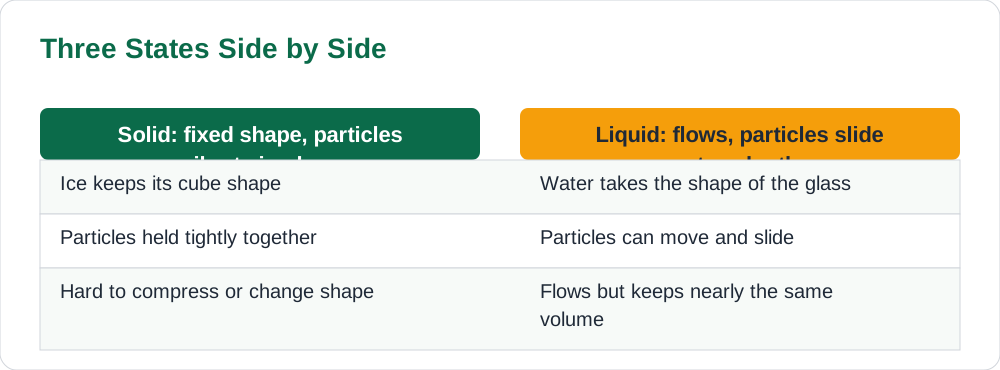
A solid keeps its shape because its particles are held tightly together and can only vibrate in place. A book stays a book, an ice cube stays a cube, and a stone stays a stone unless a force breaks or melts it. A liquid has particles that can slide past each other, so it flows and takes the shape of its container while keeping almost the same volume. Pour water from a jug into a glass and it changes shape but stays the same amount of water. A gas has particles that move freely and spread apart, so it fills whatever container it is in and can be compressed into a smaller space. The air in a room spreads everywhere, and the steam from a kettle drifts away and mixes with the air.
Temperature and pressure affect how particles behave. Heating adds energy, so particles move faster and spread further apart. Cooling removes energy, so particles slow down and pull closer together. That is why ice melts when it warms and water freezes when it cools. It also explains why a balloon left in the sun may feel tighter as the air inside warms and pushes outward. You do not need to memorise complicated definitions if you remember this one idea: the state of matter depends on how much energy the particles have and how freely they can move.
- Solids keep shape: particles vibrate in fixed positions.
- Liquids flow: particles slide past each other and take the container shape.
- Gases spread: particles move freely and fill the available space.
- Heating adds energy and speeds particles; cooling slows them down.
Melting and Freezing: The Ice and Water Story
Melting happens when a solid gains enough heat energy to loosen the hold on its particles, so it becomes a liquid. An ice cube left on a plate melts because heat from the air and the plate gives its particles more energy. The ice does not jump straight to warm water. First it changes state while staying cold, then the liquid water slowly warms up. That is why a glass of iced water stays cold while the ice is melting: much of the heat goes into the change of state rather than warming the drink. The temperature at which a solid melts is called its melting point, and for ice it is the familiar point where ice and water exist together.
Freezing is the reverse process. When liquid water loses enough heat energy, its particles slow down and lock into fixed positions, forming solid ice. Water in a freezer tray turns to ice because the cold air removes heat from it. Freezing does not mean the water becomes cold in a vague sense; it means the particles have lost enough energy to hold a fixed shape. Other liquids freeze at different temperatures, which is why cooking oil, wax, and water behave differently in the cold. In exam answers, always name the direction of energy: melting takes in heat, freezing gives out heat.
- Melting: solid gains heat, particles loosen, solid becomes liquid.
- Freezing: liquid loses heat, particles lock into place, liquid becomes solid.
- During melting, heat goes into the change of state, not just warming.
- Name the energy direction in every exam answer.
Evaporation and Condensation: The Invisible Changes
Evaporation happens when a liquid turns into a gas at the surface, even without boiling. A wet towel dries on a line because water particles at the surface gain enough energy to escape into the air as invisible vapour. Warm, dry, windy days speed up evaporation because more particles gain energy and the vapour is carried away. A puddle shrinks on a sunny day for the same reason. Evaporation is slow and quiet, which is why pupils sometimes miss it. The water does not disappear; it changes into a gas that mixes with the air. That idea matters for the water cycle, which is explained in the article on the water cycle and Sindh climate.
Condensation is the reverse: a gas turns into a liquid when it loses energy. On a cool morning, water vapour in the air touches a cold surface, such as a metal bottle or a window, and forms tiny droplets. The cold surface removes energy from the vapour, so its particles slow down and clump together as liquid. Clouds form in a similar way high in the air, where water vapour cools and condenses on tiny dust particles. If you see droplets on the outside of a cold glass, that water came from the air, not from inside the glass. That small observation is a strong exam example because it shows condensation clearly.
- Evaporation: liquid to gas at the surface, even without boiling.
- Warm, dry, windy conditions speed up evaporation.
- Condensation: gas to liquid when vapour loses energy on a cool surface.
- Droplets on a cold glass come from vapour in the air.
Boiling, and How It Differs from Evaporation
Boiling is also a change from liquid to gas, but it happens throughout the liquid, not only at the surface. When water in a kettle boils, bubbles form inside the water and rise, carrying vapour into the air. Evaporation happens quietly at the surface at many temperatures, while boiling happens quickly throughout the liquid at a specific temperature for that liquid under the same pressure. That distinction is a common exam question, so learn it as a comparison rather than two separate facts. Evaporation cools the remaining liquid because the fastest particles escape first, which is why sweat drying on skin feels cool. Boiling needs steady heat to keep the change going.
A simple classroom comparison makes the difference clear. Leave a shallow dish of water on a desk and watch it shrink slowly over hours without bubbles: that is evaporation. Heat water in a kettle and watch bubbles rise and steam rush out: that is boiling. Both produce water vapour, but the speed, the place, and the conditions differ. When you write about either process, name the starting state, the ending state, and whether heat is taken in or given out. That three-part sentence structure works for every change of state and keeps your answer complete. More exam writing habits appear in the science write-up guide.
- Evaporation: surface only, quiet, happens at many temperatures.
- Boiling: throughout the liquid, bubbly, happens at a set temperature.
- Evaporation cools the remaining liquid as fast particles escape.
- Both produce vapour, but speed, place, and conditions differ.
Everyday Changes You Can Observe and Explain
The states of matter appear in ordinary life all week. Butter melts in a warm pan, wax melts near a flame, and ice melts in a drink. Water freezes in a freezer tray, and dew forms on grass on a cool morning. A wet school uniform dries on a line, and steam fogs a bathroom mirror after a hot shower. Each of these is a change of state you can name and explain with the same pattern: what was the starting state, what is the ending state, and did the matter gain or lose heat energy. Practise by picking one example each day and writing a two-sentence explanation in your notebook. That habit turns everyday life into revision without extra study time.
Try a simple observation at home with an adult nearby. Put an ice cube on a plate and watch it melt, noting how long it takes and whether the plate feels cold. Put a cold metal spoon against a steamy kettle spout, kept at a safe distance, and watch droplets form as vapour condenses. Hang two identical damp cloths, one in sun and one in shade, and compare drying times. These small tests show melting, condensation, and evaporation in action. Record what you see in a table with time, conditions, and change of state, and you will have a strong revision page for exams. For more everyday science, see the study blog.
- Pick one change of state each day and explain it in two sentences.
- Name the starting state, ending state, and heat direction every time.
- Use safe home observations: melting ice, condensing steam, drying cloths.
- Record time, conditions, and change of state in a small table.
AI Help: Muse AI
Muse AI is Meta's personal AI assistant, and it can help you explain melting, freezing, evaporation, and condensation in simple words with a new everyday example for each change.
Join Muse with invite code LTGSWD — in the Muse app, go to Settings > Redeem token and enter the code.
Disclosure: LTGSWD is the author's Muse invite code.
Muse AI does not give official STBB answers — always verify against your Sindh Textbook Board book and your teacher.
5 key points you must know
- Solids, liquids, and gases differ in how their particles move and how much energy they have.
- Melting takes in heat; freezing gives out heat.
- Evaporation is a slow surface change; boiling is a fast change throughout the liquid.
- Condensation turns vapour into liquid when it loses energy on a cool surface.
- Every change of state can be described by start state, end state, and heat direction.
Frequently asked questions
What is the difference between melting and dissolving?
Melting is a change of state caused by heat, such as ice becoming water. Dissolving is one substance mixing into another, such as salt disappearing into water. The salt is still there in the solution, while melted ice is the same substance in a new state.
Does evaporated water disappear?
No. Evaporated water becomes invisible water vapour mixed with the air. It has changed state, not vanished. Later it can cool and condense back into droplets, which is part of the water cycle.
Why does a glass of iced water stay cold while the ice melts?
Much of the heat from the air goes into melting the ice, which is a change of state, rather than warming the water. While ice remains, the drink stays near the melting point. Once the ice is gone, the water warms more quickly.
Where does the water on the outside of a cold glass come from?
It comes from water vapour in the air. The cold glass removes energy from the vapour, so it condenses into liquid droplets on the surface. It does not leak through the glass from inside.
How should I answer a change-of-state question in an exam?
Name the starting state, the ending state, and whether heat is taken in or given out, then give one clear example. For instance, evaporation is liquid to gas, takes in heat, and dries a wet towel on a line.
Solved notes — preview free
These guides work best with the solved exercises. Preview the solved notes free on this website — 119 solved notes for Classes 6–10 in Sindhi, Urdu, English and Arabic medium. Or browse the full solved notes catalogue for your class and medium. New solved notes are added regularly — check the catalogue for coming-soon books.