The Water Cycle and Sindh's Climate: Rivers, Rain and Farming
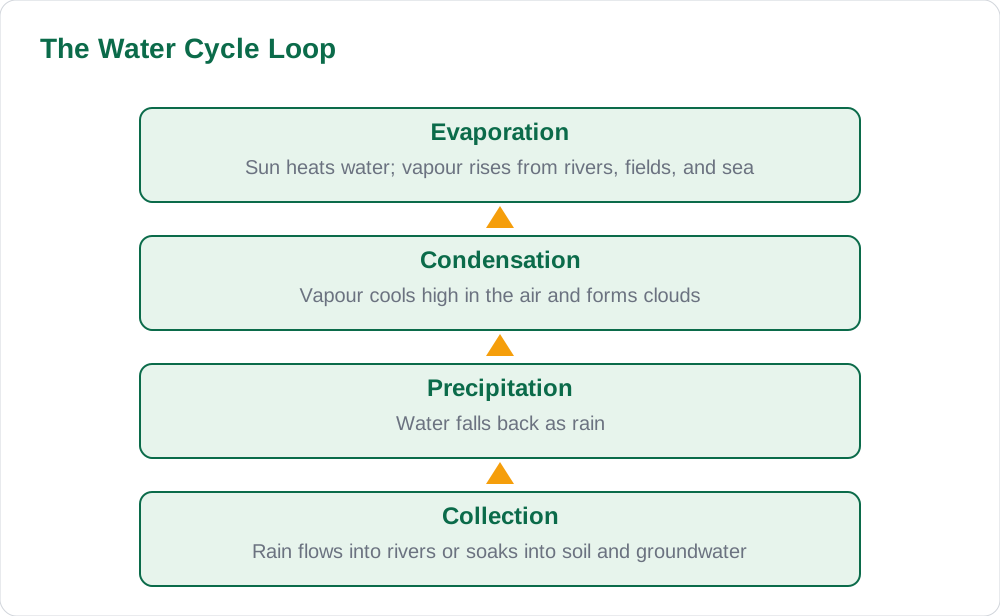
The water cycle is the endless journey of water between the sky, the land, and the sea. Water evaporates from rivers, fields, and the sea, rises into the air, cools and condenses into clouds, falls back as rain, and then flows across the land or soaks into the ground before the journey begins again. In Sindh, this cycle shapes the seasons, the rivers, and the farming that feeds so many families. When rain is timely, crops grow well. When rain is late or heavy, fields, homes, and roads feel the effect. This article explains the water cycle through Sindh's climate, rivers, and farming, so pupils can connect a textbook diagram to the weather they see. For more study support, see the [solved notes](/books.html) and the [books page](/books.html).
Evaporation: Water Rises into the Air
Evaporation starts the water cycle. Heat from the sun turns liquid water into invisible water vapour, which rises into the air. Water evaporates from the Indus River, canals, fields, ponds, wet soil, and the sea. Plants also release water vapour from their leaves, a process that adds moisture to the air. On a hot, dry, windy day, evaporation is faster because more water particles gain energy and the vapour is carried away. That is why a wet field dries quickly in summer wind, and why a puddle shrinks faster at noon than in the cool evening.
Evaporation is easy to miss because vapour is invisible. Pupils sometimes think the water has disappeared, but it has only changed state from liquid to gas. The same idea was explained in the article on states of matter, where evaporation was shown as a surface change that does not need boiling. In the water cycle, that invisible vapour is the raw material for clouds. Without evaporation, there would be no clouds and no rain, so this quiet, unseen step is the foundation of the whole cycle.
- Heat turns liquid water into invisible vapour that rises.
- Water evaporates from rivers, canals, fields, soil, and the sea.
- Plants release vapour from leaves, adding moisture to the air.
- Hot, dry, windy days speed up evaporation.
Condensation and Clouds: Vapour Becomes Visible
As water vapour rises, the air gets cooler. The vapour loses energy, slows down, and condenses into tiny droplets on dust particles in the air. Millions of those droplets together form a cloud. A cloud is not a solid object; it is a mass of tiny droplets or ice crystals floating in the air. When the droplets grow large and heavy enough, they fall as rain. That is why clouds often look darker before rain: they hold more water and let less sunlight through.
Condensation also happens near the ground. On a cool morning, dew forms on grass when vapour touches a cold surface and turns into droplets. Fog is a cloud at ground level, formed when moist air cools near the ground. Pupils can see condensation on a cold bottle on a humid day: droplets form on the outside because vapour in the air loses energy on the cold surface. The same process, on a much larger scale, builds clouds. Linking the small example to the large one helps pupils remember that condensation is one process with many forms.
- Rising vapour cools and condenses into tiny droplets on dust.
- A cloud is many tiny droplets or ice crystals floating together.
- Heavy droplets fall as rain when they grow large enough.
- Dew, fog, and droplets on a cold bottle are also condensation.
Rain, Rivers, and the Land of Sindh
When rain falls on Sindh, part of it flows across the land into drains, canals, and the Indus River, part soaks into the soil, and part is taken up by plants. The Indus River carries water through Sindh to the sea, and canals spread that water to fields for farming. Rivers and canals are therefore not separate from the water cycle; they are the collection and movement stage of it. After heavy rain, rivers rise because more water is arriving than the channel can carry away. After long dry periods, river levels fall because evaporation and use exceed the water arriving from rain and upstream flow.
The ground also stores water. Rain that soaks into soil can reach groundwater, which wells and hand pumps draw upon. Soil that is covered with plants holds water better than bare, hard ground, because roots and leaves slow the flow and let water soak in. That is one reason why caring for plants and soil matters for water as well as for food. When pupils draw the water cycle, they should show rain falling on land, water flowing to a river, water soaking into the ground, and water evaporating again, so the loop is complete. A diagram that ends at rain misses the most important idea: the cycle keeps going.
- Rain flows to rivers, soaks into soil, or is taken up by plants.
- The Indus River and canals carry and spread water for farming.
- Groundwater stores rain that soaks deep into the soil.
- Plant-covered soil holds water better than bare, hard ground.
Seasons, Farming, and Why Timing Matters
Farming in Sindh depends on water arriving at the right time and in the right amount. Crops need water when they are growing, but too much water at harvest time can damage grain and make fields hard to work. A late monsoon can delay sowing, while a very heavy spell can flood low fields and roads. Farmers watch the sky, the river, and the soil together, because each tells part of the story. School pupils can learn the same habit by keeping a simple weather diary: date, cloud type, rain or no rain, and how wet the soil feels. Over a term, that diary shows patterns that a single day cannot.
The water cycle also explains why water must be used carefully. Water that is wasted on a field does not vanish, but it may flow away before crops can use it, or it may carry soil with it. Saving water through careful irrigation, fixing leaks, and mulching soil helps more of the rain and river water reach the plants. These habits connect science to daily life and to the article on recycling at school, where caring for resources is the central theme. Pupils who understand the cycle can explain why water is precious even when it seems to fall freely from the sky.
- Crops need water at the right time, not only the right amount.
- Late or very heavy rain can delay sowing or flood fields.
- A simple weather diary shows seasonal patterns over a term.
- Careful irrigation and mulching help water reach crops.
Observing the Water Cycle Where You Live
You can observe the water cycle without leaving your neighbourhood. Watch a puddle after rain and note how long it takes to shrink in sun and in shade. Look for dew on grass in the early morning and clouds building in the afternoon. Notice where rainwater flows after a shower: into a drain, into a field, or into a pond. Ask where that water goes next. Each observation is a piece of the cycle, and writing it down makes the textbook diagram feel real. A short table with date, weather, and what you saw is enough to build a useful record.
A class project can make the cycle even clearer. Pupils can measure rainfall with a simple gauge made from a bottle, record river or canal levels if the teacher arranges a safe visit, and track how soil moisture changes after rain. They can also draw a local water cycle diagram showing the river, fields, clouds, and sea, with arrows for evaporation, condensation, rain, and flow. That local diagram is more memorable than a generic one because it shows the places pupils know. For more on writing up observations, see the science write-up guide.
- Watch puddles, dew, clouds, and rainwater flow in your area.
- Record date, weather, and what you saw in a short table.
- Measure rainfall with a simple bottle gauge in a class project.
- Draw a local water cycle with the river, fields, clouds, and sea.
AI Help: Muse AI
Muse AI is Meta's personal AI assistant, and it can help you explain the water cycle in simple words and link each stage to a local example from Sindh's rivers, rain, and farming.
Join Muse with invite code LTGSWD — in the Muse app, go to Settings > Redeem token and enter the code.
Disclosure: LTGSWD is the author's Muse invite code.
Muse AI does not give official STBB answers — always verify against your Sindh Textbook Board book and your teacher.
5 key points you must know
- The water cycle is evaporation, condensation, precipitation, and collection, driven by the sun.
- Clouds form when rising vapour cools and condenses into tiny droplets.
- Rain flows to rivers, soaks into soil, or is taken up by plants.
- Farming depends on water arriving at the right time and in the right amount.
- Local observation makes the textbook water cycle real and memorable.
Frequently asked questions
What drives the water cycle?
Heat from the sun drives the cycle by evaporating water from rivers, fields, soil, and the sea. That vapour rises, cools, condenses into clouds, falls as rain, and collects again. Without the sun's heat, the cycle would slow and stop.
What is the difference between dew and fog?
Both are condensation near the ground. Dew is liquid droplets that form on cool surfaces such as grass when vapour condenses there. Fog is a cloud at ground level, made of tiny droplets floating in the air when moist air cools.
Where does rainwater go after it falls?
Some flows across the land into drains, canals, and rivers, some soaks into the soil and becomes groundwater, and some is taken up by plants. The exact split depends on the soil, the slope, and how heavy the rain is.
Why does Sindh farming depend so much on the water cycle?
Crops need water at the right growth stages. Rain and river water supply that water, so late, light, or very heavy rain affects sowing, growth, and harvest. Careful irrigation helps farmers use the available water at the right time.
How can pupils observe the water cycle safely?
Watch puddles shrink, dew form, clouds build, and rainwater flow, and record what you see with dates. A class can measure rainfall with a simple bottle gauge and draw a local cycle diagram. No risky visits to rivers or canals are needed.
Solved notes — preview free
These guides work best with the solved exercises. Preview the solved notes free on this website — 119 solved notes for Classes 6–10 in Sindhi, Urdu, English and Arabic medium. Or browse the full solved notes catalogue for your class and medium. New solved notes are added regularly — check the catalogue for coming-soon books.