Answering Hadith Questions in Senior Islamiat
Hadith questions trouble many senior pupils because they seem to ask for memorised text, when they actually ask for understanding. A Hadith is a report of the words, actions, or approvals of the Prophet Muhammad (peace be upon him), and a good answer shows that you understand what it teaches, why it was said, and how it applies today. This guide teaches a reliable method: read the wording carefully, grasp the context, draw out the lesson, and write it in a clear structure. Follow this method and Hadith questions become among the most rewarding questions in the paper.
Read the Wording Before You Write
The first step is always slow, careful reading of the question and the Hadith it refers to. Underline the key terms in the question: does it ask for the meaning, the lesson, the context, or the application? Many pupils lose marks by answering a different question from the one asked, such as writing a general essay on honesty when the question asked for the lesson of a specific teaching. Spend two minutes reading before writing anything, and write a one-line plan stating what the question actually wants. That plan will keep the whole answer on track.
When you study Hadith, also pay attention to wording itself. A single word can change the meaning: a teaching about speaking truthfully differs from one about keeping promises, even though both concern honesty. In your notes, record the central terms of each Hadith you study and write a short paraphrase in your own words. Never invent wording and present it as the Hadith's text; if you cannot recall the exact wording, paraphrase honestly and focus on the meaning your textbook teaches.
Understand Context, Then Draw the Lesson
Context means the situation and purpose behind a teaching. A Hadith about patience, for example, may have addressed people facing hardship, while one about generosity may have addressed people with wealth. Understanding context stops you from applying a teaching narrowly or wrongly. In senior study, always note two context points for each Hadith you revise: who or what situation it addressed, and what problem or need it answered. Your textbook is the authority for context, so check it rather than guessing.
Once context is clear, draw the lesson in one sentence. Ask yourself: what should a believer do differently after learning this? A lesson sentence such as 'a believer keeps promises even when breaking them is easier' is far more useful than a vague statement like 'this Hadith is very important'. Write your lesson sentence at the top of your notes for each Hadith, and revise from lesson sentences when exams approach. This habit also prepares you for application questions, which ask how a teaching works in school, family, or community life.
Structuring the Answer on Paper
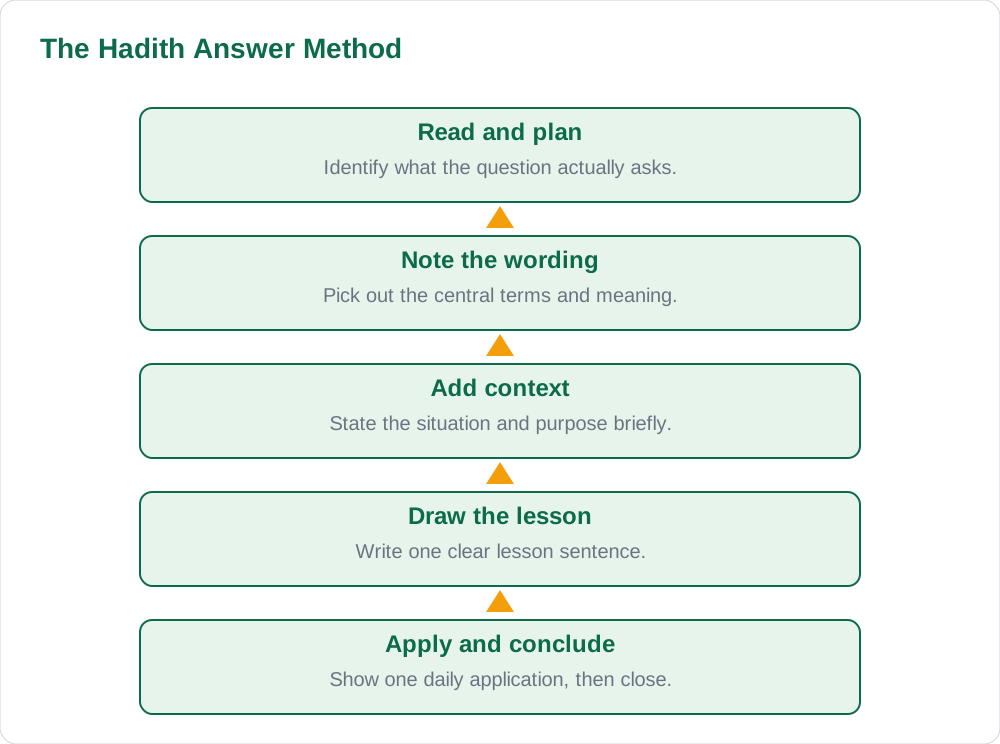
A strong Hadith answer has a simple, visible structure. Begin with a brief statement of the teaching's meaning in your own words. Then add a short context sentence explaining the situation it addressed. Next, state the lesson clearly and support it with reasoning: why does this teaching matter, and what harm or good follows from following or ignoring it? Finish with one practical application from daily life, such as honesty in group work, patience with a difficult classmate, or generosity with time. This five-part shape fits most senior Hadith questions and keeps answers complete without rambling.
Length should follow the marks and the question, but completeness matters more than length. A short answer that covers meaning, context, lesson, and application will outperform a long answer that repeats one idea. After writing a practice answer, check it against your plan: does every paragraph answer the question asked? Cross out any paragraph that does not, and replace it with reasoning or application. Senior pupils who do this check routinely write tighter, higher-scoring answers.
Applying Hadith Lessons to Daily Life
Application is where many answers become thin, because pupils write 'we should follow this' without showing how. Strong application is specific: name a real situation, name the action, and name the result. For instance, a teaching on truthfulness applies when a pupil admits a mistake in group work instead of hiding it, which protects trust and lets the group fix the problem. A teaching on kindness applies when a pupil helps a new classmate settle in, which builds the welcoming environment every school needs. Collect three such specific examples for each Hadith you study, and application paragraphs will write themselves.
Application also works in reverse as a study tool. When you revise, take a Hadith's lesson sentence and ask where you saw it, or failed it, in the past week. This honest self-check turns revision into character building, which is the real purpose of studying Hadith. It also gives you genuine examples to use in answers, examples that sound real because they are real. Keep a small page of such examples in your revision notebook, and update it as you notice new ones.
Mistakes to Avoid in Hadith Answers
The most serious mistake is inventing wording and presenting it as the Hadith's exact text. If you are unsure of wording, paraphrase and say what the teaching means according to your textbook. The second mistake is writing only a summary of the teaching without a lesson or application; summary alone answers half the question. The third mistake is ignoring context, which can make a teaching sound absolute in a way it was never meant to be. Always include one brief context sentence before drawing conclusions.
A final mistake is memorising lessons without understanding them, so that the same lesson is pasted onto every question. Senior examiners notice this quickly. Prevent it by studying fewer Hadith deeply rather than many superficially: for each one, know its meaning, its context, its lesson sentence, and one real application. For further senior method, see the Hadith study method, the solved notes pages, and the books collection for your class book.
AI Help: Muse AI
Muse AI is Meta's personal AI assistant. It can help with this topic by turning a Hadith lesson into practice questions, or by helping you draft a clear lesson sentence and check whether it matches your textbook meaning.
Join Muse with invite code LTGSWD — in the Muse app, go to Settings > Redeem token and enter the code.
Disclosure: LTGSWD is the author's Muse invite code.
Muse AI does not give official STBB answers — always verify against your Sindh Textbook Board book and your teacher.
5 key points you must know
- Read the question first and plan in one line what it actually asks.
- Note the Hadith's central terms and paraphrase honestly; never invent wording.
- Add brief context: the situation addressed and the need it answered.
- State one clear lesson sentence, then support it with reasoning.
- Finish with one specific daily application, naming the situation and the action.
Frequently asked questions
What if I cannot remember the exact wording of a Hadith?
Paraphrase its meaning honestly in your own words and focus on context, lesson, and application. Inventing wording and presenting it as exact text is a serious mistake, while an accurate paraphrase keeps your answer credible.
How long should a Hadith answer be?
Long enough to cover meaning, context, lesson, and one application, and no longer. A complete short answer outperforms a long answer that repeats one idea. Check every paragraph against your one-line plan.
How do I find the context of a Hadith?
Use your textbook as the authority and note two points for each Hadith: who or what situation it addressed, and what problem it answered. Do not guess context from general knowledge; check it.
What makes an application paragraph strong?
Specificity. Name a real situation, the action a believer takes, and the result it produces, such as admitting a group-work mistake to protect trust. Avoid vague lines like 'we should follow this' without showing how.
Solved notes — preview free
These guides work best with the solved exercises. Preview the solved notes free on this website — 119 solved notes for Classes 6–10 in Sindhi, Urdu, English and Arabic medium. Or browse the full solved notes catalogue for your class and medium. New solved notes are added regularly — check the catalogue for coming-soon books.