Roza and Hajj: Worship and Lessons for Senior Pupils
Roza, the fast, and Hajj, the pilgrimage, are two great acts of worship that shape a Muslim's year and life. Roza comes each year and trains daily discipline, while Hajj comes once in a lifetime for those able, and gathers Muslims from every land in one place of worship. Senior Islamiat asks pupils to understand both as worship with lessons, not only as rituals to describe. This guide explains Roza and Hajj at senior depth, drawing lessons in discipline, patience, unity, and gratitude that apply long after the fast ends or the pilgrimage is complete.
Roza: Worship That Trains Daily Discipline
Roza is the fast observed in the month of Ramazan, in which a Muslim abstains from food, drink, and other invalidating acts from dawn to sunset, as an act of worship and obedience. Its purpose is not hardship for its own sake; it is training. A fasting person learns to control appetite, to guard speech, to use time well, and to feel the hunger that poor people feel daily. Senior pupils should explain Roza in this way: as worship that disciplines the whole person, body and character together, rather than as a list of rules alone.
The discipline of Roza extends beyond the fast itself. A person who can control eating and drinking for a whole day can also learn to control anger, gossip, and wasted time. This is why senior answers should connect Roza with character: patience with family during long days, honesty in work despite tiredness, and generosity toward those who fast in harder conditions. When you revise Roza, write one lesson for the body, one for speech, and one for conduct, so that your notes cover the whole person.
Hajj: Worship That Teaches Unity
Hajj is the pilgrimage to Makkah, performed once in a lifetime by those who are able, in which pilgrims from every country, language, and background worship together in the same simple dress and the same rites. Its central lesson is unity: before Allah, distinctions of wealth, nationality, and status fall away, and every pilgrim stands equal. Senior pupils should explain Hajj as both a journey and a lesson: a journey of devotion, sacrifice, and patience, and a lesson that the Muslim community is one family bound by common worship.
Hajj also teaches patience and sacrifice in practical ways. Pilgrims travel far, endure crowds and heat, follow a fixed order of rites, and give up comforts of home. These hardships are part of the worship, because they train the pilgrim to put obedience above convenience. When you study Hajj, note both dimensions: the rites as acts of worship, and the conditions of the journey as training in patience. An answer that covers only one dimension is only half complete.
Lessons That Last Beyond the Act
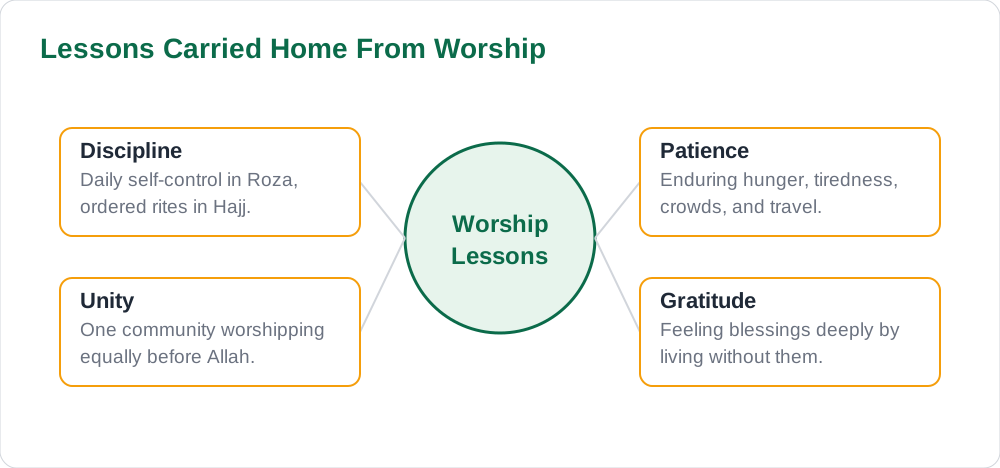
The most valuable senior question about Roza and Hajj is what remains after they end. Roza leaves a trained appetite and a habit of self-control that can be used all year: in study routines, in spending, and in speech. Hajj leaves a sense of unity and humility that can be used at home: treating every Muslim as a brother or sister, judging no one by wealth or origin, and serving the community without pride. Senior answers should always include a 'lessons that last' paragraph, because it shows that worship changes life, not only fills days.
Gratitude is another lasting lesson of both acts. Fasting teaches gratitude for food and water by their temporary absence, while pilgrimage teaches gratitude for home, health, and the ability to travel by their temporary surrender. A pupil who has felt these lessons can write about gratitude with real feeling rather than borrowed phrases. In your notes, keep a short gratitude list for each act: three blessings that the act made you notice. Such lists make revision personal and answers convincing.
Writing Senior Answers on Roza and Hajj
A senior answer on Roza or Hajj should open with a clear definition of the act as worship, then explain its main features briefly, then develop two or three lessons, and close with a lasting application. For Roza, lessons might be discipline, patience, and compassion for the hungry. For Hajj, lessons might be unity, sacrifice, and equality. When a question asks for both acts together, treat each in its own paragraph and connect them only in the conclusion, where you show that both train the same qualities in different ways.
Accuracy matters here as with all worship topics: describe rites and conditions only as your textbook teaches them, and do not invent details. If you are unsure of a detail, develop the lessons you are sure about instead. Vague praise such as 'Hajj is very important' adds nothing; a specific lesson such as 'Hajj teaches equality because pilgrims of every background worship in the same simple dress' adds a great deal. Practise replacing one vague sentence with one specific lesson sentence in every practice answer.
Common Mistakes on Worship Topics
The first common mistake is describing only the rules and forgetting the lessons. Rules without lessons make an answer read like a manual, while lessons without any description of the act make it read like a general essay. Senior answers need both, balanced. The second mistake is writing about Roza and Hajj as if they were only for the people performing them, when their lessons concern every Muslim: discipline, unity, and gratitude are for the whole community, including those who support fasting family members or welcome returning pilgrims.
The third mistake is confusing the two acts or mixing their details. Keep separate note pages for Roza and Hajj, each with its own definition, features, and lessons, and revise them separately before comparing them. A short comparison paragraph at the end of revision is useful, but only after each act is clear on its own. Find your class book through the books collection, the solved notes pages, and the Azan meaning lessons for a simpler worship topic to compare method with.
AI Help: Muse AI
Muse AI is Meta's personal AI assistant. It can help with this topic by explaining the lessons of Roza and Hajj in simpler words, or by helping you turn each lesson into a daily habit for the rest of the year.
Join Muse with invite code LTGSWD — in the Muse app, go to Settings > Redeem token and enter the code.
Disclosure: LTGSWD is the author's Muse invite code.
Muse AI does not give official STBB answers — always verify against your Sindh Textbook Board book and your teacher.
5 key points you must know
- Roza trains daily discipline of body, speech, and conduct, not only abstinence.
- Hajj teaches unity and equality as pilgrims from every background worship together.
- Both acts train patience: enduring hunger, tiredness, crowds, and travel.
- The lasting lessons are discipline, unity, patience, and gratitude in everyday life.
- Senior answers balance a clear description of the act with specific, lasting lessons.
Frequently asked questions
What is the main purpose of Roza beyond not eating?
Roza trains the whole person: control of appetite, guarding of speech, good use of time, and compassion for people who face hunger daily. Senior answers should present it as discipline of body and character together.
What is the central lesson of Hajj?
Unity and equality. Pilgrims from every country, language, and background worship together in the same simple dress and rites, showing that before Allah distinctions of wealth and status fall away.
How are Roza and Hajj lessons connected?
Both train the same qualities in different ways: discipline, patience, sacrifice, and gratitude. Roza trains them daily through the year, while Hajj trains them intensely through a once-in-a-lifetime journey.
How should I structure an answer asking for both Roza and Hajj?
Treat each act in its own paragraph with definition, features, and lessons, and connect them only in the conclusion. This keeps details separate and shows the shared lessons clearly.
Solved notes — preview free
These guides work best with the solved exercises. Preview the solved notes free on this website — 119 solved notes for Classes 6–10 in Sindhi, Urdu, English and Arabic medium. Or browse the full solved notes catalogue for your class and medium. New solved notes are added regularly — check the catalogue for coming-soon books.