Morning and Evening Study Blocks: When to Study What

Not all study hours are equal, because your mind works differently at different times of day. Morning minds are usually fresh and good at taking in new material and memorising, while evening minds, after a school day, are often better suited to practising problems, reviewing, and consolidating what was learned earlier. A morning-and-evening block planner uses this difference deliberately, matching the right task to the right time instead of treating every hour as identical. This guide explains how to divide a pupil's day into morning and evening blocks, what belongs in each, and how to adapt the pattern to school hours and family life in Sindh. Timings here are examples, not official schedules.
Why timing matters as much as total hours
Two pupils can both study for two hours and learn very different amounts, because one matched tasks to energy and the other did not. Memorising new vocabulary or definitions late at night, when the mind is tired, takes longer and sticks less well than doing it in a fresh morning session. Similarly, struggling through new problem types in the early morning, before the day's lessons have warmed up the mind, can feel harder than practising them in the evening after related schoolwork. Energy is a study resource just like time, and planning should spend both wisely.
This does not mean every pupil has the same energy pattern. Some pupils feel sharpest early, others after school, and the pattern can change with sleep, health, and season. The useful habit is to notice your own pattern for a week: when did reading feel easy, when did problems flow, and when did you merely stare at the page. A morning-and-evening planner built on your observed pattern will beat any generic schedule, because it fits the mind it serves.
The morning block: fresh learning and memorisation
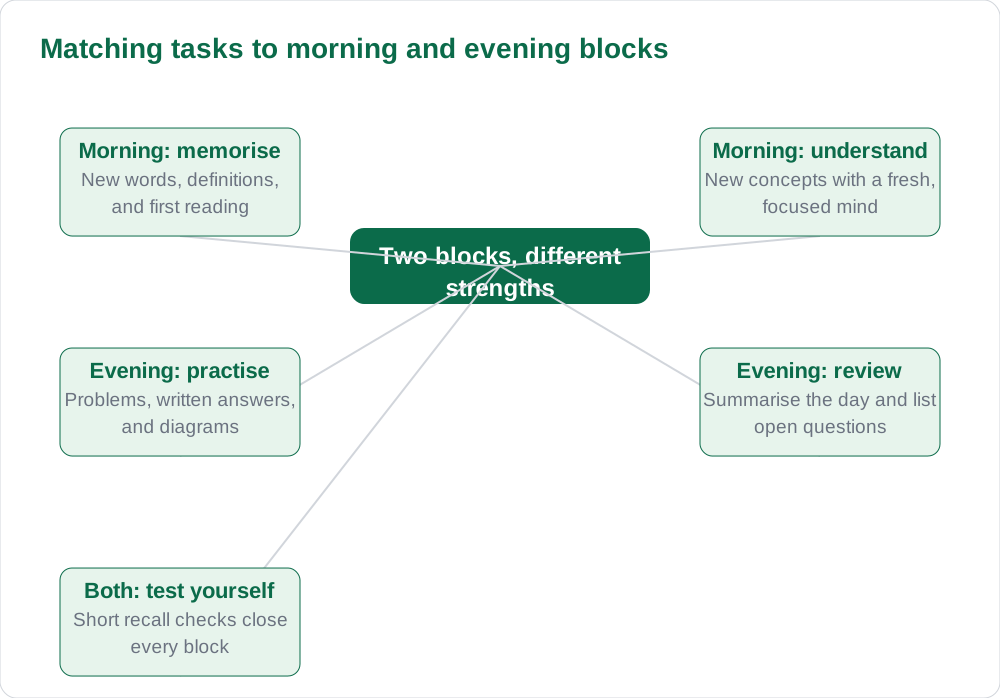
Morning study suits tasks that need a fresh, undistracted mind: learning new definitions, memorising vocabulary or duas, reading a new lesson for the first time, and understanding a new concept. Keep morning blocks focused and relatively short, because freshness fades quickly, and test yourself at the end of the block while the material is still new. Writing short notes in your own words during a morning block helps twice: it forces understanding now, and it creates a summary for evening review later.
For school pupils, the morning block often happens before school or on weekend mornings, since school occupies weekday mornings. Even a short pre-school session of twenty minutes can serve memorisation well, such as reviewing vocabulary or reciting a lesson summary. Weekend mornings are the larger opportunity: a focused morning block on Saturday can cover the week's hardest new material while the mind is at its best. Protect that time from chores and screens where possible, and treat it as the week's prime learning slot.
The evening block: practice, problems, and review
Evening study suits tasks that use and consolidate knowledge rather than first learning it: solving Mathematics problems, answering written questions, practising diagrams, and reviewing the day's lessons. After school, your mind has already been working with school material all day, so practice feels more natural than fresh memorisation. Evening blocks also suit homework naturally, since homework usually practises what was taught that day, and homework done in the evening is still fresh from class.
Evening review has a special advantage: material reviewed in the evening is often remembered better the next morning, because sleep helps consolidate recent learning. Use the last part of an evening block to summarise what you studied, list questions you could not answer, and note tomorrow's priorities. This closing summary turns the evening block into preparation for the next day, not just a record of the past one. Keep evening blocks free of heavy new memorisation where possible, and save that for the next morning's fresh mind.
Building a two-block day around school hours
A realistic two-block day for a school pupil might look like this as an example: a short morning block before school for memorisation, school during the day, then an evening block after rest and homework for practice and review. On weekends, the morning block can be longer and the evening block lighter, or the reverse if family commitments fall in the morning. The shape matters less than the principle: fresh tasks in fresh hours, practice tasks in practised hours, with rest between school and evening study so the evening block does not begin exhausted.
Rest between blocks is not wasted time; it is what makes the second block work. Pupils who rush straight from school into evening study often study slowly and retain little, while pupils who rest, eat, and play briefly return with a clearer mind. Aim for a genuine break after school, not a break filled with screens that leave the mind more tired. The evening block should have a clear start time, so rest does not drift into the whole evening, and a clear finish time, so study does not swallow the night.
Adapting the pattern when your energy differs
If you genuinely feel sharper in the evening than in the morning, adapt the pattern rather than fighting it. Some pupils memorise best after school, when the day's lessons have warmed their minds, and practise best in quiet early mornings. The principle survives the swap: give your best hours to your hardest new learning, and your steadier hours to practice and review. What damages learning is not a particular pattern, but ignoring energy entirely and assigning hard tasks to tired hours by habit.
Test any new pattern for two weeks before judging it, and keep notes on what worked. If morning memorisation consistently fails, move it to the evening and compare results honestly. Also consider sleep: a pupil who sleeps poorly will feel tired in every block, and no scheduling trick fixes that. Regular sleep, meals, and breaks are the foundation that makes morning and evening blocks meaningful, and they deserve attention before any timetable refinement. Find your subjects in books and practice material in solved notes. See Parent Screen Time Study Balance for family routines that protect sleep and study time.
AI Help: Muse AI
Muse AI is Meta's personal AI assistant. You can ask it to explain a concept in simple words, summarise a lesson, or make practice questions for revision.
For this topic, ask Muse AI to make a quick morning memorisation quiz on yesterday's lesson, so your fresh morning block starts with recall instead of re-reading.
Join Muse with invite code LTGSWD — in the Muse app, go to Settings > Redeem token and enter the code.
Disclosure: LTGSWD is the author's Muse invite code.
Muse AI does not give official STBB answers — always verify against your Sindh Textbook Board book and your teacher.
5 key points you must know
- Match tasks to energy: fresh minds learn and memorise, practised minds solve and review.
- Use mornings for new definitions, vocabulary, and first reading of new lessons.
- Use evenings for homework, problem practice, diagrams, and summarising the day.
- Rest genuinely between school and evening study so the second block works.
- Adapt the pattern to your own observed energy, and test any change for two weeks.
Frequently asked questions
I have no time before school. Can I still use morning and evening blocks?
Yes. Use weekend mornings as your main morning block, and a short pre-school slot of even ten minutes for quick memorisation on school days. The evening block then carries practice and review. The pattern is about matching task types to fresh and practised hours, not about equal block lengths.
Should I memorise in the evening if a test is tomorrow?
A test eve is an exception: use the evening for targeted memorisation of the test material, because the test cannot wait for morning. Keep the session focused, test yourself repeatedly, and protect sleep, since a rested mind recalls far more than an exhausted one.
How long should each block be?
Morning blocks of thirty to sixty minutes work well, and evening blocks of one to two hours with a break in the middle suit most pupils. Shorter, focused blocks beat longer, distracted ones. Adjust lengths to your school hours and energy, and keep a clear finish time for each block.
What if I feel sleepy in the morning block?
Check sleep first: late nights make every morning block fail. If sleep is adequate, try a shorter morning block with active tasks such as self-testing rather than passive reading, and a glass of water and fresh air before starting. Persistent morning sleepiness may mean your sharpest hours are later, so adapt the pattern.
Can I study a subject in both blocks on the same day?
Yes, and it can work well: learn a topic in the morning and practise it in the evening. This spaced pattern strengthens memory, because the evening practice acts as a second encounter with the material. Just avoid studying the same topic for very long in both blocks, or the day becomes unbalanced.
Solved notes — preview free
These guides work best with the solved exercises. Preview the solved notes free on this website — 119 solved notes for Classes 6–10 in Sindhi, Urdu, English and Arabic medium. Or browse the full solved notes catalogue for your class and medium. New solved notes are added regularly — check the catalogue for coming-soon books.