Story Elements in an Urdu Afsana

To understand story elements Urdu afsana work, you need to see how a short story is built. An afsana is a short Urdu story that focuses on one event, one problem, or one turning point in a character's life. Unlike a novel, it does not have room for many subplots. Every detail, from the opening scene to the closing line, serves the story. Many pupils read an afsana like a news report, remembering only what happened. A stronger reader asks how the story is built: who the characters are, where and when it happens, how the plot moves, and what message the writer leaves behind. This guide shows that method so you can analyse any afsana in your Sindh Textbook Board book.
What Makes an Afsana Different
An afsana is short, focused, and built around a single effect. A good afsana often opens in the middle of a situation, introduces a problem quickly, and ends with a moment that makes the reader think. Because the story is short, the writer cannot explain everything. Instead, the writer shows character through small actions, short dialogues, and telling details. A nervous character might keep checking the door. A generous character might share food without making a show of it. Your job as a reader is to notice these small details and ask what they reveal.
This focus is what makes afsana questions fair. The examiner cannot ask you to summarise a long plot, because the plot is short. Instead, the examiner asks about character, setting, plot, and message. If you can name these four elements and explain how they work together, you can answer most afsana questions. Keep this frame in mind from the first reading: who, where and when, what happens, and what it means.
Plot: How the Story Moves
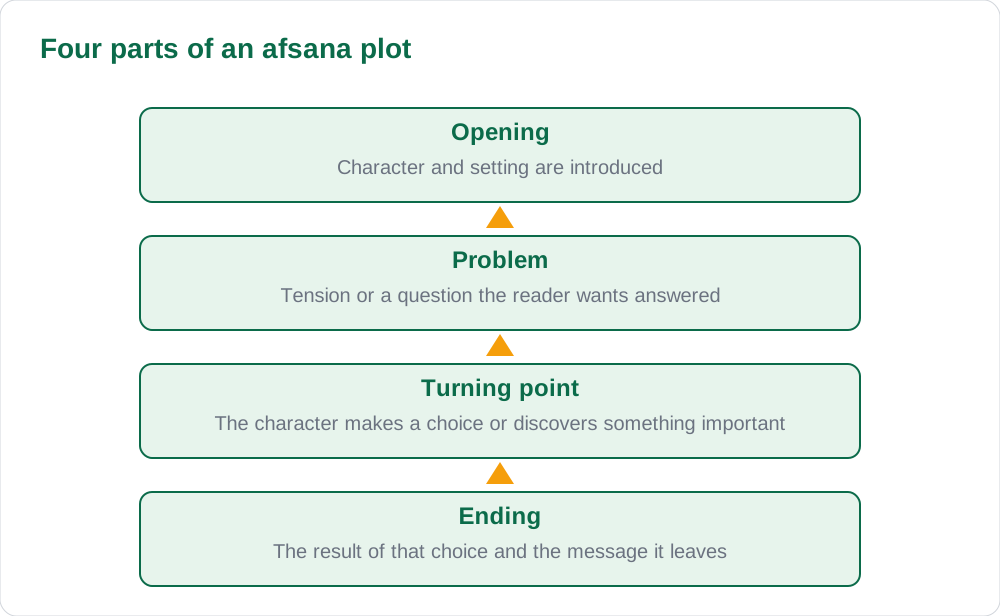
Plot is the sequence of events in the story, shaped by cause and effect. A simple way to trace plot is to divide the afsana into four parts: opening, problem, turning point, and ending. The opening introduces the character and the setting. The problem creates tension or a question the reader wants answered. The turning point is the moment when the character makes a choice or discovers something important. The ending shows the result of that choice. When you can name these four parts in one sentence each, you understand the plot.
Avoid retelling every small event. Focus on the events that change the story. Ask of each event: if this event were removed, would the story still make sense? If yes, it is a supporting detail. If no, it belongs to the main plot. In your answer, describe the main plot in a short paragraph, then spend more time on the turning point, because that is where the writer's message usually becomes clear. A turning point might be a quiet decision, not a dramatic accident, so read carefully.
Character: What People Do and Why
Character study in an afsana means looking at what a character does, says, and decides, rather than only how the writer describes them. Start with the main character. What does this person want? What stands in the way? What choice does this person make at the turning point? Then look at supporting characters. Each one should have a job: to help, to oppose, to reveal something, or to represent a view. If a character seems unimportant, ask what would change if that character were removed. The answer often shows the character's real job in the story.
Use evidence for every claim about character. Instead of writing only 'the character is kind', add the action that proves it, such as sharing food, helping a stranger, or forgiving a mistake. This evidence habit makes your answer strong and honest. It also helps you avoid judging characters too quickly. A character who seems harsh in the opening may show kindness later, and a character who seems kind may fail at the turning point. Follow the whole arc before you judge.
Setting and Atmosphere
Setting is where and when the story happens, including place, time, season, and social surroundings. In an afsana, setting is rarely just background. A crowded bazaar, a quiet village, a school, or a home at night each creates a different mood and shapes what characters can do. Ask how the setting affects the plot. Would the story work the same way in a different place? If not, the setting is doing real work. Notice also small setting details: light, sound, weather, and objects. Writers choose these details to build atmosphere, the feeling that surrounds a scene.
Atmosphere matters because it guides the reader's feelings without stating them. A scene set in heavy rain feels different from the same scene set in bright morning light. When you write about setting, name the place and time, describe the atmosphere in one line, and explain how it supports the plot or character. For example, you might say that a quiet night setting makes the character's lonely decision feel heavier. One clear link like this is worth more than a long description of the place.
Message: What the Story Leaves Behind
The message is the idea the writer wants the reader to carry away. It is rarely stated directly. Instead, it emerges from the turning point and the ending. To find it, ask what the main character learns, what the ending rewards or warns against, and what a reader might do differently after reading the story. A good message sentence names the idea and the evidence. For example, 'the story shows that honesty costs courage at first but brings peace in the end, because the character sleeps calmly after telling the truth'. That sentence links idea and evidence together.
Be careful not to force a moral onto every story. Some afsanay explore a feeling or a situation rather than teaching a lesson. In that case, your message sentence can describe the insight: what the story helps the reader see more clearly. Whether the message is a lesson or an insight, keep it tied to the story. Do not add a general sermon that could fit any tale. The same discipline helps when you write a character study and summary of a novel, where the message must also come from the character's choices.
Writing a Strong Afsana Answer
A strong afsana answer follows a simple order. Open with one paragraph naming the story, the writer if known, and the central problem. Then write one short paragraph on plot, one on character, one on setting, and one on message. Close with one line about what makes the story effective. This order keeps your answer organised and makes marking easy. Use short quotations or clear references to scenes as evidence, but do not retell the whole story. The examiner has read the story; the examiner wants to see your thinking.
Practise with one afsana at a time. Read it twice, fill a notebook page with four headings, plot, character, setting, and message, and then write a short answer from your notes. Compare your answer with your teacher's guidance and fix one weakness at a time. For more Urdu reading practice, look at how to analyse a nazm and the solved notes, and check the books catalogue for the right lesson.
AI Help: Muse AI
Muse AI is Meta's personal AI assistant, and it can help you practise naming the turning point of an afsana in one sentence. Muse AI does not give official STBB answers — always verify against your STBB book and your teacher.
Join Muse with invite code LTGSWD — in the Muse app, go to Settings > Redeem token and enter the code.
Disclosure: LTGSWD is the author's Muse invite code.
Muse AI does not give official Sindh Textbook Board answers — always verify against your Sindh Textbook Board book and your teacher.
5 key points you must know
- An afsana focuses on one event, problem, or turning point.
- Trace plot as opening, problem, turning point, and ending.
- Study character through actions, words, and choices, with evidence.
- Setting shapes mood and plot, not only background.
- State the message as idea plus evidence from the story.
Frequently asked questions
What are the four main story elements in an afsana?
Plot, character, setting, and message. Plot is what happens, character is who acts and chooses, setting is where and when it happens, and message is the idea the story leaves behind.
How is an afsana different from a novel?
An afsana is short and focused on one event or turning point, while a novel follows many events and characters over a longer span. An afsana has no room for subplots, so every detail serves the single effect.
How long should an afsana answer be?
Long enough to cover plot, character, setting, and message with evidence, usually four short paragraphs plus an opening and closing line. Avoid retelling the whole story.
What if the story has no clear moral?
Not every afsana teaches a direct lesson. In that case, describe the insight the story offers: what it helps the reader see more clearly about people or life, tied to the turning point and ending.
Solved notes — preview free
These guides work best with the solved exercises. Preview the solved notes free on this website — 119 solved notes for Classes 6–10 in Sindhi, Urdu, English and Arabic medium. Or browse the full solved notes catalogue for your class and medium. New solved notes are added regularly — check the catalogue for coming-soon books.