Character Study and Summary in Urdu Novels

To write a good character study summary Urdu novels require, you must balance two jobs: summarising the story and studying the person at its centre. A novel is long, with many characters and events, so a summary that retells everything becomes long and unfocused. A character study that ignores the plot becomes vague. The method in this guide joins the two jobs: track one character's choices and growth, and use those choices to shape a concise summary. This way, your summary has a centre, and your character study has evidence. The method works for any Urdu novel in your Sindh Textbook Board course or school reading list.
Why Character Is the Key to Summary
A novel summary without a character focus becomes a list of events. A character focus gives the summary a spine: the reader follows one person's wants, obstacles, choices, and growth. When you know whose story you are telling, you can decide which events matter and which can be left out. Events that change the character belong in the summary. Events that do not change the character can be shortened to one line or left out. This rule keeps a long novel summary short and readable.
Choose the main character for your study. In most school novels, the main character is the person whose choices drive the plot and whose growth the novel follows. If the novel has two main characters, choose one and note the other briefly, or compare the two if your teacher asks for a comparison. State your choice in the opening line of your answer, so the examiner knows whose story you are following. A clear focus from the start makes the whole answer easier to follow.
Tracking Choices and Growth
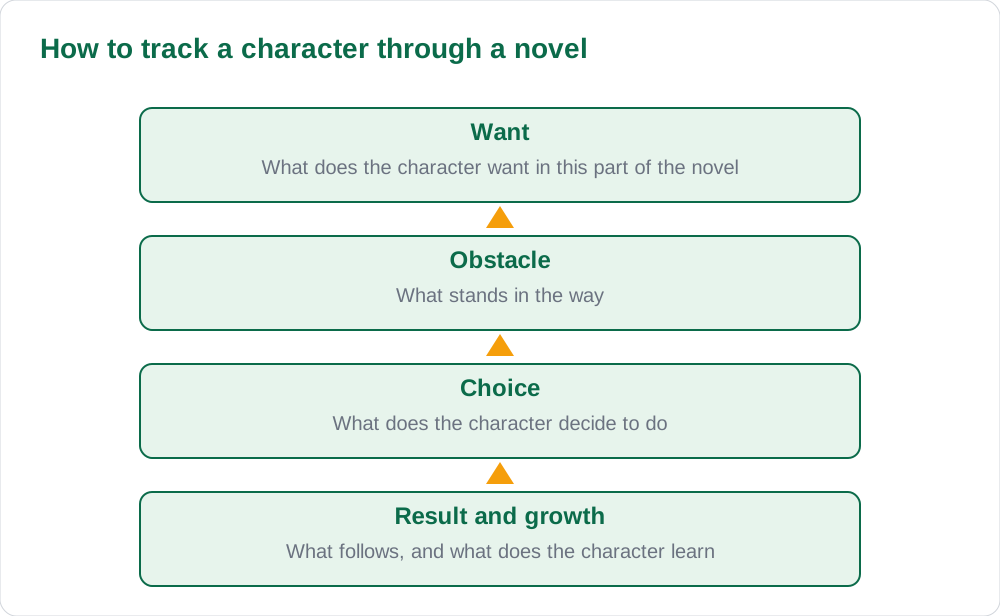
Track a character by tracking choices. For each major part of the novel, ask four questions: What does the character want? What stands in the way? What choice does the character make? What follows from that choice? Write the answers in a notebook table with one row per major part. This table becomes the backbone of both your summary and your character study. It shows the character arc: how the person changes from the opening to the ending. A character who makes the same choice at the end as at the start has not grown. A character who chooses differently has learned something.
Look for evidence in actions, words, and relationships. Actions show what the character does under pressure. Words show what the character believes or fears. Relationships show how the character treats others and how others respond. Use all three kinds of evidence. For example, a character might speak bravely but act fearfully, and that gap tells you something important. Note such gaps, because they make a character study honest and interesting. The same evidence habit helps when you study story elements in an afsana, where small actions also reveal character.
Writing a Concise Novel Summary
A concise novel summary covers the whole story in a short space. Use three paragraphs: opening situation, middle turning points, and ending. The opening paragraph introduces the main character, the setting, and the central problem. The middle paragraph covers the two or three turning points that change the story, in order. The ending paragraph states the outcome and what the character has learned. Keep each paragraph focused on the main character. If a subplot does not affect the main character, leave it out or mention it in one line.
Avoid retelling every chapter. A summary is not a chapter-by-chapter retelling. Ask of each event: does this event change the main character's choices? If yes, include it. If no, shorten or omit it. Keep the summary in your own words, in the order the events happen, and avoid adding your opinion inside the summary. Save opinions and judgements for the character-study paragraphs, where they belong. This separation keeps the summary clean and the study focused.
Writing the Character Study
A character study explains who the character is, how the character changes, and why the character matters to the novel. Organise it in three paragraphs. The first paragraph describes the character at the start: wants, strengths, weaknesses, and relationships. The second paragraph follows the character through the turning points, showing choices and their results with evidence. The third paragraph describes the character at the end and states what has changed. This before, during, and after structure makes growth visible.
Support every claim with evidence from the novel. Instead of writing only 'the character is brave', describe the moment the character acted bravely despite fear, and what it cost. Instead of writing only 'the character is kind', describe a specific act of kindness and its effect on another character. Evidence makes a study convincing. It also protects you from judging a character on one scene alone. Follow the whole arc before you judge, because a character who seems weak early may grow strong, and a character who seems strong may fail at a key moment.
Theme and Message Through Character
Theme in a novel often appears through character growth. To find it, ask what the main character learns and what the ending rewards or warns against. A character who learns patience through hardship points to a theme about patience. A character whose selfish choice harms others points to a theme about responsibility. State the theme as idea plus evidence: name the idea and link it to the character's choices. This keeps the theme tied to the novel rather than floating as a general sermon.
In your answer, place the theme paragraph after the character study, not before it. The reader should see the evidence first and the theme second, so the theme feels earned. Keep the theme paragraph short: two or three lines. If the novel explores more than one theme, name the strongest one and note the second briefly. Do not list many themes without evidence. One theme with clear evidence earns more marks than three themes with none. The same discipline helps when you analyse theme and imagery in a nazm.
Common Mistakes and a Practice Routine
A common mistake is retelling the whole novel in the summary. A summary should be concise, with only the turning points that change the character. Another mistake is judging the character without evidence. Every claim about character needs an action, a line, or a relationship to support it. A third mistake is confusing the character with the writer. The character's views are not always the writer's views. Describe what the character does and learns, and keep the writer's message separate until the theme paragraph.
Practise with a short novel or a long afsana first. Read it once for story, then re-read with a notebook table tracking wants, obstacles, choices, and results. Write a three-paragraph summary from the table, then a three-paragraph character study. Ask your teacher to check the balance: is the summary concise, and is the study supported by evidence? For more Urdu reading practice, browse the solved notes and the books catalogue.
AI Help: Muse AI
Muse AI is Meta's personal AI assistant, and it can help you practise tracking one character choices in a simple table. Muse AI does not give official STBB answers — always verify against your STBB book and your teacher.
Join Muse with invite code LTGSWD — in the Muse app, go to Settings > Redeem token and enter the code.
Disclosure: LTGSWD is the author's Muse invite code.
Muse AI does not give official Sindh Textbook Board answers — always verify against your Sindh Textbook Board book and your teacher.
5 key points you must know
- Use one main character to give the summary a spine.
- Track wants, obstacles, choices, and results in a notebook table.
- Summary: opening situation, turning points, and ending in three paragraphs.
- Character study: before, during, and after, with evidence for every claim.
- State theme as idea plus evidence from the character choices.
Frequently asked questions
How long should a novel summary be?
Long enough to cover the opening situation, two or three turning points, and the ending, usually three paragraphs. Leave out subplots that do not affect the main character.
What if the novel has two main characters?
Choose one as the focus and note the other briefly, or compare the two if your teacher asks for a comparison. State your choice in the opening line so the answer stays focused.
How do I show character growth?
Compare the character at the start and at the end through choices. Show a moment early when the character chooses one way, and a moment late when the character chooses differently, with evidence for both.
Should the summary include my opinion?
No. Keep the summary factual and in story order. Save opinions and judgements for the character-study and theme paragraphs, where they belong.
Solved notes — preview free
These guides work best with the solved exercises. Preview the solved notes free on this website — 119 solved notes for Classes 6–10 in Sindhi, Urdu, English and Arabic medium. Or browse the full solved notes catalogue for your class and medium. New solved notes are added regularly — check the catalogue for coming-soon books.